
Caught Between Dream and Disillusion: The Fragile Emotional Balance of “Edge of Reality”
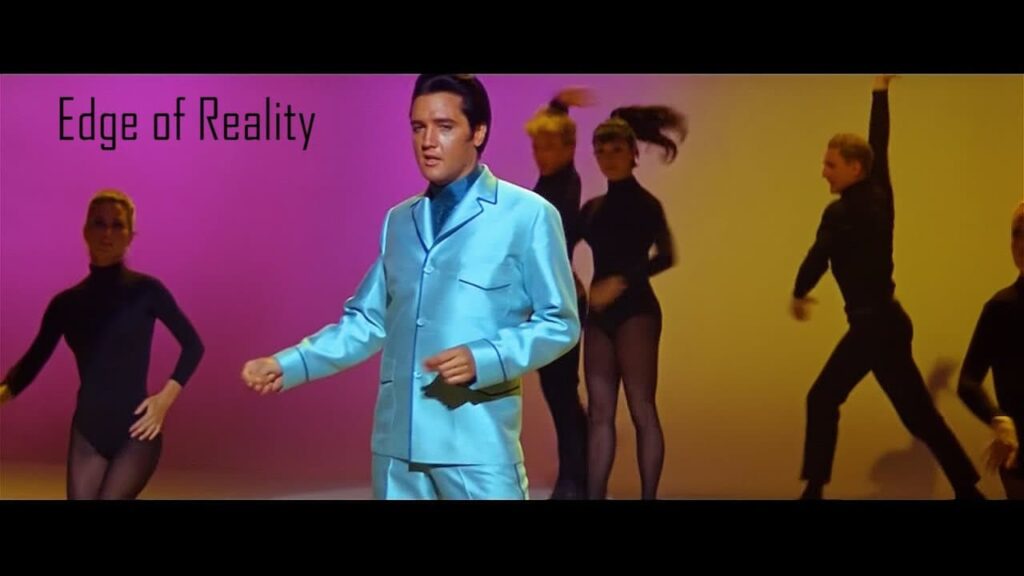
“Edge of Reality” occupies a unique and often overlooked place in Elvis Presley’s vast body of work. Released in 1968, the song arrived during one of the most complex and transitional periods of his career—a time when Elvis stood between two worlds: the carefully managed Hollywood image he had outgrown, and the deeper artistic rebirth that was just beginning to emerge. In many ways, “Edge of Reality” feels like a quiet confession from that in-between space.
The song was recorded for the soundtrack of the film Live a Little, Love a Little, one of Elvis’s more unconventional movies of the late 1960s. Unlike many of his earlier film songs, “Edge of Reality” carried a mood of introspection and emotional tension rather than simple romance or lighthearted escapism. Upon its release as a single, the song reached No. 40 on the Billboard Hot 100, a modest chart position by Elvis’s standards, yet one that does not reflect its artistic significance.
Written by Ben Weisman and Sid Wayne, two long-time contributors to Elvis’s catalog, the song explores emotional uncertainty with unusual sensitivity. The narrator is suspended between hope and heartbreak, unsure whether love is real or already slipping away. The “edge” in the title is not dramatic or theatrical—it is psychological. It is the thin line between believing in love and recognizing its fragility.
Musically, “Edge of Reality” is restrained and atmospheric. The arrangement relies on gentle orchestration, subtle rhythm, and a sense of emotional space. Nothing pushes forward aggressively. Instead, the music seems to hover, mirroring the emotional state of the lyrics. This restraint allows the listener to focus entirely on the voice—and on what that voice is quietly admitting.
Elvis Presley’s vocal performance is particularly telling. Gone is the swagger of his early rock ’n’ roll years, and absent too is the exaggerated cheerfulness that defined many soundtrack recordings of the era. What remains is control, vulnerability, and a hint of emotional fatigue. Elvis sings softly, almost cautiously, as if aware that certainty is no longer available to him. His phrasing lingers on key lines, giving the impression that each word has been carefully weighed.
Lyrically, “Edge of Reality” speaks to emotional doubt without ever naming its cause. There is no argument, no betrayal, no clear ending—only the uneasy realization that something once solid may no longer be trustworthy. This ambiguity is precisely what gives the song its power. It allows listeners to bring their own experiences into the space Elvis creates. The song does not tell a story; it captures a feeling.
Within the broader context of 1968, the song gains even deeper meaning. That year would mark a turning point for Elvis Presley, culminating in the legendary ’68 Comeback Special, where he reintroduced himself as a vital and emotionally honest artist. “Edge of Reality” feels like a quiet precursor to that rebirth—a moment where introspection begins to replace routine.
Though it never became one of Elvis’s signature hits, “Edge of Reality” has endured precisely because of its subtlety. It reveals an artist becoming increasingly aware of emotional complexity, both in his music and in his life. There is maturity here, and restraint, and a willingness to sit with uncertainty rather than escape it.
Today, “Edge of Reality” stands as a reflective pause in Elvis Presley’s journey. It reminds us that not all important songs arrive with thunder. Some arrive softly, carrying questions instead of answers. In that fragile space—between hope and doubt, dream and truth—Elvis found a voice that still resonates, quietly and honestly, long after the final note fades.