
A Gentle Farewell, a Promise Carried Across Distance and Time
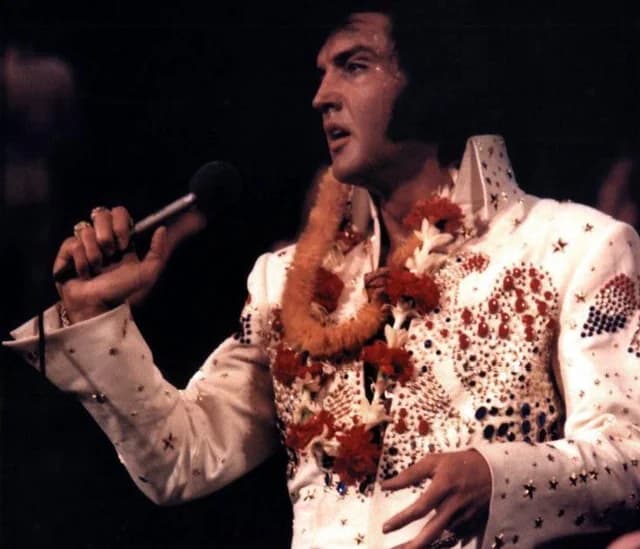
When Elvis Presley stepped onto the stage in Honolulu in January 1973 for Aloha From Hawaii, the world watched a spectacle. Satellites. Rhinestones. An audience counted in the millions. Yet in the midst of that global event, one of the most quietly moving moments came not from grandeur, but from restraint: “I’ll Remember You.” In that performance, Elvis lowered his voice, softened his posture, and delivered a song that felt less like a concert number and more like a personal vow.
“I’ll Remember You” was written by Kui Lee, a gifted Hawaiian songwriter who composed the song in 1964 and passed away tragically young in 1966. Long before Elvis sang it, the song had already become deeply associated with Hawaii, memory, and farewell. Elvis first recorded it in 1966 for the album Spinout, but it was the 1973 live performance that gave the song its lasting emotional identity.
The Aloha From Hawaii concert itself was historic. Broadcast live via satellite to over 40 countries, it became one of the most-watched entertainment events of its era. The accompanying album reached No. 1 on the Billboard Top LPs chart, reaffirming Elvis’s global reach at a time when popular music was rapidly changing. But charts and numbers fade quickly. What remains is tone—and in “I’ll Remember You,” the tone is intimate, reflective, and unmistakably human.
Elvis introduces the song simply, almost reverently, acknowledging its Hawaiian roots. There is no rush. When he begins to sing, his voice is warm and controlled, carrying a tenderness that contrasts sharply with the power he displays elsewhere in the show. This is not the defiant Elvis of the early rock years, nor the dramatic showman of Vegas. This is a man standing still, looking inward, aware that moments—and people—do not last forever.
Lyrically, “I’ll Remember You” is deceptively simple. It does not speak of grand promises or eternal devotion. Instead, it offers something quieter and perhaps more honest: remembrance. “I’ll remember you long after this endless summer is gone.” The line feels especially poignant in 1973. Elvis was at a crossroads—physically heavier, emotionally more guarded, and already carrying the weight of time. When he sings these words, they sound less like romance and more like acceptance.
The arrangement during Aloha is minimal. Soft strings, gentle accompaniment, nothing that distracts from the vocal. Elvis phrases each line carefully, allowing space between thoughts. His vibrato is restrained. He is not performing at the audience; he is speaking with them. In that moment, the massive arena seems to disappear.
The deeper meaning of this performance lies in what it suggests without stating outright. “I’ll Remember You” becomes a meditation on impermanence—on love, youth, place, and connection. Hawaii itself, often associated with beauty and escape, becomes a symbol of moments we visit but cannot stay within. Elvis, who had spent much of his life being watched rather than known, sings a song about holding onto what truly matters when departure is inevitable.
There is also a subtle sense of farewell woven into the performance. Not a final goodbye, but an acknowledgment that memory may sometimes be all that remains. Elvis does not dramatize this realization. He treats it gently, almost protectively, as if aware that too much emphasis would break the spell.
For those who have lived long enough to understand how quickly seasons pass, this performance resonates deeply. It does not insist on joy, nor does it dwell in sadness. It exists in between—where gratitude and loss quietly meet. That emotional balance is rare, and Elvis achieves it without effort, simply by trusting the song.
In the broader context of Elvis’s career, “I’ll Remember You” (Aloha From Hawaii, 1973) stands as one of his most emotionally sincere moments on stage. It shows that even at the height of spectacle, he could still choose simplicity. He could still pause. He could still mean every word.
When the song ends, there is applause—but it feels almost intrusive, as if the audience understands they have just witnessed something private. And perhaps they have. Because in that brief, gentle performance, Elvis Presley reminds us that remembrance itself is a form of love—and sometimes, it is the most enduring one we have.