
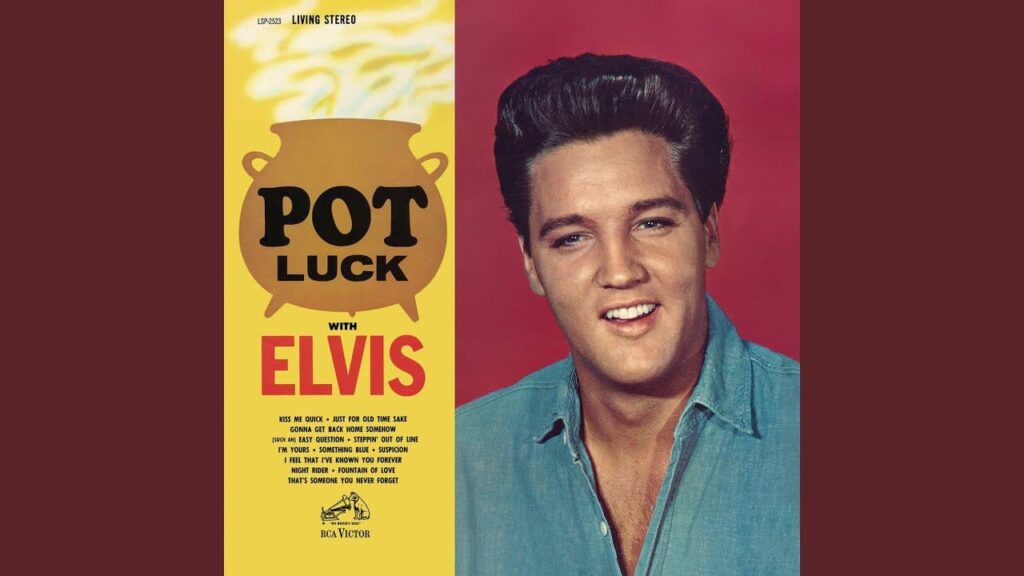
A Moment of Urgency and Tender Desire, Captured in a Softly Spoken Plea
“Kiss Me Quick” occupies a quietly fascinating place in Elvis Presley’s catalog. It is not among his loudest rockers, nor his most dramatic ballads, yet it endures because of its emotional immediacy. This is a song built on urgency—not the urgency of passion alone, but of time, uncertainty, and the fear that a moment of closeness might slip away forever.
“Kiss Me Quick” was recorded by Elvis Presley on June 25, 1961, at RCA Studio B in Nashville, during a period when his career was increasingly shaped by film projects and soundtrack sessions. The song was written by Doc Pomus and Mort Shuman, one of the most important songwriting teams of the era, responsible for many of Elvis’s most emotionally nuanced recordings. Their writing here is deceptively simple, yet deeply revealing.
Although “Kiss Me Quick” was not initially released as a major U.S. single, it found strong life overseas. In the United Kingdom, it was issued in 1963 as part of the EP Kiss Me Quick, where it became a notable hit, reaching the UK Top 20. This transatlantic success is important—it shows how Elvis’s softer, more vulnerable material often resonated especially deeply beyond American charts, where the focus had shifted toward newer rock sounds.
From its opening line, “Kiss me quick while we still have this feeling,” the song establishes its emotional center. There is no bravado here. No swagger. Elvis sings as someone fully aware that love can be temporary, that closeness can vanish without warning. His vocal is controlled and intimate, almost conversational, with a tenderness that feels unguarded. He does not push the melody. He lets it come to him.
What makes “Kiss Me Quick” particularly compelling is how it balances longing with restraint. The narrator is not demanding permanence. He is asking for presence. Just one moment fully lived. That idea—of savoring what exists now, without promises—gives the song its quiet depth. Pomus and Shuman understood that love is often felt most intensely when it is fragile, and Elvis delivers that truth without exaggeration.
Musically, the arrangement is gentle and uncluttered. Soft backing vocals provide warmth without distraction. The rhythm is steady but unhurried, allowing the lyrics to lead. There is a slight pop polish, but it never overwhelms the emotional core. This restraint reflects Elvis’s growing maturity as a vocalist in the early 1960s. He no longer needed to dominate a song; he could inhabit it.
Historically, “Kiss Me Quick” comes from a transitional era in Elvis’s career. Rock music was changing. New voices were emerging. Elvis himself was navigating the balance between commercial expectations and personal expression. Songs like this reveal an artist leaning inward, exploring vulnerability rather than rebellion. While critics at the time often dismissed soundtrack-era recordings as lightweight, hindsight reveals moments of genuine emotional craftsmanship—and “Kiss Me Quick” is one of them.
The song’s meaning deepens with time. What may initially sound like a simple romantic plea gradually reveals itself as something more reflective. It speaks to moments when love is uncertain, when tomorrow is unclear, and when the only honest response is to ask for closeness now, without conditions. Elvis sings not as a conqueror, but as a witness to how fleeting connection can be.
For listeners who have lived long enough to understand that some of the most important moments are brief, “Kiss Me Quick” carries a special resonance. It does not celebrate grand romance. It honors intimacy in its most fragile form. The kind that exists between departures, between changes, between chapters of life.
In the wider arc of Elvis Presley’s work, this song stands as a reminder that his greatness was not limited to cultural revolutions or iconic performances. It also lived in quieter spaces—in songs where he allowed tenderness to lead, where emotion spoke softly rather than shouted.
“Kiss Me Quick” remains enduring because it asks for something timeless and deeply human: not forever, not certainty, but a moment of shared feeling before it fades. Sung in Elvis’s gentle, reflective voice, that request still lingers—unanswered, but unforgettable.