
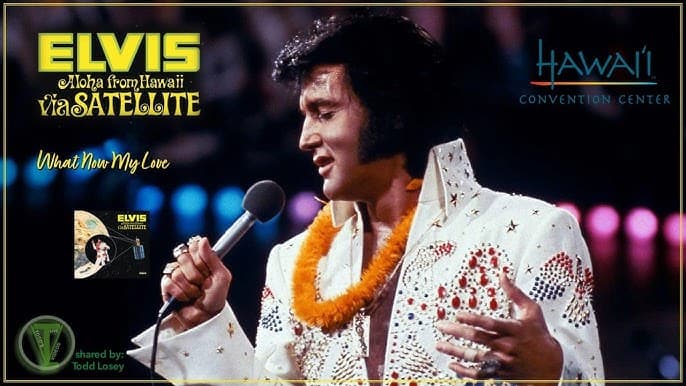
A moment of reckoning and grandeur, where love’s end is faced not with surrender, but with defiant dignity on a global stage
When Elvis Presley stepped onto the stage of the Honolulu International Center Arena on January 14, 1973, the world was already watching. Aloha From Hawaii via Satellite was not merely another concert; it was a historic broadcast, the first live global satellite television event by a solo artist, reaching dozens of countries and millions of viewers. Among the many unforgettable performances that night, “What Now My Love” stands as one of the most emotionally commanding moments of Elvis’s later career — a performance shaped by experience, loss, and a hard-earned sense of resolve.
Originally written as “Et Maintenant” by Gilbert Bécaud and Pierre Delanoë in 1961, the song was later adapted into English by Carl Sigman and recorded by numerous artists, including Frank Sinatra and Shirley Bassey. Elvis had introduced the song into his live repertoire in the early 1970s, but it was during Aloha From Hawaii that it reached its most definitive expression. This was not simply a cover; it was a transformation.
Released afterward as a live single, “What Now My Love” (Aloha From Hawaii) performed strongly on the charts, reaching the Top 20 on the Billboard Hot 100 and becoming a notable entry on the Adult Contemporary chart in 1973. Yet numbers alone fail to capture why this performance endures. Its importance lies in how Elvis reshaped the song’s emotional center.
From the opening lines, Elvis delivers the lyric not as a wounded lover pleading for answers, but as a man standing amid emotional ruins, refusing to collapse. His voice begins low and controlled, almost conversational, as if carefully measuring each word. The arrangement mirrors this restraint — subdued strings, measured tempo, and space between phrases. Then, gradually, the performance expands. The orchestra swells, the rhythm tightens, and Elvis’s voice rises with unmistakable authority.
What makes this rendition remarkable is its emotional arc. Many singers treat “What Now My Love” as a song of despair. Elvis, however, turns it into a declaration of survival. When he reaches the climactic lines — “I’ll live on, I’ll live on” — there is no hint of self-pity. Instead, there is defiance, pride, and a sense of hard-won self-knowledge. This is heartbreak viewed from the other side of the storm.
Context matters deeply here. By 1973, Elvis Presley was no longer the young revolutionary who shocked television audiences in the 1950s. He was a seasoned performer, carrying the weight of personal struggles, immense fame, and relentless public scrutiny. Aloha From Hawaii presented him not as a nostalgia act, but as a commanding vocalist capable of emotional complexity and dramatic control. “What Now My Love” became a mirror of that moment — a song about endings, sung by an artist who understood them intimately.
Visually, the performance adds another layer of meaning. Dressed in the now-iconic American Eagle jumpsuit, Elvis stands tall, almost statuesque. His gestures are minimal, deliberate. He lets the voice do the work. The camera captures not theatrical excess, but focus — eyes forward, posture steady, presence undeniable. It is the confidence of someone who knows exactly who he is on that stage.
Musically, the song bridges genres: European chanson roots, American pop orchestration, and Elvis’s unique blend of gospel intensity and dramatic phrasing. It exemplifies his ability to absorb diverse influences and return them as something distinctly his own. Few artists could command such a large arrangement without being overwhelmed by it; Elvis rides the orchestral wave effortlessly.
Over time, “What Now My Love” (Aloha From Hawaii, 1973) has come to represent more than a single performance. It captures a mature Elvis — reflective, powerful, and emotionally unguarded without ever sounding fragile. It reminds listeners that strength and vulnerability are not opposites, but partners.
Long after the satellite signal faded and the applause settled, this performance continues to resonate. It speaks to moments when love ends, certainty disappears, and the only honest question left is the one the song dares to ask. In Elvis’s hands, the answer is clear: life goes on — not quietly, not easily, but with dignity intact.