
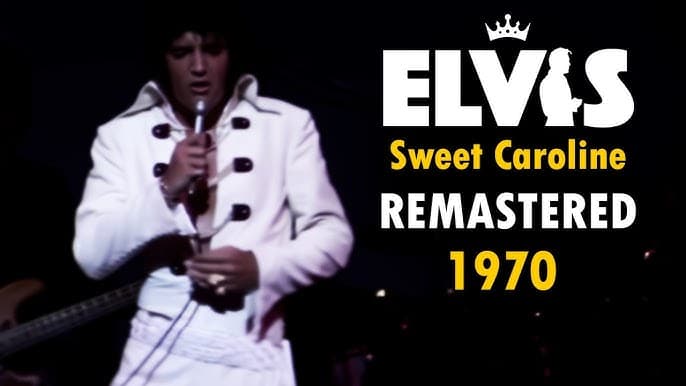
A familiar melody reborn as shared joy, where a borrowed song becomes a moment of warmth, ease, and human connection
When Elvis Presley performed “Sweet Caroline” live in 1970, he transformed a well-known pop anthem into something unexpectedly intimate. Originally written and recorded by Neil Diamond in 1969, the song was already a global favorite, reaching No. 4 on the Billboard Hot 100 and becoming one of the defining sing-along songs of its era. Yet in Elvis’s hands, especially during his 1970 live performances in Las Vegas, “Sweet Caroline” took on a different emotional shape — less an anthem, more a relaxed conversation set to music.
Elvis first introduced “Sweet Caroline” into his setlists during his celebrated Las Vegas engagements in 1970, following his triumphant return to live performance in 1969. These shows marked a critical moment in his career. He was no longer the restless rebel of the 1950s, nor yet the mythic figure of his final years. Instead, Elvis stood at a rare midpoint — confident, vocally strong, and fully in command of his stage presence. The choice to include “Sweet Caroline” reflected that confidence. He did not need to reshape the song radically; he simply needed to inhabit it.
Unlike many of his dramatic ballads or gospel-infused climaxes, Elvis approached “Sweet Caroline” with ease. His phrasing is playful, unhurried, and lightly conversational. He leans into the rhythm rather than pushing against it, allowing the melody to roll naturally. There is a subtle smile in his voice — something listeners can hear even without seeing him. This is Elvis enjoying the moment, sharing a song he knows the audience already loves.
Musically, the arrangement stays close to the spirit of Neil Diamond’s original, but with the unmistakable polish of Elvis’s live band. The rhythm section keeps the tempo buoyant, while backing vocals echo the familiar responses, inviting participation. What stands out is Elvis’s instinctive sense of timing. He knows exactly when to stretch a phrase, when to pull back, and when to let the crowd carry the moment. It is a masterclass in connection rather than control.
Context is essential here. By 1970, Elvis’s concerts were carefully structured, blending high-energy rockers, sweeping ballads, gospel numbers, and moments of lightness. “Sweet Caroline” served a specific purpose within that arc. It offered relief from intensity — a pause where performer and audience could meet on equal ground. No dramatic gestures, no emotional extremes. Just a shared melody and a familiar refrain.
Lyrically, the song celebrates simple joy, anticipation, and emotional closeness. Lines like “Good times never seemed so good” carry a natural optimism that resonated deeply during this period. In Elvis’s delivery, those words feel earned rather than idealized. They sound like an acknowledgment of a good night, a good room, a good song — fleeting perhaps, but genuine.
Vocally, Elvis in 1970 was in exceptional form. His voice retains warmth and flexibility, with none of the strain that would appear later in the decade. On “Sweet Caroline,” he avoids overpowering the song. Instead, he blends into it, respecting its simplicity. This restraint reveals a mature artist who understands that not every performance needs to be a statement. Some moments are valuable precisely because they are light.
The audience response plays a crucial role. As the familiar chorus arrives, the room comes alive. Elvis does not fight this; he welcomes it. He allows the collective energy to lift the song, reinforcing the idea that live music is a shared experience rather than a one-sided display. It is easy to imagine the smiles in the room, the sense of togetherness that cannot be captured fully on record.
Though Elvis Presley’s “Sweet Caroline” was never released as a commercial single and therefore did not chart independently, its legacy lives in recordings and memories. It represents a side of Elvis that is sometimes overshadowed — not the icon, not the legend, but the performer who knew how to relax into a song and let it breathe.
In retrospect, this performance reminds us of something essential about Elvis’s greatness. He did not need every song to carry his name or his history. He could step into another songwriter’s world and make it feel personal, warm, and unmistakably his own. “Sweet Caroline” became, for a few minutes in 1970, an Elvis song — not by force, but by feeling.
Long after the applause fades, the performance lingers as a gentle reminder: sometimes the most lasting moments in music are not born from spectacle, but from ease, familiarity, and the simple joy of singing together.