
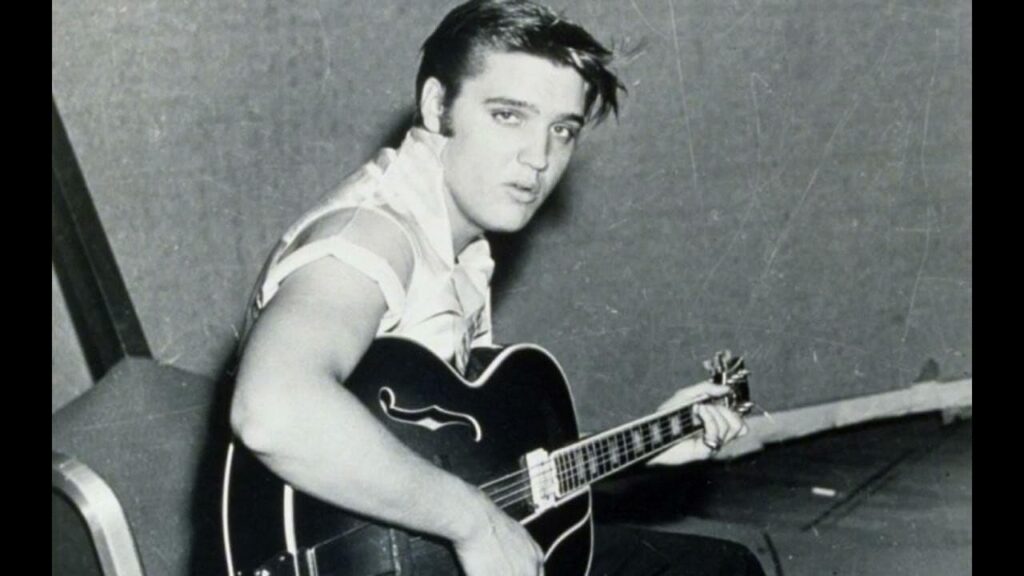
A quiet revolution in heartbreak, where memory and loss reshaped the sound of popular music
When Elvis Presley recorded “I Forgot to Remember to Forget” in August 1955 at Sun Studio, Memphis, few could have predicted how significant this restrained, sorrowful song would become. Often overshadowed by his explosive early rockers, this recording marked a turning point not only in Elvis’s career, but in the emotional vocabulary of popular music itself. It was the moment when heartbreak, delivered with understatement, crossed decisively into the mainstream.
Written by Stan Kesler and Charlie Feathers, two key figures in the Sun Records circle, “I Forgot to Remember to Forget” was released in October 1955 as the B-side to “Mystery Train.” Yet history had other plans. Radio listeners gravitated toward its aching simplicity, and by early 1956, the song climbed to No. 1 on the Billboard Country & Western chart, while also reaching No. 5 on the Billboard Top 100. This achievement was historic: it made Elvis Presley the first artist to simultaneously top the country chart while firmly establishing himself in the pop market with a song so emotionally restrained.
At its core, “I Forgot to Remember to Forget” is built on contradiction. The title alone suggests emotional confusion — the human tendency to move forward while still carrying the past. Rather than dramatizing heartbreak, the song accepts it as a quiet, lingering presence. The narrator does not rage against loss. He simply admits that forgetting is harder than expected. That honesty, delivered without ornament, is what gives the song its lasting power.
Musically, the recording is spare and deliberate. Scotty Moore’s guitar lines are clean and reflective, never intruding on the vocal. Bill Black’s bass moves gently, grounding the song without urgency. There is no rush here, no attempt to chase trends. The tempo allows the emotion to unfold naturally, as if time itself has slowed under the weight of memory. This was not the sound of rebellion it was the sound of emotional realism.
Vocally, Elvis delivers one of his most controlled early performances. His voice is warm but distant, steady but shaded with regret. He avoids embellishment, choosing instead a conversational tone that feels deeply personal. There is no sense of performance bravado. Instead, he sounds like someone speaking aloud what he has been trying not to think about. In 1955, this kind of emotional vulnerability especially from a young male singer was quietly radical.
The song also reveals Elvis’s deep connection to country music traditions. While he would soon be crowned the King of Rock ’n’ Roll, “I Forgot to Remember to Forget” is firmly rooted in the lineage of country heartbreak songs. Its themes echo earlier ballads of loss, yet Elvis’s phrasing gives it a modern immediacy. He bridges generations without drawing attention to the act.
Historically, the success of the song carried enormous consequences. Its chart performance helped propel Elvis from a regional Southern sensation into a national figure. When RCA Victor purchased his contract from Sun Records later in 1955, this song stood as proof that Elvis was not just a novelty he was an artist capable of emotional depth and broad appeal. It reassured skeptics that beneath the headlines and controversy was a singer who understood sadness as well as joy.
Emotionally, “I Forgot to Remember to Forget” speaks to a universal experience: the realization that healing does not follow a schedule. Forgetting, the song suggests, is not an action but a process one that resists command. The narrator’s admission is gentle, almost resigned, yet never hopeless. There is dignity in his acceptance that memory cannot be erased at will.
Over time, the song has come to represent an often-overlooked side of Elvis Presley. Before the jumpsuits, before the global superstardom, there was a young singer willing to stand still and let silence do part of the work. This performance reminds us that Elvis’s greatness did not rest solely in his ability to electrify a room, but also in his willingness to sit quietly with a broken heart.
Decades later, “I Forgot to Remember to Forget” remains striking in its honesty. It does not beg for sympathy, nor does it attempt to resolve its own sadness. It simply tells the truth that some memories linger, not because we invite them, but because they are part of who we have been.
And in that quiet confession, Elvis Presley gave popular music one of its earliest lessons in emotional maturity: sometimes the hardest thing is not remembering it is forgetting.