
A song whispered from the shadows — where Elvis lets the night, the river, and desire speak for him
Among Elvis Presley’s vast catalog, “Crawfish” occupies a quiet, mysterious corner — a song that never chased the charts, never announced itself loudly, yet continues to linger in memory with an almost cinematic pull. Recorded in 1958 for the film and soundtrack album King Creole, “Crawfish” was not released as a standalone single and therefore did not appear on the Billboard singles charts. However, the King Creole soundtrack itself was a major success, reaching No. 2 on the Billboard Top LPs chart in 1958, confirming the film’s music as some of the most respected work of Elvis’s early career.
“Crawfish” was written by Fred Wise and Ben Weisman, two of Elvis’s most important collaborators during the 1950s. Unlike the rock-and-roll explosions that defined his rise, this song leans into atmosphere rather than momentum. It is steeped in the humid air of New Orleans, where King Creole is set, and it borrows its soul from blues, folk, and river-born work songs rather than jukebox pop.
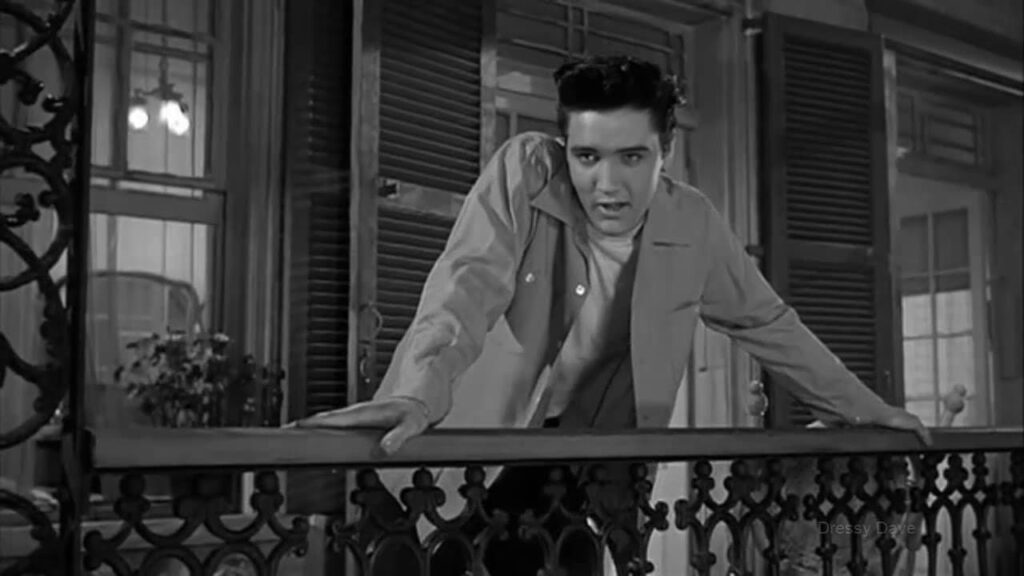
In the film, “Crawfish” is performed as a duet between Elvis’s character, Danny Fisher, and a street singer portrayed by Kitty White, whose haunting female vocal answers Elvis from the darkness. The scene unfolds on a quiet dock at night, lit sparsely, with the river moving slowly beside them. There is no spectacle here — only mood. Elvis sings softly, almost conversationally, his voice restrained and intimate, while White’s voice drifts like a distant echo. It is one of the rare moments in his early film career where silence and space are allowed to breathe.
Musically, the song is built on simplicity. A slow, repetitive rhythm mirrors the steady pull of the river. The melody feels ancient, as though it existed long before it was written down. Elvis does not dominate the song; he blends into it. This restraint reveals a side of him that is often overlooked — an instinctive understanding of when not to push, when to let the song carry itself.
Lyrically, “Crawfish” is rich with symbolism. The repeated call — “Crawfish, crawfish” — is not merely about food or livelihood. It evokes survival, hunger, longing, and the rhythms of working life along the water. The song hints at desire and loneliness without ever stating them outright. Like much traditional blues, it trusts implication more than explanation. What is unsaid becomes as powerful as what is sung.
This subtlety marks King Creole as a turning point. Many critics — including Elvis himself — later cited the film as his strongest acting role. The music followed the same philosophy. Songs like “Crawfish”, “Trouble”, and “Hard Headed Woman” were rooted in character rather than formula. They belonged to a place, a story, a mood. Elvis was not just performing; he was inhabiting.
There is also something quietly daring about “Crawfish” within the context of 1958. At the height of his fame, when expectations leaned toward high-energy hits, Elvis embraced a song that refused to hurry. It trusted atmosphere over hooks, tone over volume. That choice speaks to his musical intelligence — an understanding that power can come from stillness.
Over the decades, “Crawfish” has grown in stature, often cited by musicians and critics as an example of Elvis’s depth beyond rock and pop. It reveals his ability to absorb American roots music and reflect it back with authenticity rather than imitation. This is not Elvis the icon; this is Elvis the listener, the interpreter, the storyteller.
Today, hearing “Crawfish” feels like stepping into a half-remembered night — the sound of water nearby, voices carried by the air, time moving slowly. It does not demand attention. It waits for it. And when one finally leans in, the reward is profound.
In the end, “Crawfish” reminds us that some songs are not meant to shine brightly. They are meant to glow softly, from the edges — where memory, longing, and music quietly meet.