
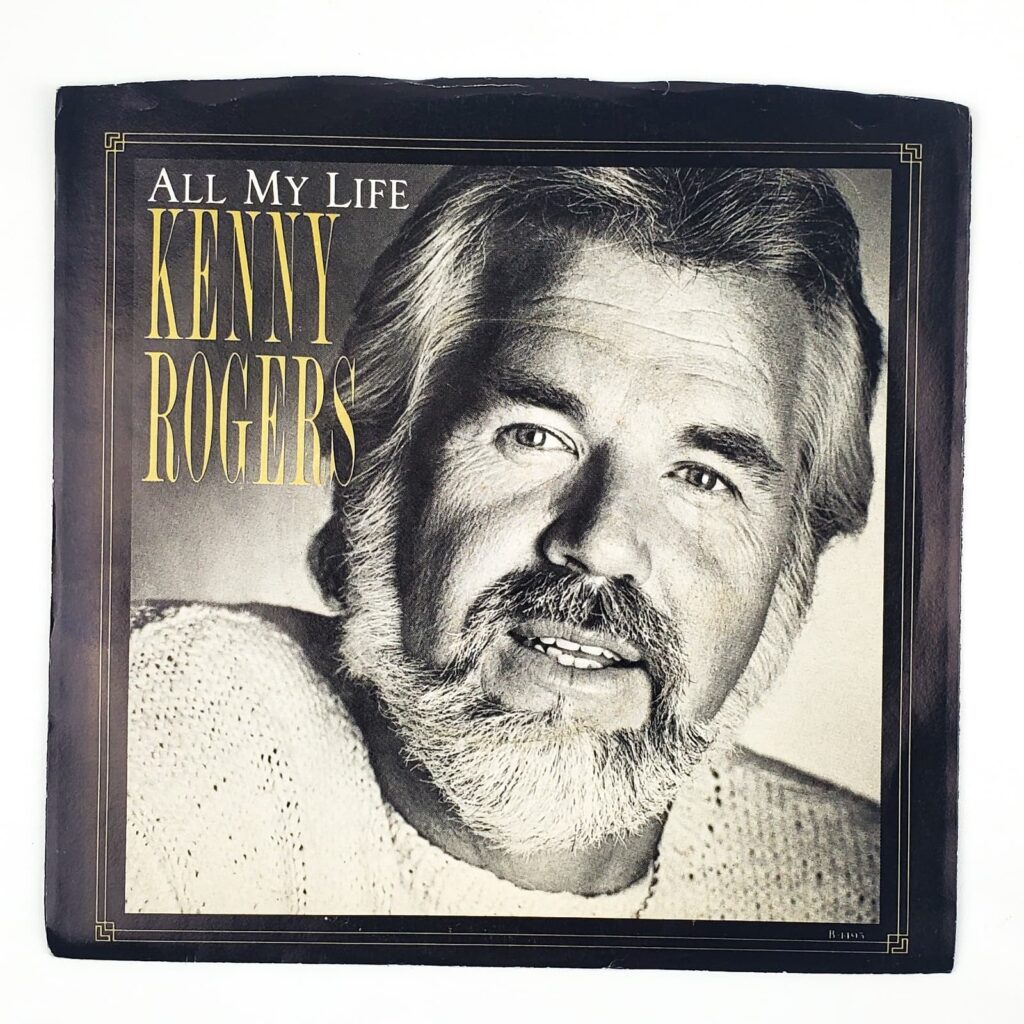
A reflective vow shaped by time, where love is measured not in promises, but in endurance
“All My Life” by Kenny Rogers is one of those songs that does not announce itself loudly, yet lingers long after it ends. Recorded during a mature and reflective phase of his career, the song appeared on the 1983 album Eyes That See in the Dark, a landmark release that confirmed Rogers’ ability to balance commercial success with emotional depth. While the album produced major chart-topping singles, “All My Life” itself was not released as a standalone single and therefore did not enter the Billboard charts upon release. Its importance lies elsewhere —in the quiet honesty of its message and the way it reveals a deeper, more contemplative side of Rogers’ artistry.
By the early 1980s, Kenny Rogers had already lived several musical lives. From his early days with The First Edition, through his rise as one of the most trusted storytellers in country music, he had become a voice associated with experience rather than ambition. Eyes That See in the Dark, produced with strong pop influences and sophisticated arrangements, reflected a man comfortable enough to look inward. “All My Life” fits perfectly within that emotional landscape.
The song was written by Karla Bonoff, a songwriter known for her introspective, emotionally precise compositions. Her writing often centers on love viewed through the lens of time how it evolves, matures, and sometimes softens into something quieter but more lasting. In “All My Life,” that sensibility is unmistakable. The lyrics do not describe sudden passion or dramatic revelation. Instead, they unfold as a recognition: love understood not as a moment, but as a continuum.
Lyrically, the song speaks from a place of awareness. The narrator reflects on years gone by, acknowledging that love was present even before it was fully recognized. There is a gentle humility in that realization. The words suggest that understanding comes slowly, shaped by mistakes, patience, and growth. Rather than declaring love as something newly discovered, the song frames it as something that has been quietly forming over time waiting to be named.
Kenny Rogers’ vocal performance is central to the song’s impact. His delivery is calm, measured, and deeply sincere. There is no attempt to dramatize the emotion. Instead, he allows the meaning to surface naturally, trusting the listener to feel what is implied rather than what is stated outright. His voice, by this point in his career, carries a natural gravity slightly weathered, unmistakably human. It sounds like a voice that has learned the value of reflection.
Musically, “All My Life” is understated. The arrangement leans on soft keyboards, restrained guitar lines, and a gentle rhythmic pulse. Nothing distracts from the emotional core. The production, consistent with the tone of Eyes That See in the Dark, is polished but never intrusive. It supports the song rather than reshaping it, allowing space for silence and nuance.
Within the context of the album, “All My Life” serves as a counterbalance to the more widely celebrated tracks. While songs like “Islands in the Stream” brought warmth and accessibility, this track offered introspection. It reminded listeners that behind Rogers’ success was a man willing to explore quieter emotional truths. That balance between public appeal and private reflection is one of the defining strengths of his career.
The meaning of “All My Life” extends beyond romantic interpretation. It speaks to the idea that understanding of love, of oneself, of life often arrives later than expected. The song does not express regret for that delay. Instead, it embraces acceptance. There is peace in recognizing that some things take time, and that clarity, when it comes, is worth the wait.
Over the years, the song has remained somewhat hidden within Rogers’ catalog, overshadowed by his chart-topping hits. Yet for those who return to it, “All My Life” offers something rare: a moment of stillness. It does not seek to impress. It seeks to connect, quietly and honestly.
In the broader arc of Kenny Rogers’ work, the song stands as a reminder of why his voice mattered. He was never just a performer of stories he was a carrier of reflection. “All My Life” captures that essence beautifully, offering a message shaped by time rather than urgency.
In the end, the song feels less like a declaration and more like an understanding reached at last. Through Kenny Rogers’ gentle delivery and Karla Bonoff’s thoughtful writing, “All My Life” becomes a meditation on love that has endured quietly waiting patiently to be recognized, and once found, never needing to be explained.