
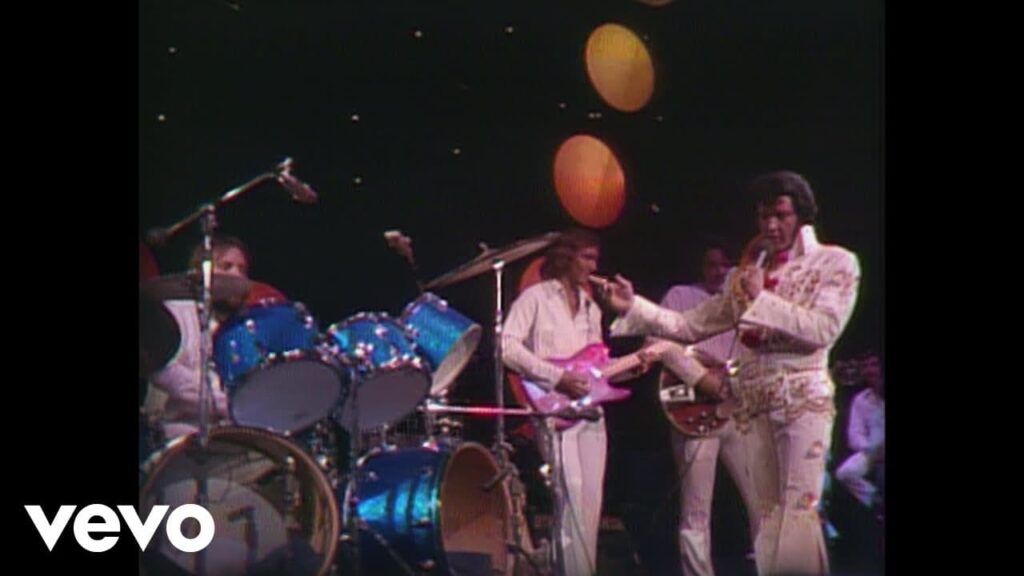
A pause in the spotlight where gratitude replaces spectacle, and a legend speaks as a man among musicians
“Introductions by Elvis”, taken from Aloha from Hawaii via Satellite (Live in Honolulu, 1973), is one of the most quietly revealing moments in Elvis Presley’s entire recorded career. It is not a song, not a performance in the conventional sense, but a spoken interlude that carries extraordinary emotional and historical weight. In the middle of one of the most ambitious live broadcasts ever staged, Elvis chose to slow everything down and acknowledge the people who made the music possible.
The concert took place on January 14, 1973, at the Honolulu International Center, and was broadcast live via satellite to dozens of countries around the world. It was a groundbreaking event the first concert by a solo artist transmitted globally in real time reaching an estimated one billion or more viewers. The resulting album, Aloha from Hawaii via Satellite, was released in February 1973 and debuted at No. 1 on the Billboard Top LPs chart, remaining there for three weeks. It also topped the Billboard Top Country Albums chart, underscoring Elvis’ unmatched reach across genres and audiences.
Within this monumental context, “Introductions by Elvis” feels almost disarmingly simple. Elvis steps away from the microphone as a singer and speaks as a bandleader. He introduces members of the TCB Band, the backing vocalists, the orchestra, and the musical director naming James Burton, Ronnie Tutt, Jerry Scheff, Glen D. Hardin, John Wilkinson, J.D. Sumner & The Stamps, The Sweet Inspirations, and conductor Joe Guercio, among others. Each name is met with applause, but what matters most is how Elvis delivers them.
His tone is relaxed, warm, and genuine. There is humor, affection, and unmistakable pride. This is not a contractual courtesy or a rehearsed script it sounds like gratitude spoken in real time. Elvis acknowledges skill, loyalty, and friendship, subtly reminding the audience that the sound they are hearing is the result of collaboration, not mythology.
By 1973, Elvis Presley had lived several musical lives. He had been the revolutionary force of the 1950s, the Hollywood star of the 1960s, and the commanding live performer of the early 1970s. In this moment, however, he presents himself not as “The King,” but as a musician who understands that endurance comes from shared effort. The moment strips away distance. The jumpsuit, the lights, the global broadcast all fade briefly into the background.
There is also something deeply symbolic about this interlude. The TCB Band represented stability in Elvis’ later years. “Taking Care of Business” was more than a motto; it was a philosophy rooted in trust and loyalty. Many of these musicians had traveled with Elvis extensively, sharing not only stages but long nights, pressure, and constant movement. By naming them on a worldwide broadcast, Elvis was fixing their place in history alongside his own.
Musically, the introductions serve as a natural breath within the concert’s pacing. Surrounded by powerful performances such as “Burning Love,” “My Way,” and “An American Trilogy,” this spoken passage grounds the event emotionally. It reminds the listener that beneath the grandeur lies something human and sincere.
What is especially striking is Elvis’ speaking voice itself. Calm, slightly playful, and unforced, it contrasts with the intensity of his singing. There is no strain, no urgency only ease. It reveals an artist comfortable in his role, secure enough to share the spotlight without fear of diminishing it.
Over time, “Introductions by Elvis” has become one of the most cherished non-musical moments in the Elvis catalog. It is often cited as evidence of his professionalism, generosity, and awareness of his musicians. In an industry that often celebrates the individual, Elvis chose to highlight the collective.
Historically, the segment also marks a shift in how Elvis connected with his audience. Earlier in his career, mystery and distance fueled his appeal. By the early 1970s, openness had taken its place. He no longer needed to hide behind image or myth. He could speak plainly and be heard just as clearly.
In the end, “Introductions by Elvis” endures not because of melody or arrangement, but because of character. It captures a fleeting moment when the world was watching, and Elvis Presley chose gratitude over grandeur, acknowledgment over ego.
It is a reminder that even at the height of global attention, true authority is shown not by standing alone at the center, but by recognizing those who stand beside you.