
A quiet celebration of domestic love — where everyday moments become the truest form of harmony.
When Crosby, Stills, Nash & Young released “Our House” in 1970, it stood apart from much of the music surrounding it. At a time when songs often wrestled with war, social fracture, and generational unrest, “Our House” turned inward. It chose intimacy over ideology, warmth over protest, and found profound meaning in the smallest domestic details. That choice is precisely why the song has endured.
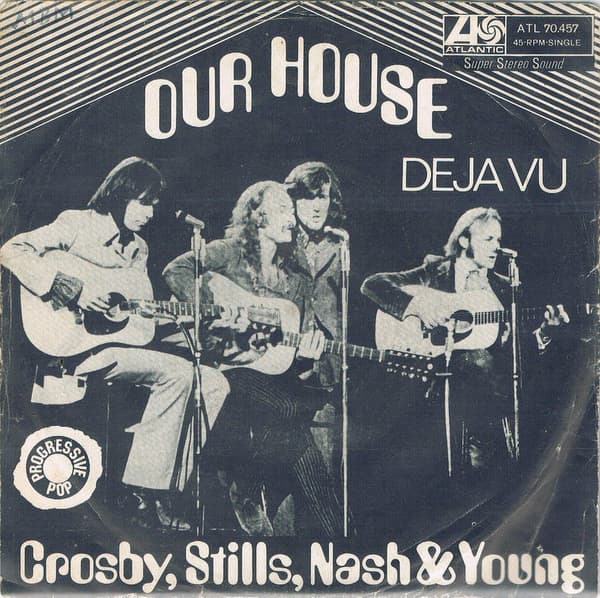
“Our House” was written by Graham Nash and appeared on the group’s landmark album Déjà Vu (1970), one of the most influential folk-rock records of its era. As a single, the song reached No. 30 on the Billboard Hot 100, a modest chart position compared to some of the band’s more politically charged work — yet its cultural afterlife would far exceed its initial ranking. This was not a song built for headlines. It was built for memory.
The inspiration behind “Our House” is remarkably simple and entirely real. Graham Nash wrote the song about his life with Joni Mitchell in their Laurel Canyon home. One rainy day, after buying a vase at an antique shop, they returned home and arranged flowers together. Nash sat down at the piano and wrote the song almost immediately. There is no metaphor hidden beneath the surface, no allegory waiting to be decoded. What you hear is what happened — and that honesty is the song’s greatest strength.
Musically, “Our House” is gentle and inviting. The piano sets a relaxed, almost childlike tone, while the harmonies the signature sound of Crosby, Stills, Nash & Young wrap around the melody like familiar voices in a familiar room. There is no urgency here, no dramatic build. The song unfolds at the pace of a quiet afternoon, where time feels unimportant and presence is everything.
Lyrically, the song celebrates domestic ritual: lighting the fire, placing flowers, sharing small acts of care. Lines like “Our house is a very, very, very fine house” are deceptively simple. Repeated three times, the phrase gains emotional weight, suggesting that the value of a home is not found in its walls, but in the shared life inside them. It is a declaration, not of ownership, but of belonging.
What makes “Our House” especially poignant is its contrast to the broader Déjà Vu album. That record contains songs marked by tension, ambition, and emotional complexity reflections of a band navigating both creative brilliance and personal strain. In that context, “Our House” feels like a pause. A breath. A reminder of what all the striving is meant to protect.
The vocal delivery reinforces this feeling. Graham Nash’s voice is warm and unguarded, supported by harmonies that feel less like performance and more like companionship. There is no attempt to impress. The beauty lies in restraint. Even Neil Young, whose songwriting often carried a restless edge, fits seamlessly into this moment of calm.
Over the years, “Our House” has become synonymous with the idea of sanctuar a song returned to during moments of reflection, often played not for nostalgia alone, but for reassurance. It reminds the listener that happiness does not always arrive with fanfare. Sometimes it comes quietly, while arranging flowers on a rainy afternoon.
The song’s legacy is also shaped by its bittersweet undertone. The relationship that inspired “Our House” did not last. Knowing this adds a layer of tenderness rather than irony. The song becomes a preserved moment a snapshot of love as it was, honest and complete in that instant. It does not promise permanence. It simply honors presence.
In the vast catalog of Crosby, Stills, Nash & Young, “Our House” remains unique. It is not a manifesto. It does not argue or persuade. Instead, it opens a door and invites the listener inside. The fire is lit. The table is set. The world, for a moment, feels kind.
Decades later, “Our House” still resonates because it speaks to something timeless: the quiet joy of sharing a life, the comfort of routine, and the profound beauty found in ordinary love. It is a song that does not ask to be remembered and is remembered all the more because of it.