
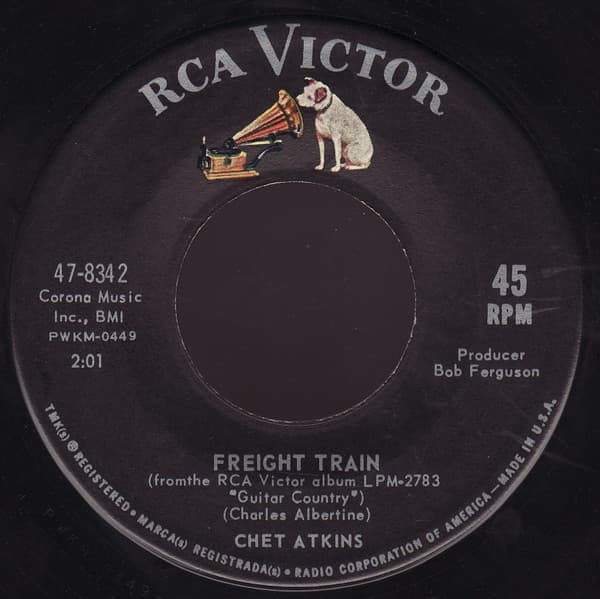
A rhythmic marvel of locomotive grace, where the echoes of a folk tradition are polished into a sophisticated symphony of moving parts and silver strings.
When the needle drops on Chet Atkins’ rendition of “Freight Train,” one doesn’t just hear a guitar; one hears the steady, relentless pulse of a journey. Originally composed by the legendary folk artist Elizabeth Cotten when she was just a young girl in the early 1900s, the song is a cornerstone of American vernacular music. While the original was a humble, two-finger “Cotten picking” masterpiece, Chet Atkins—the “Country Gentleman”—transformed it into a showcase of technical brilliance and suburban sophistication. His version, notably found on the 1971 album For the Good Times and often featured in his historic live medleys, took the “iron horse” of the railways and gave it a coat of Nashville chrome. For the listener who grew up with the sound of the steam whistle in the distance or the steady rhythm of the tracks beneath their feet, this performance is a polished, nostalgic trip through the landscape of the American heart.
Historically, “Freight Train” acted as a bridge between the raw folk traditions of the South and the sleek pop-country crossover success that Atkins pioneered at RCA Victor. While the song saw various chart successes in the late 1950s (notably by Chas McDevitt and Nancy Whisky in the UK), Chet’s instrumental version achieved a permanent “ranking” in the curriculum of every fingerstyle guitarist in the world. It helped cement his legacy as a 14-time Grammy winner and a man who could take a simple nursery-rhyme-like melody and imbue it with the complexity of a classical etude. It is the sound of a master craftsman honoring his roots while simultaneously pushing the boundaries of what a single hollow-body guitar could achieve.
The story behind the song is one of hidden genius and late-life recognition. Elizabeth Cotten had written the song about the trains she heard passing her home in North Carolina, but she spent much of her life as a domestic worker, her musical talent largely unknown until she was discovered by the Seeger family in her sixties. Chet Atkins, always a scholar of the instrument, recognized the inherent “swing” in her style. He took her fundamental pattern and layered it with his trademark “galloping” thumb and intricate melodic flourishes. By the time he was performing it on world stages, he was not just playing a song; he was celebrating the survival of a melody that had traveled from a young girl’s porch to the halls of international fame. It is a testament to the idea that great art is never lost; it just waits for the right hands to carry it forward.
Meaningfully, “Freight Train” explores the concept of momentum and the bittersweet nature of the “long goodbye.” The lyrics—though absent in Chet’s instrumental version—speak of a desire to be buried “under the tracks” so the sound of the train can be heard even in rest. For a mature audience, the song acts as a metaphor for the steady passage of time. The rhythm is relentless, yet comforting; it moves forward without hesitation, just as we do through the decades of our lives. As Chet’s fingers mimic the “clack-clack” of the wheels over the rail joints, there is a sense of profound order. It reminds us that there is a quiet beauty in the repetitive nature of a life well-lived—the daily rhythms, the consistent work, and the steady movement toward home.
There is a crystalline, metallic warmth to Chet’s tone on this track that feels like a crisp autumn morning. Listening to it now, one can almost see the landscape blurring past a passenger window—the red barns, the rolling hills, and the crossing signals. Chet Atkins didn’t just play “Freight Train”; he gave it a pulse. He proved that a song about a machine could feel deeply human. For those of us who have lived through the era of the great railways and the subsequent shift to the high-speed modern world, this performance is a grounding force. It is a reminder that while the world may move faster than ever, the most beautiful journeys are still the ones that take their time, driven by a steady heart and a master’s hand.