
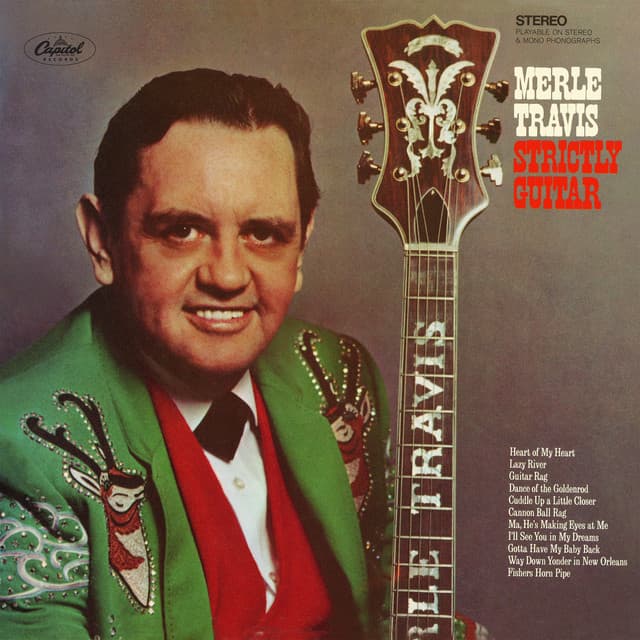
A rhythmic explosion of coal-country soul and thumb-picking fire, where the heavy pulse of the mines is transformed into a high-speed masterclass of guitar virtuosity.
In the late 1950s, while the burgeoning rock ‘n’ roll movement was grabbing the headlines, a true architect of the American guitar was proving that acoustic strings could hit just as hard as any electric amp. When Merle Travis stepped onto the stage of the Western Ranch Party in 1958 to perform “Nine Pound Hammer,” he wasn’t just playing a folk song; he was demonstrating the “Travis Picking” style that had already revolutionized Nashville. Originally a traditional work song of the Appalachian tunnels, “Nine Pound Hammer” became a signature piece for Travis, appearing on his landmark 1947 album Folk Songs of the Hills. For the listener who appreciates the raw, unvarnished power of a single man and a guitar, this 1958 live performance is a revelation—a moment where the soot of the Kentucky mines is polished into a gleaming, rhythmic jewel.
Historically, this performance captures Merle Travis at the absolute height of his technical powers. While the song is a staple of the bluegrass and country repertoire, its “ranking” in the history of guitar is foundational. Travis took the steady, driving beat of the steam drill and translated it into a “walking” thumb-bass rhythm that allowed him to play melody, harmony, and percussion simultaneously. On the Western Ranch Party—a popular filmed variety show that showcased the elite of the West Coast country scene—Merle stood as a giant. His influence on peers like Chet Atkins and Doc Watson is on full display here; you can see the direct lineage of every fingerstyle guitarist who ever sought to sound like a “one-man band.”
The story behind the song is one of blue-collar pride and the grueling reality of the labor that built America. “Nine Pound Hammer” tells the story of a man working on the “John Henry” line, feeling the weight of the hammer and the heat of the sun. Merle, whose own father was a coal miner, didn’t just sing these lyrics; he felt them in his bones. In the 1958 footage, there is a visible joy in his playing—a playful “swing” that contrasts with the heavy subject matter. It reflects a time when music served as both a document of hardship and a means of escaping it. By the time he finishes the instrumental break, his fingers moving with a blur of precision, he has elevated a simple work song into a sophisticated piece of American art.
Meaningfully, “Nine Pound Hammer” explores the concept of the “long haul”—the relentless effort required to provide for a family and forge a path in a hard world. The chorus, with its plea to “roll on, buddy,” speaks to the endurance of the human spirit. For a mature audience, this theme carries a deep, nostalgic weight. We have all had our “nine-pound hammers” to carry—the weight of careers, responsibilities, and the steady rhythm of the years. As Merle’s thumb keeps that rock-solid beat, it provides a sense of order and strength. It reminds us that there is a quiet dignity in hard work, and that the “rhythm” of our labor is often what defines the music of our lives.
There is a crisp, vibrant energy in the Western Ranch Party recording—the sound of a hollow-body guitar being pushed to its limits. Listening to it now, one is struck by the sheer physical authority of Merle’s playing. He doesn’t need a backing band; his right hand provides everything the song requires. For those of us who have followed the evolution of the guitar through the decades, this performance is a grounding force. it is a reminder of a time when greatness was measured by the calluses on your fingers and the soul in your touch. Merle Travis didn’t just “play” the hammer; he swung it with a grace that still resonates today, reminding us that the strongest melodies are those built on a foundation of honest grit.