
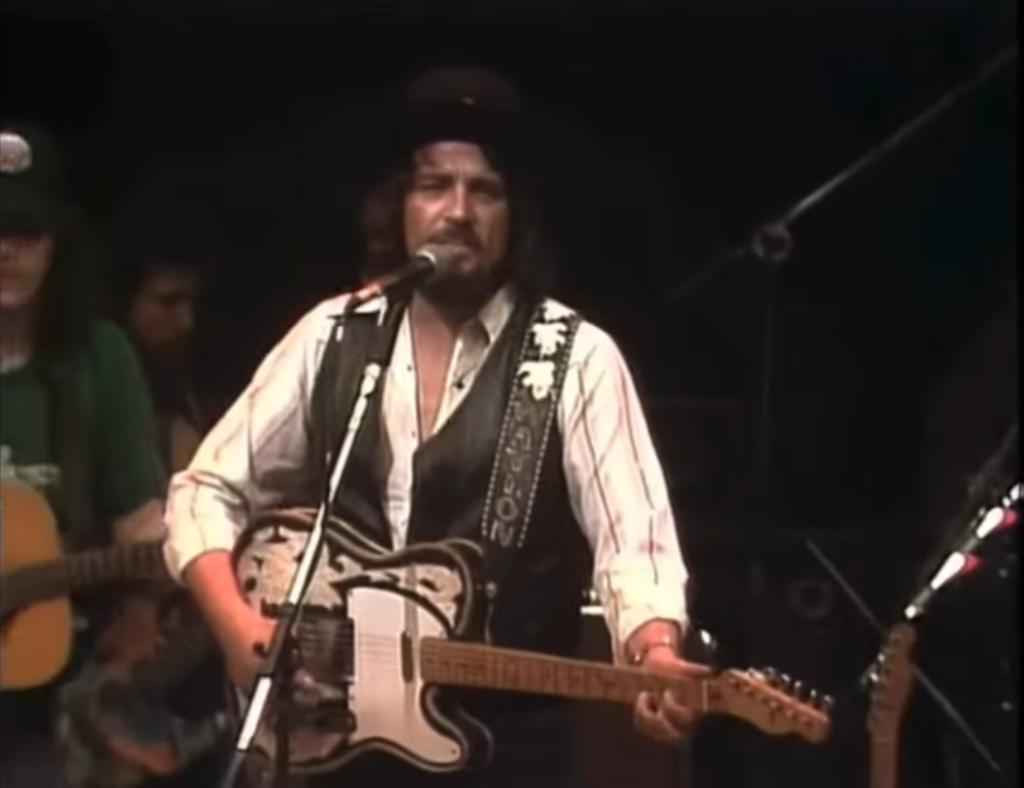
A Night of Fire and Reflection in Nashville
In 1978, Waylon Jennings delivered a commanding live performance at Opryland in Nashville, Tennessee, capturing a defining moment of the outlaw country movement. Backed by his trusted band, the Waylors, Jennings presented a set that blended grit, authenticity, and emotional depth, with “A Long Time Ago” standing out as one of the evening’s most introspective highlights.
The concert, recorded at the height of Jennings’ influence, reflects a period when outlaw country was reshaping the genre’s boundaries. By the late 1970s, Jennings had already established himself as a leading figure in this movement, rejecting the polished Nashville sound in favor of a rawer, more personal style. His live performances were widely regarded as essential to his artistry, often capturing an energy and honesty that studio recordings could not fully replicate.
“A Long Time Ago” offers a particularly revealing glimpse into Jennings’ songwriting. The lyrics draw from personal reflection, touching on themes of freedom, restlessness, and the consequences of a life lived on one’s own terms. Delivered in his unmistakable baritone, the song resonates as both confession and declaration. Live on stage, Jennings amplifies its emotional weight, using subtle phrasing and timing to connect directly with the audience.
The band’s lineup for the performance underscores the tight musical chemistry that defined Jennings’ live shows. With Richie Albright on drums providing a steady backbone and Ralph Mooney’s pedal steel adding texture and depth, the arrangement remains faithful to the outlaw aesthetic while allowing space for improvisation. The interplay between electric and acoustic guitars, led by Jennings himself, reinforces the song’s reflective tone without sacrificing momentum.
What makes this performance particularly compelling is its balance between control and spontaneity. Jennings does not overstate the song’s message. Instead, he lets the narrative unfold naturally, trusting both his voice and the band’s restraint. This approach highlights his reputation as a performer who thrived in live settings, where authenticity took precedence over perfection.
More broadly, the Opryland concert illustrates why Jennings remains a central figure in country music history. His ability to merge storytelling with a rebellious musical identity helped redefine what country music could be. Performances like this one continue to resonate decades later, not because of spectacle, but because of their sincerity.
In “A Long Time Ago,” Jennings does more than revisit the past. He transforms it into a living, breathing moment on stage, reminding listeners why his voice still carries weight in the story of American music.