
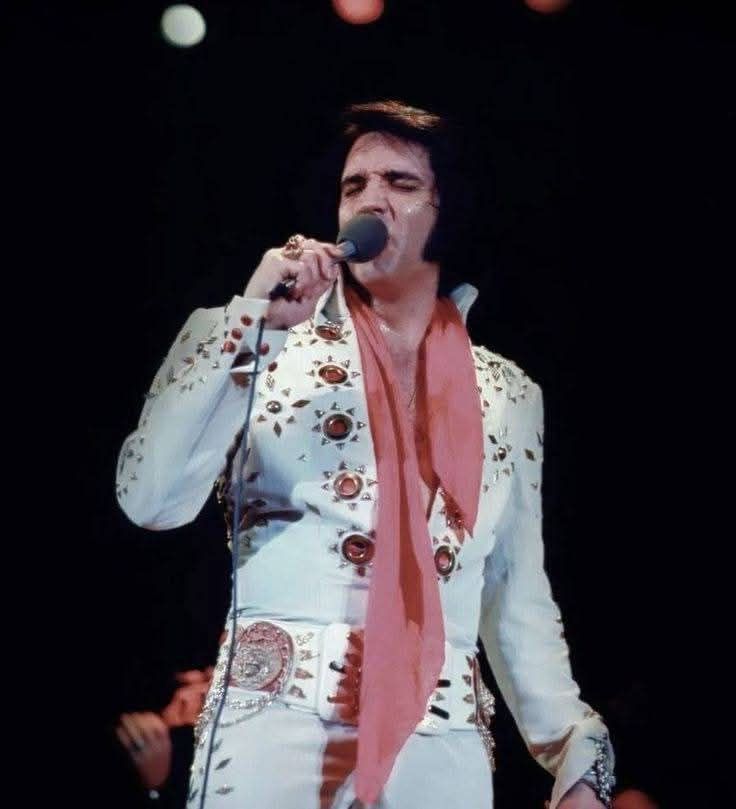
THE FINAL ECHO OF A LEGEND: ELVIS PRESLEY AND “WAY DOWN” IN 1977
In the final chapter of Elvis Presley’s career, “Way Down” stands as a striking reminder that even in decline, greatness can still resonate with power. Released in June 1977, just weeks before his passing, the song captured both the vitality and vulnerability of an artist nearing the end of an extraordinary journey.
“Way Down,” written by Layng Martine Jr., was recorded in October 1976 at Presley’s home studio in Graceland. The session reflected a more intimate and controlled environment compared to his earlier large scale studio productions. Despite reports of his declining health and inconsistent focus during this period, the resulting track emerged as one of his strongest late career recordings.
Musically, the song blends rock, country, and a subtle gospel influence, driven by a steady rhythm and anchored by Presley’s unmistakable vocal tone. A standout feature is the deep bass vocal of J D Sumner, whose descending notes add a dramatic and almost hypnotic texture to the chorus.
Upon release, “Way Down” achieved significant commercial success. It reached number one on the American country chart and later climbed to number one in the United Kingdom, becoming one of Presley’s most notable posthumous hits. The song’s resurgence after his death underscores the enduring connection between Presley and his global audience, even as his personal struggles became increasingly visible.
In 1977, Presley was still performing live, including recordings for the television special Elvis in Concert. These performances revealed a complex reality, where moments of vocal brilliance coexisted with signs of physical and emotional exhaustion. Within this context, “Way Down” feels almost symbolic, a powerful recording released during a time when the artist himself was nearing his final curtain.
“Way Down” is more than just a late era single. It is a document of resilience. Even as circumstances around him deteriorated, Elvis Presley delivered a performance filled with energy, control, and musical identity.
Today, the song remains a compelling piece of his legacy, not because it represents his peak, but because it reveals his persistence. In its rhythm and voice, listeners can still hear the essence of the King, echoing one last time before silence.
 Timeless Melodies