
When a Voice Finds Its Origin: LeAnn Rimes’ Tearful Tribute Revives Patsy Cline’s Timeless Echo
At the 2013 American Country Awards, LeAnn Rimes delivered a performance that transcended tribute and entered something closer to reckoning. Marking half a century since the death of Patsy Cline, the moment was framed not simply as remembrance, but as a return.
Rimes has long been linked to Cline, often described as her modern successor. That connection carries an almost mythic undertone. One of Rimes’ breakthrough songs, Blue, was originally intended for Cline, who died before she could record it. The performance at the American Country Awards therefore carried a sense of unfinished history quietly resolving itself on stage.
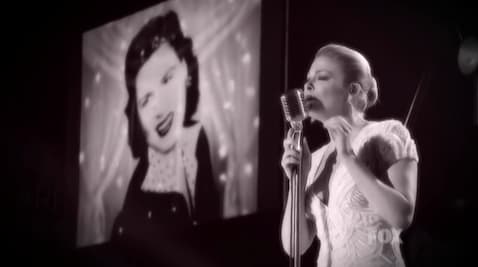
The staging reinforced this idea of time folding in on itself. Bathed initially in black and white, Rimes stood before a vintage microphone as archival imagery of Cline loomed behind her. The visual language was unmistakable. This was not imitation, but invocation. As the medley moved through classics such as Crazy, Walkin’ After Midnight and Sweet Dreams, the atmosphere shifted from controlled homage to something far more fragile.
Midway through the performance, Rimes stripped the arrangement down to an a cappella passage. With instrumentation removed, her voice carried the full emotional weight of the moment. It was here that the performance ceased to be technically polished and instead became deeply human. Her voice trembled, and soon after, she did too.
“I love you, Patsy,” she said through tears, a line that felt less like stagecraft and more like confession. The audience response was immediate, rising to its feet in recognition of something unguarded and real. It was not perfection that moved the room, but vulnerability.
Behind the scenes, Rimes would later describe the experience as a full circle moment in a career shaped from its earliest days by Cline’s influence. The contrast between a lively, even chaotic dressing room and the emotional intensity of the stage only deepened the narrative. It revealed the distance between preparation and surrender, between performance and truth.
What made the tribute resonate so widely was its clarity of purpose. These were songs of heartbreak, long associated with Cline’s own трагically short life, now filtered through a voice that had grown up in their shadow. In that sense, Rimes was not merely revisiting the past. She was extending it.
By the time the visuals shifted from monochrome into colour, the symbolism was complete. The past had not only been remembered. It had been revived, reframed and carried forward.