
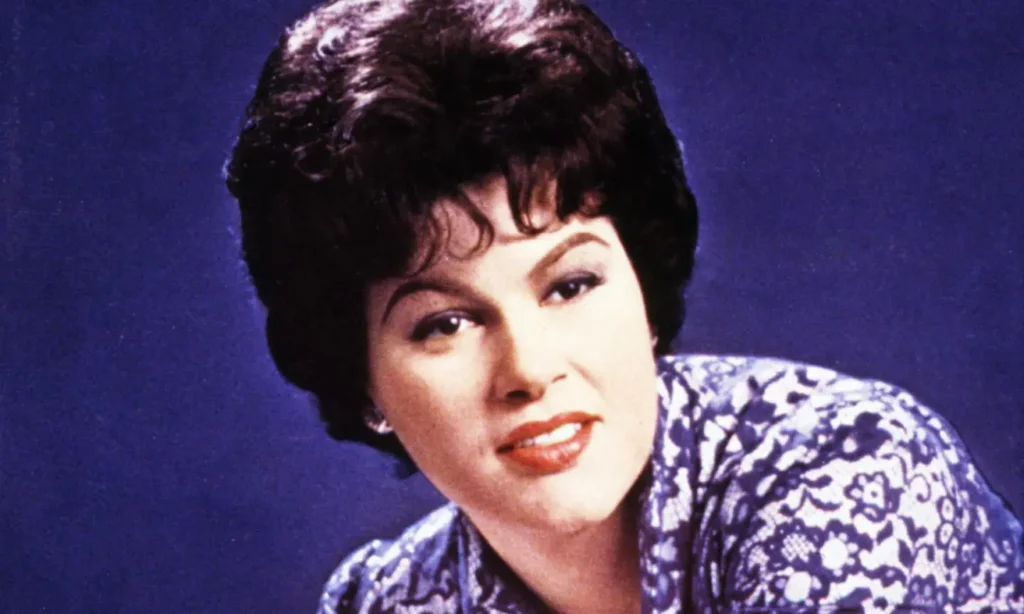
A timeless confession of lingering love becomes a defining moment of emotional truth in country music history
In a performance that continues to resonate across generations, Patsy Cline delivers a deeply moving interpretation of “I Can’t Help It If I’m Still in Love with You,” a song originally written and recorded by Hank Williams in 1951. More than a simple cover, Cline’s version transforms the song into an intimate emotional narrative, reflecting both the universal pain of lost love and the singer’s own evolving artistry.
I Can’t Help It (If I’m Still in Love with You) was first released as a B side but quickly rose to prominence, reaching number two on the Billboard country chart thanks to its simple yet profoundly expressive lyrics . The song’s opening line about passing a former lover on the street captures a moment of quiet devastation, a theme that would later find even deeper emotional weight in Cline’s hands.
Recorded for her 1962 album Sentimentally Yours, Cline’s rendition reflects the refined Nashville Sound that defined her later career. Backed by lush arrangements and subtle instrumentation, her voice carries a controlled vulnerability that differs from Williams’ raw delivery. Critics and historians have often noted that her interpretations of Williams’ songs were “nothing short of a revelation,” elevating familiar material into something hauntingly personal .
What makes this performance particularly compelling is its connection to Cline’s own life. By the early 1960s, she had survived a near fatal car accident that left her physically and emotionally scarred. Forced to adjust her vocal technique due to injury, she began to rely less on power and more on nuance. This shift is evident in “I Can’t Help It,” where every phrase feels measured, თითქოს she is holding back tears rather than releasing them. That restraint gives the song its enduring emotional force.
The themes of the song mirror the emotional landscape that defined much of Cline’s repertoire. Love that lingers, memories that refuse to fade, and the quiet acceptance of loss became central to her identity as an artist. Though her life was tragically cut short in 1963, her ability to convey such complex feelings ensured her legacy would endure.
Today, this performance stands as more than a reinterpretation of a country classic. It is a moment where artist and song become inseparable, where personal experience deepens artistic expression. In giving voice to a love that refuses to disappear, Patsy Cline did not just sing a song. She told a truth that continues to echo, long after the final note fades.