
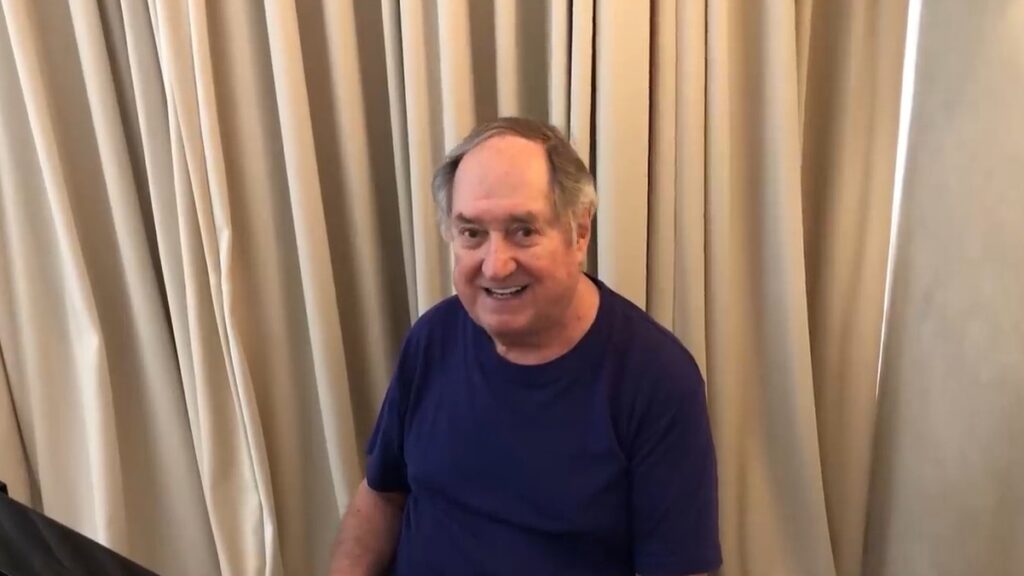
A Voice Across Distance and Time,Neil Sedaka’s Intimate Mini Concert Reveals the Soul Behind the Songs
In April 2020, as much of the world faced uncertainty and isolation, Neil Sedaka offered something rare and deeply মানব: an intimate mini concert recorded from home. Far removed from the grandeur of traditional stages, this performance stands as a quiet yet powerful document of an artist in his eighties continuing to connect through music with sincerity and purpose.
The setting plays a crucial role in shaping the experience. Without the presence of a live audience, elaborate production, or orchestral backing, the focus rests entirely on Sedaka himself. His voice, his phrasing, and his emotional delivery become the center of attention. What emerges is not a performance driven by perfection, but one guided by authenticity and lived experience.
The selection of songs reflects a thoughtful emotional progression. With “King of Clowns,” Sedaka revisits one of his earlier works, a song built on the contrast between outward joy and inner sorrow. In this context, it resonates differently. Sung decades after its release, it feels less like a youthful expression and more like a reflection shaped by time. The image of a smiling figure hiding pain gains additional weight when delivered by someone who has lived through the complexities of life.
This is followed by “Won’t You Share This Dream Of Mine,” a song that introduces a softer and more hopeful tone. Here, the message shifts toward connection. Rather than concealing emotion, the song becomes an invitation to share it. The transition from guarded feeling to openness is subtle, yet meaningful.
The emotional peak arrives with “How Can I Change Your Mind.” This performance brings vulnerability to the forefront. The lyrics express regret, longing, and the fear of loss. Unlike the earlier metaphor of the clown, there is no distance between the singer and the emotion. The delivery is direct and unguarded, reflecting a willingness to confront feelings rather than hide them.
Taken together, these songs form a coherent narrative. They move from concealment to connection, and finally to emotional honesty. It is a progression that mirrors not only the structure of the performance, but also the broader journey of a lifetime.
The closing words of Sedaka carry particular significance. He speaks of music as a source of spiritual uplift and expresses a simple hope that it can offer the same to others. In a moment defined by global uncertainty, this message feels both timely and timeless.
This mini concert does not rely on spectacle. Its strength lies in its restraint, its honesty, and its ability to remind listeners that even after decades in music, the most powerful performances are often the most personal.
 Timeless Melodies