
Five Years Before Forever: The Performance That Foretold a Legend,A Quiet Stage, A Loud Future: Bowie’s Earliest Glimpse of Immortality
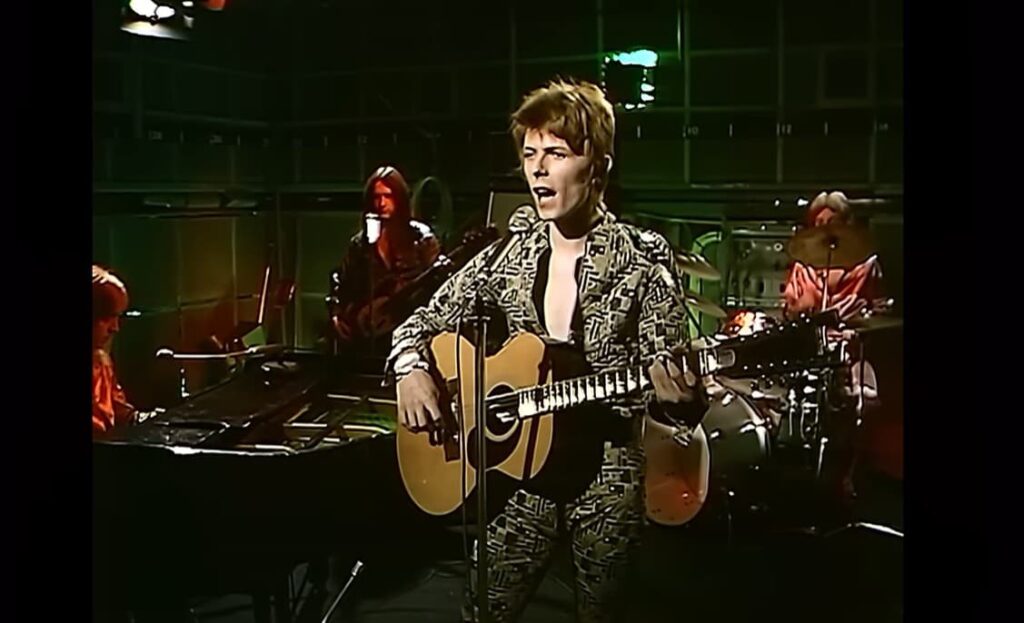
In 1972, on the intimate set of The Old Grey Whistle Test, David Bowie delivered a performance that, in hindsight, feels almost prophetic. Singing Five Years, the opening track from The Rise and Fall of Ziggy Stardust and the Spiders from Mars, Bowie stood at the threshold of transformation. At the time, he was not yet the global icon he would soon become. Yet something in the room suggested that this moment mattered.
The performance itself is striking in its simplicity. There are no elaborate visuals, no theatrical excess, only Bowie’s voice, his expression, and a growing emotional intensity that unfolds with quiet precision. The song begins as a narrative, describing a world informed that it has only five years left to exist. Rather than focusing on spectacle, Bowie narrows his lens to human reactions, capturing fragments of fear, denial, and fragile hope. As the song builds, so does the sense that this is not merely a story about the end of the world, but a reflection of a society searching for meaning.
What makes this performance remarkable is not only its artistic control, but its position in Bowie’s career. This was one of the earliest televised glimpses of the Ziggy Stardust persona, a character that would soon redefine the boundaries between music, identity, and performance. Here, Ziggy is still emerging, not yet fully formed, but already carrying the alien distance and emotional depth that would captivate audiences worldwide.
Viewed through the lens of history, the performance takes on an added layer of resonance. Decades later, Bowie’s final album, Blackstar, would confront themes of mortality and legacy with striking clarity. His death just days after its release transformed that work into a deliberate farewell. In that context, Five Years feels less like fiction and more like an early meditation on time, impermanence, and the inevitability of endings.
The connection between song and performance lies in this quiet tension between beginning and ending. On that BBC stage, Bowie was introducing a concept that would shape his career and influence generations. At the same time, he was already exploring ideas that would define his final artistic statement. The result is a moment suspended between innocence and awareness, between emergence and legacy.
This performance endures not because of spectacle, but because of its honesty. It captures an artist before the world fully understood him, and in doing so, reveals the origins of a cultural force that would never stop evolving.