
A haunting echo of loneliness transformed into a timeless anthem of the heart, where a legendary voice finds new life across the horizons of time.
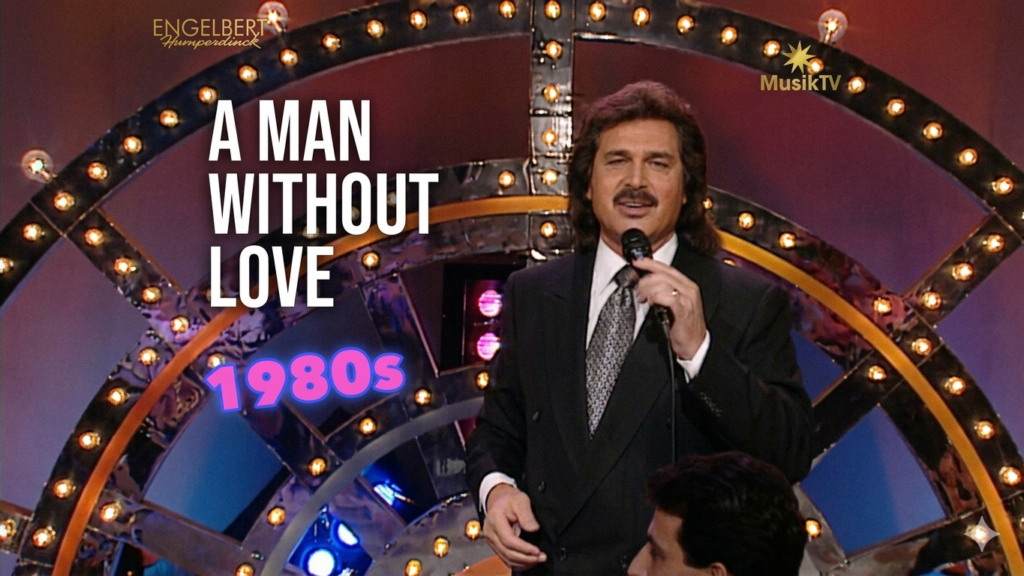
There is a unique magic in seeing a classic performance from the 1980s suddenly resurface in the cultural zeitgeist of today. When Engelbert Humperdinck’s iconic hit “A Man Without Love” was featured in the Marvel series “Moon Knight” on Disney Plus, it wasn’t just a clever musical choice; it was a bridge that allowed a new generation to discover the sheer vocal power we have admired for decades. Seeing a television performance of this song from the mid-eighties—an era where Engelbert had fully embraced his role as a global emissary of romance—reminds us of the theatrical grace and emotional depth that defined the variety show era. It brings back the flickering warmth of the television screen and the undeniable presence of a man who could command an entire room with nothing more than a microphone and a broken heart.
The history of “A Man Without Love” is as storied as the artist himself. Originally an Italian song titled “Quando m’innamoro,” it was adapted into English and released by Engelbert in 1968. It became a monumental success, peaking at No. 2 on the UK Singles Chart and becoming a massive hit across Europe and the United States. By the 1980s, the song had matured along with its singer. In his television appearances during that decade, Engelbert often delivered the song with a more seasoned, dramatic flair, utilizing the expansive arrangements that were the hallmark of eighties production. For those of us who remember those broadcasts, it was a moment of pure, unadulterated sentiment—a reminder that in a world of changing fashions, the language of love remained constant.
The story behind the song’s recent resurgence is a fascinating testament to the “staying power” of quality. The creators of “Moon Knight” chose the song to represent the internal struggle and the solitary journey of the main character, but for the mature listener, the song carries a much more personal weight. It speaks to the fundamental human need for connection and the hollow silence that follows when love is absent. The lyrics, “I cannot face the world that’s passin’ me by,” resonate deeply with anyone who has navigated the quiet hours of reflection. It evokes memories of the long-playing records spinning on a quiet evening, the letters written in the moonlight, and the realization that our lives are defined by the people we choose to hold dear.
Watching this 1980s footage today is a journey through a golden afternoon of our own history. It reminds us of a time when variety specials were the center of our social lives—a time of tuxedos, sweeping orchestral swells, and a standard of professionalism that seems increasingly rare. Engelbert’s performance is a masterclass in the “power ballad”; his ability to build from a hushed, intimate verse to a soaring, triumphant chorus is a technical marvel that still leaves us breathless. There is a nostalgic comfort in his signature sideburns and the confident, silver-toned resonance of his baritone—a sound that feels like a familiar port in a storm.
The significance of “A Man Without Love” in the present day is its ability to remain relevant without losing its soul. Whether heard through a vintage speaker in 1980 or a high-definition stream in 2026, the emotional core of the song remains untouched. Engelbert Humperdinck didn’t just sing a hit; he provided a soundtrack for the solitary moments of the human experience. As we look back on that eighties television stage, we aren’t just seeing a performer; we are revisiting a milestone of our own journey, a reminder that while the world may pass us by, the melodies of the heart are eternal. It is a legacy of longing, wrapped in a voice that will never truly be alone.