
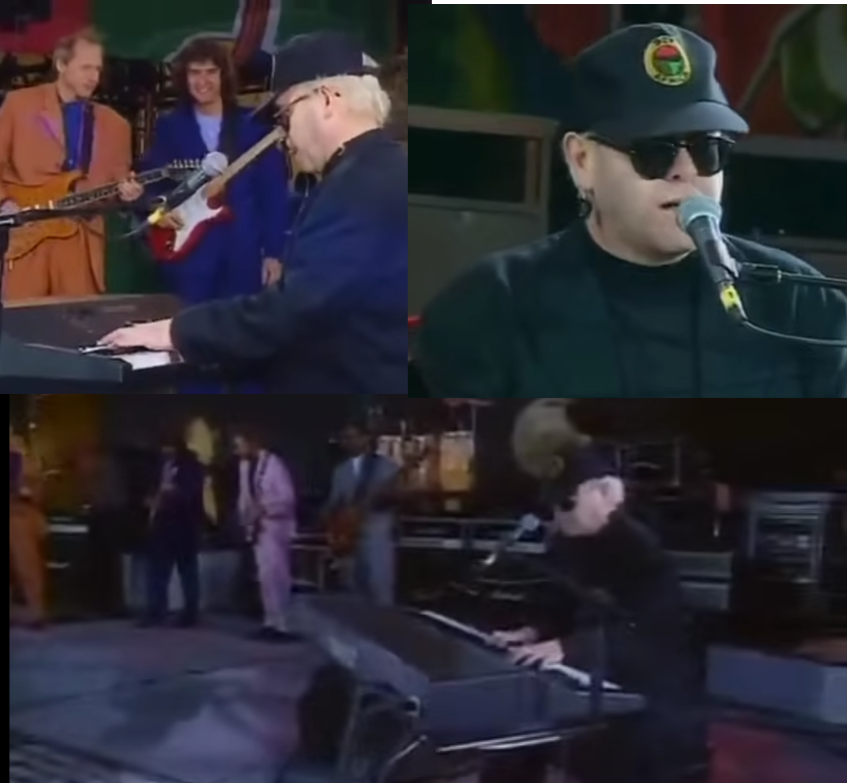
A masterful study in restraint and emotional maturity, where a pop legend found his deepest resonance in the quiet spaces of the heart.
By 1990, Elton John had spent two decades as the world’s most flamboyant showman, but with the release of “Sacrifice,” he offered something entirely different: a moment of profound, hushed sincerity. For those of us who had followed his journey from the glitter-soaked stadiums of the seventies to the more reflective landscape of the early nineties, this song felt like a revelation. It wasn’t just a hit; it was a career milestone that finally secured him his first solo No. 1 on the UK Singles Chart, staying at the top for five weeks. It marked the arrival of a mature artist who no longer needed spectacle to command a room—only a melody and a universal truth.
The history of “Sacrifice” is rooted in the long-standing and poetic partnership between Elton and lyricist Bernie Taupin. Found on the 1989 album Sleeping with the Past, the song was intended as a tribute to the soul-stirring ballads of the 1960s—specifically the works of Percy Sledge and Aretha Franklin. However, the result was something uniquely “Elton.” By 1990, as the song dominated the airwaves, it represented a significant personal and professional turning point for him. It was a period of sobriety and redirection, where the music became a sanctuary of clarity. For a generation navigating the complexities of long-term commitments and life’s transitions, “Sacrifice” became the definitive anthem for the quiet dignity of making difficult choices.
For the sophisticated listener, the beauty of the song lies in its “cold” and clinical musical arrangement—a deliberate contrast to the warmth of the vocal. The rhythmic, almost robotic beat of the drum machine and the shimmering synthesizers create a sense of emotional distance that perfectly mirrors the lyrics. It isn’t a song about a dramatic breakup; it’s about the slow, silent drifting apart that can happen in any long-standing union. “It’s a human sign / When things go wrong,” Elton sings with a weary wisdom. It evokes memories of our own moments of reflection—those quiet hours in a study or by a window where we weighed the cost of our decisions and the “sacrifice” required to maintain our integrity and our peace.
Listening to “Sacrifice” today brings back a vivid, atmospheric nostalgia for the start of the nineties. It reminds us of a time when the world was changing rapidly, yet music still held the power to stop us in our tracks and make us feel. There is a profound comfort in the deep, resonant tone of Elton’s baritone in this era—a voice that had moved beyond the high-flying acrobatics of his youth to find a steady, soul-stirring strength. It brings back memories of late-night drives and the hushed intimacy of our own homes, where a single song could articulate the things we felt but couldn’t quite say.
The significance of “Sacrifice” in the legacy of Elton John is its enduring elegance. He proved that he could move a global audience with a “whisper” rather than a “scream,” a lesson that resonates with those of us who have come to value the quiet, steady truths over the flash of the moment. As the final, atmospheric chords of the synthesizer fade into the air, we are left with a sense of calm perspective. It is a reminder that the most significant acts in our lives—the real sacrifices—are often the ones that nobody sees, performed with the same quiet grace that defines this timeless masterpiece. It remains a golden standard of songwriting, a bridge between a legendary past and an enduring, sophisticated present.