
The Heavy Heart of Yesterday: Finding Closure in the Impossible Echoes of “I Can’t Unlove You”
In this devastatingly beautiful modern ballad, Kenny Rogers explores the haunting reality of a love that refuses to fade, capturing the helpless frustration of a heart that can easily pack away physical mementos but remains utterly powerless to erase the memories etched deep within the soul.
For those who have traveled through the many seasons of life, the pain of letting go is a familiar companion. Yet, rarely has that quiet struggle been articulated with as much raw, mature vulnerability as in “I Can’t Unlove You.” Released on March 21, 2006, as the lead single from his critically acclaimed twenty-sixth studio album, Water & Bridges, the song marked a profound late-career triumph for The Gambler. Produced by the legendary Dann Huff and penned by the talented songwriting duo of Wade Kirby and Will Robinson, the track struck a deep chord with audiences, embarking on a steady climb to peak at #17 on the Billboard Hot Country Songs chart and bridging the gap between traditional country narrative and contemporary adult emotion.
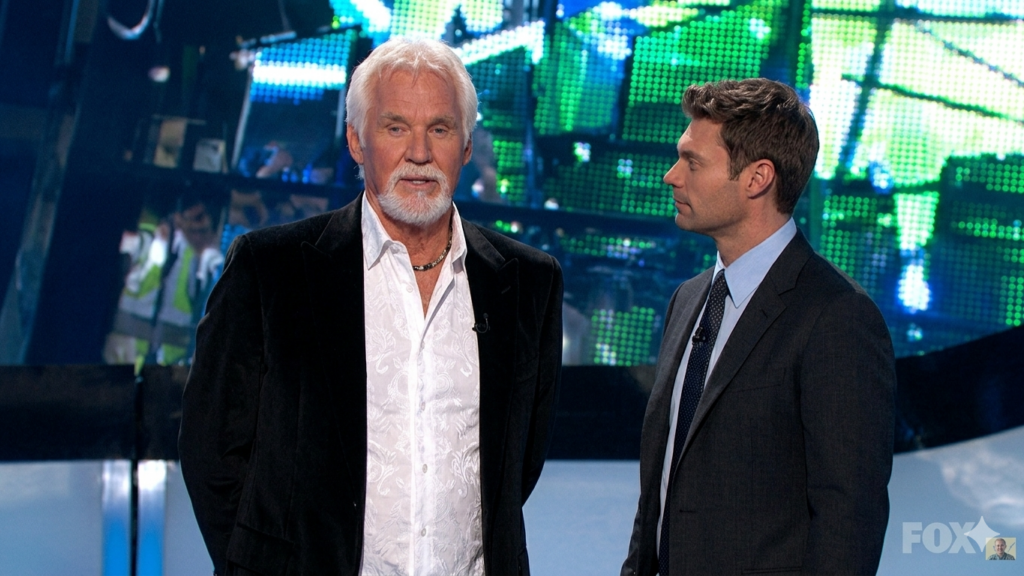
The song’s journey reached a spectacular, high-visibility milestone on April 5, 2006, during the fifth season of American Idol. Having spent the week mentoring the Top 9 finalists through the nuances of country music, Kenny Rogers took to the stage on the live results show to deliver the debut televised performance of his new single. Clad in black, under the soft glow of the stage lights, and backed by a lush, sweeping arrangement, the then 67-year-old icon showed a nationwide audience of millions exactly what it meant to live inside a lyric. It was a masterclass in seasoned stagecraft; his signature silver beard and weathered, raspy baritone lent the performance a weight that no youthful contestant could ever hope to replicate.
The story behind “I Can’t Unlove You” is rooted in the concept of irreversible emotional connection. The lyrics paint a vivid, cinematic picture of the aftermath of a broken relationship. It begins with the practical, almost clinical steps of moving on—packing up “postcards and letters,” tossing out “knickknacks and souvenirs.” These are the tangible things we can control, the items we can easily banish from our sight in an afternoon. But as the chorus swells, the song confronts the devastating truth: the human mind has no “undo” button. The prefix “un” becomes a desperate, impossible plea. Kenny’s delivery of the lines—“I can’t unthink about you / I can’t unfeel your touch / I can’t unhear all the words unsaid”—captures a profound psychological frustration that resonates deeply with anyone who has tried to force their heart to forget.
What makes this performance on American Idol and the track on Water & Bridges so significant is its contrast to the youthful, high-gloss pop of the mid-2000s. Amidst an era of loud vocal gymnastics, Kenny Rogers brought the wisdom of a statesman back to prime-time television. He reminded us that the most powerful instrument is not the one that hits the highest note, but the one that carries the most truth. The performance was a stark, beautiful reminder of the power of restraint.
To listen to this song, or to watch that 2006 broadcast today, is to step into a room of quiet reflection. It evokes a strong sense of nostalgic melancholy, taking us back to our own moments of quiet transition, where we realized that some people leave footprints on our souls that no amount of time can wash away. It is a song that honors the persistence of love, suggesting that even when a relationship ends, the love itself remains an indelible part of who we are.
“I Can’t Unlove You” stands tall as one of the final great masterpieces in the vast discography of Kenny Rogers. It is a track that doesn’t offer easy comfort or a tidy resolution. Instead, it offers validation. It tells us that it is okay to still feel, to still remember, and to accept that some loves are simply too big to ever be unloved. It remains a poignant, starlit milestone of a legend who, even in his golden years, knew exactly how to reach into our hearts and put our deepest, unspoken sorrows into perfect harmony.