
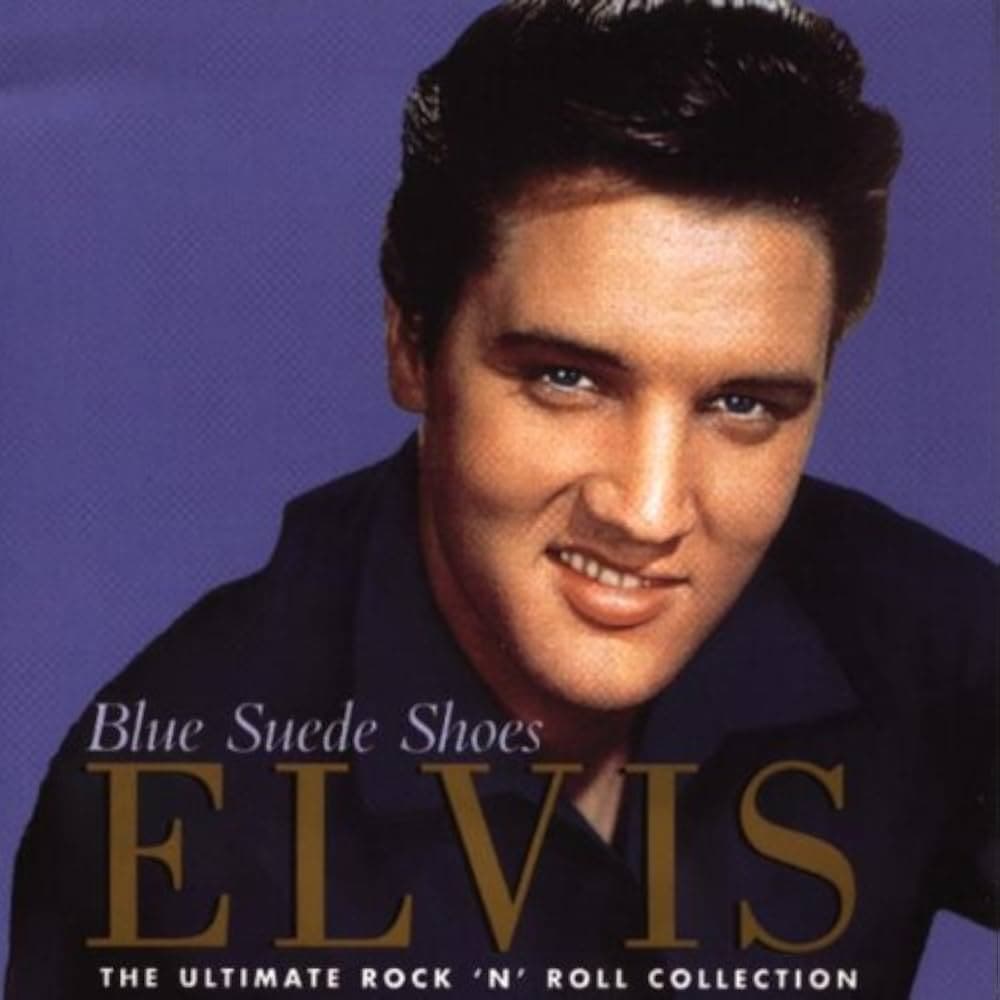
A rebellious spark that helped define early rock ’n’ roll and forever changed the way the world heard Elvis Presley.
Few songs capture the restless spirit of early rock ’n’ roll the way “Blue Suede Shoes” does. Long before it became one of the most recognizable titles associated with Elvis Presley, the song began as a rockabilly anthem written and first recorded by Carl Perkins in late 1955. But when Elvis released his own electrifying interpretation in 1956—featured on his debut album Elvis Presley—the song took on a new life, surging into the heart of a cultural revolution. While Perkins’ original version hit No. 2 on the Billboard Pop chart, Elvis’ rendition quickly earned its own chart success, peaking at No. 20 on the Billboard Hot 100 and No. 24 on the Country chart, an impressive achievement for a track already dominating the airwaves in another version. What Elvis offered wasn’t competition—it was transformation.
Behind this recording lies a story woven from admiration, opportunity, and the unstoppable rise of a young artist whose voice could reshape anything he touched. Elvis, who deeply respected Carl Perkins, chose to record the song not to overshadow the original but because he loved its rhythm, swagger, and the way it captured the rebellious energy sweeping through America’s youth. And even after Elvis performed the song on national television—propelling it to millions of ears—he insisted publicly that people buy Perkins’ version first. Yet audiences couldn’t ignore Elvis’ magnetic charisma. His performance fused rhythm and blues, country twang, and a driving beat into a sound that felt both familiar and entirely new, like a door opening onto a future no one had yet imagined.
Listening to “Blue Suede Shoes” now, one can still feel the raw excitement of a moment when music itself seemed to step out of line and dare the world to follow. The song’s theme—protecting one’s prized blue suede shoes—is playful on the surface, but beneath that playful energy lies something deeper: a declaration of independence in a world that was beginning to move faster than ever. Elvis’ delivery, crisp yet loose, carried a thrilling sense of self-possession. It was as if he were telling a generation learning to express itself, “Your identity matters. Stand your ground. Don’t let anyone step on what makes you who you are.”
The instrumentation, built on a pounding rhythm and bright guitar lines, matched Elvis’ voice stride for stride. Every shout, every breath, every rhythmic snap of the words came alive with a rare kind of spontaneity. There is a reason this track is still taught, studied, and cherished—not merely for its chart history but for the way it helped define what rock ’n’ roll could be. In Elvis’ hands, the song became less about footwear and more about the freedom to move, to rebel, to claim a space in the world.
Over time, “Blue Suede Shoes” has become a living artifact of an era when music felt like open highway—wild, new, and full of promise. It stands as one of Elvis’ most enduring performances because it captures him at a moment of pure transition: a young man rising so quickly that even he could barely grasp the magnitude of what was happening. Each listen brings back the memory of jukebox glow, dance-hall floors, and nights alive with possibility.
And perhaps that is why the song continues to resonate. It reminds the world of a time when rock ’n’ roll was still discovering itself—bold, unpolished, and full of heart. Through Elvis Presley’s “Blue Suede Shoes,” we revisit not only a great recording but the birth of a feeling that has never truly faded.