
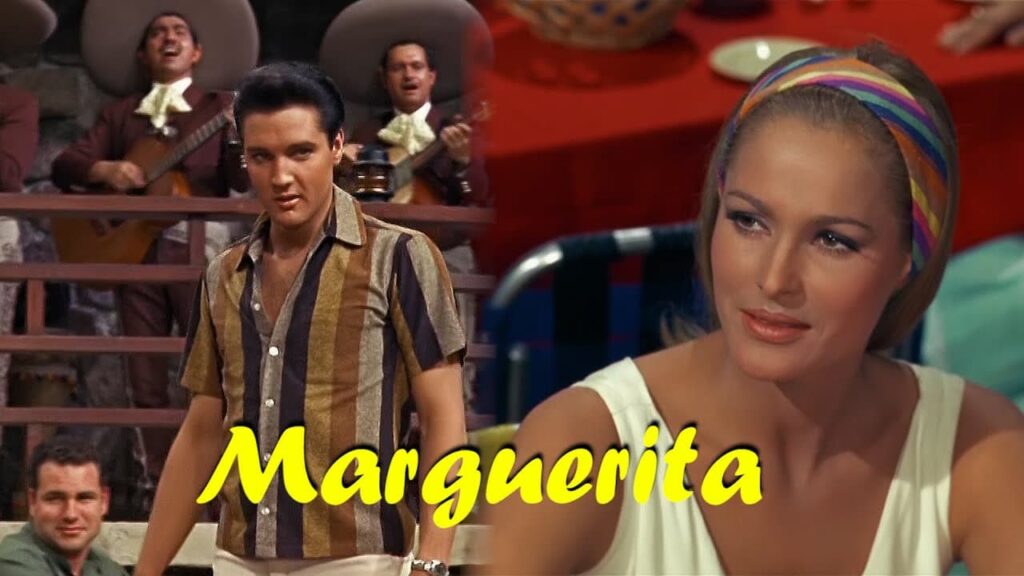
A Warm Serenade Under the Mexican Sun: Elvis Presley – “Marguerita”
In the sprawling tapestry of Elvis Presley’s musical journey, Marguerita is a shimmering thread that glows quietly with romance and gentle passion an intimate moment captured on film and forever etched in the heart of those who remember the slower, warmer side of the King’s voice.
When Marguerita first reached the world in 1963, it did so not as a chart-topping single but as part of something broader: the soundtrack album to Fun in Acapulco, a vibrant travelogue film that found Elvis embracing a Latin-flavored musical landscape as naturally as a summer breeze. The soundtrack itself climbed to No. 3 on the Billboard Top LPs chart, holding its place among the most beloved albums of his evolving 1960s era.
For many listeners today, Marguerita isn’t measured by chart positions or commercial performance but by the way it feels. Like an old postcard tucked into an album sleeve, the song carries a sense of place: sun-lit plazas, the warmth of coastal air, the hush of twilight serenades. Written by Don Robertson and laid down in January 1963 at Radio Recorders in Hollywood, this track is a tender love song woven into the cinematic moments of Fun in Acapulco, where Elvis plays Mike Windgren a man whose heart is as open as the sea before him.
From its opening lines, Marguerita reveals itself as a confession laid bare. The lyrics, with lines like “Who makes my heart beat like thunder?” and “Her lips have made me her prisoner,” are not braggadocio but sincere musical poetry that carry a breath of longing and awe. There is no pretense here only Elvis’s voice, warm and expressive, flirting with the melody as though each note were a whispered compliment to the woman he sings about.
It’s worth pausing on the texture of the song itself. Unlike the electrifying rock ‘n’ roll that first propelled Elvis into the spotlight, Marguerita leans into something softer, more atmospheric. The instrumentation bright yet gentle guitars, playful mandolin, brass accents, and the rich backing harmonies of The Jordanaires and The Amigos creates a soundscape that feels both exotic and familiar. It’s the kind of arrangement that seems to catch sunlight in its rhythm, evoking the very spirit of Acapulco’s sandy beaches and festive evenings.
It’s also a song that sits within a special chapter of Elvis’s career one where he was blending his rock foundation with new musical colors and cultural influences. The Latin touches in Marguerita reflect an artist curious, respectful, and eager to explore beyond the established boundaries of his earlier work. In songs like this, you hear a voice comfortable in its maturity an artist capable of subtle nuance as well as electrifying bravado.
To many who grew up with Presley’s films and their soundtracks, Marguerita holds a particular nostalgia. It’s the soundtrack playing in the background of warm family gatherings, the song that drifted from a radio on a long drive, or the melody that seemed to dance with memories of youth long past. There’s a gentle charm to it that stands apart from big hits like “Bossa Nova Baby” or “Mexico,” and yet it always returns to its rightful place in the hearts of devoted listeners who cherish it not for fame, but for feeling.
In revisiting Marguerita today, decades after its release, listeners may find something unexpected: in the simple act of Elvis singing a name Marguerita there is a bridge between worlds. It is the bridge between music and memory, between place and emotion, between the youthful thrill of discovering new sounds and the reflective wisdom that only comes with time.
Marguerita may not have been a blockbuster single, but its legacy is timeless. It is a quiet love song that carries within it the laughter of fiestas, the secret of moonlit strolls, and the warmth of a voice that once defined an era. To listen is to be transported not just to Acapulco’s shores, but to a treasured moment in music history where one man’s voice could make the earth beneath your feet feel lighter and your heart, infinitely braver.