
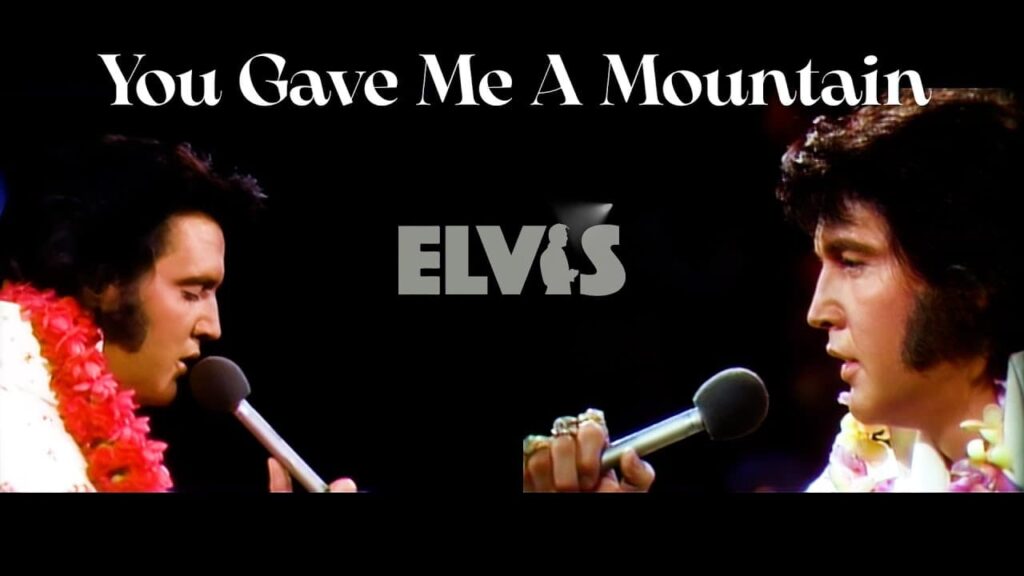
A Monument of Emotion: Elvis Presley – “You Gave Me A Mountain” (Aloha From Hawaii, Live in Honolulu, 1973)
“You Gave Me A Mountain” stands as one of Elvis Presley’s most stirring live performances a powerful statement of struggle, loss, and heartfelt resilience, delivered at the peak of his stage presence and broadcast to a global audience.
In the bold context of Aloha From Hawaii Via Satellite, recorded live on January 14, 1973, Elvis presented this song not merely as a performance but as a near-spiritual confession that resonated across continents. The entire concert was transmitted around the world via satellite and was later released as a live album that reached No. 1 on the Billboard album chart, cementing its place as one of the most iconic moments of Presley’s later career.
Originally written by country-music great Marty Robbins, You Gave Me A Mountain tells a narrative of a life shaped by relentless hardship symbolizing hill after hill turned into an insurmountable mountain. The lyrics speak of a lifetime of sorrow: the death of a mother in childbirth, the absence of a father, and the loss of a child and home. With its vivid storytelling, the song goes beyond a simple ballad into something profoundly human: an account of endurance and lamentation that transcends genre.
Although not released as a standalone single in Presley’s career charts, the version recorded for Aloha From Hawaii became definitive to many fans and critics alike. On a stage in Honolulu, under the Pacific stars and before a satellite audience that would number in the hundreds of millions, Elvis poured every ounce of his vocal soul into the song. This was a man who had known his own mountains career fluctuations, personal heartbreaks, and the unrelenting glare of fame and the raw emotion in his voice makes it feel as if he were singing directly from his own heart.
The Aloha From Hawaii special was itself a watershed moment: it wasn’t just a concert but a technological and cultural phenomenon. Beamed live across Asia, Europe, and beyond, it reached an audience estimated to be among the largest ever assembled for a single broadcast event at the time. The accompanying live album not only topped the US pop and country charts but stood as a testament to Elvis’s enduring global appeal well into the 1970s.
Within that setlist, You Gave Me A Mountain sits among an unusually reflective group of songs alongside his tender “Something,” the introspective “I’m So Lonesome I Could Cry,” and the heartfelt ballad “Welcome To My World.” In this context, the grit and gravel of the mountain song offered a stark contrast to the more romantic or nostalgic pieces, yet it was perhaps the most emotionally unguarded.
Listening to Elvis deliver the line “But this time, Lord, You gave me a mountain / A mountain You know I may never climb” carries an almost spiritual weight rich with the sense that this is more than a song, that it represents something deeper about human experience. With backing vocals adding a gospel-like resonance and his own voice rising so vulnerably above the arrangement, it feels like a shared confession, a musical moment of collective empathy that binds performer and listener together.
Fans and scholars often point to this rendition as one of the emotional highlights of the Aloha From Hawaii concert a performance that continues to move and captivate listeners decades later. In a set filled with spectacle, the raw honesty of You Gave Me A Mountain remains a towering testament to Elvis’s ability to inhabit a song with profound sincerity and to make a universal statement about the human condition.
More than just a live track, this performance carries the weight of memory, resilience, and the simple acknowledgment that life’s greatest challenges whether mountains of grief or moments of doubt can become shared songs of understanding when sung from the heart. In Elvis’s voice, one hears not just the echo of rock and soul but the very breath of human struggle set to melody.