
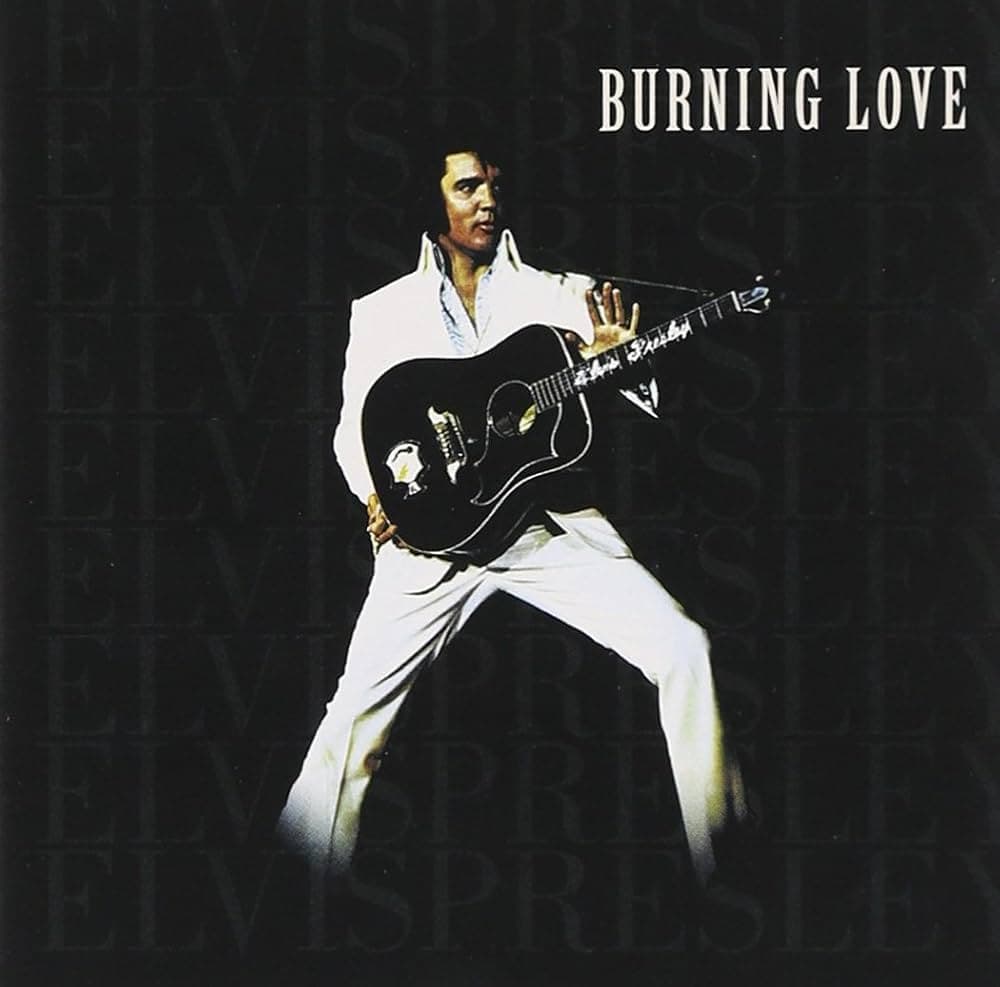
A fiery confession of irresistible passion “Burning Love” by Elvis Presley
“Burning Love” is a song that crackles with desire, as Elvis Presley gives voice to a love so intense it feels like it might consume him entirely.
When Elvis released “Burning Love” on August 1, 1972, it became one of his last great rock/pop anthems. Recorded on March 28, 1972 at RCA’s Hollywood studios, the track features an unforgettable, searing guitar riff played by the songwriter Dennis Linde himself. The single soared up the charts it reached #2 on the U.S. Billboard Hot 100, narrowly missing the top spot because of Chuck Berry’s “My Ding-a-Ling.” Meanwhile, it also climbed to #1 on the Cashbox pop chart, marking a significant moment late in Elvis’s chart career. In the United Kingdom, the song peaked at #7, reflecting its broad appeal.
Behind the raw energy of “Burning Love” lies a surprisingly spontaneous origin story. The writer, Dennis Linde, later revealed that he conceived the song in just 20 minutes, laying down a drum track in his home studio before overdubbing the rest of the instruments and vocals. He described it as written “on a lark,” though the passion in the lyrics would become legendary. Linde later said the inspiration stemmed partly from being newly married and perhaps that sense of new, powerful emotion found its way into the song’s burning heart.
Musically, the song is built for intensity. The electric guitar introduction hits like a spark to tinder, and the arrangement with driving rhythms and bold instrumentation underlines the urgency in Elvis’s delivery. The production, overseen by Felton Jarvis, balances the rock edge with Elvis’s signature vocal warmth. Elvis sings with both strength and vulnerability: “Lord Almighty, I feel my temperature rising … It’s burning through to my soul.” The image of his “brain flaming” and being “set on fire” by love suggests a passion so overwhelming it threatens to take control.
Beyond the studio, “Burning Love” became a defining moment in Elvis’s live performances. One particularly notable rendition came during his historic “Aloha from Hawaii via Satellite” concert on January 14, 1973, held at the Honolulu International Center. Broadcast via satellite to much of the world, that performance became a symbol of Elvis’s global reach. In that set, “Burning Love” opened the show with explosive energy, and Elvis delivered it with his magnetic stage presence and unmistakable charisma.
Lyrically, the song captures the paradox of desire: it’s both joyous and dangerous. His kisses are “higher than a choir,” yet the “flames” are closing in, igniting a fire he can barely contain. That tension — between passion’s ecstasy and its destructive potential is what makes the song feel timeless. Elvis doesn’t just sing about love: he embodies its urgency and risk.
In the wider arc of his career, “Burning Love” stands as one of Elvis’s last true rock hits. According to records, it was his 40th and final Top-10 hit on the Billboard charts. That gives the song a bittersweet resonance not just a burning flame, but a final blaze of creative fire.
Emotionally, “Burning Love” resonates deeply with listeners who remember Elvis’s later years, when he carried both the weight of fame and a longing to connect deeply. For more mature audiences, the song may evoke memories of his television specials, his powerful stage presence, and the way his voice could still bring raw feeling decades into his career.
In the end, “Burning Love” is not merely a love song it’s a declaration, a confession, and a blazing testament to passion’s power. Elvis, with his unmistakable voice and presence, turns what could have been a simple rock number into an emotional fire that continues to burn brightly in the history of popular music.