
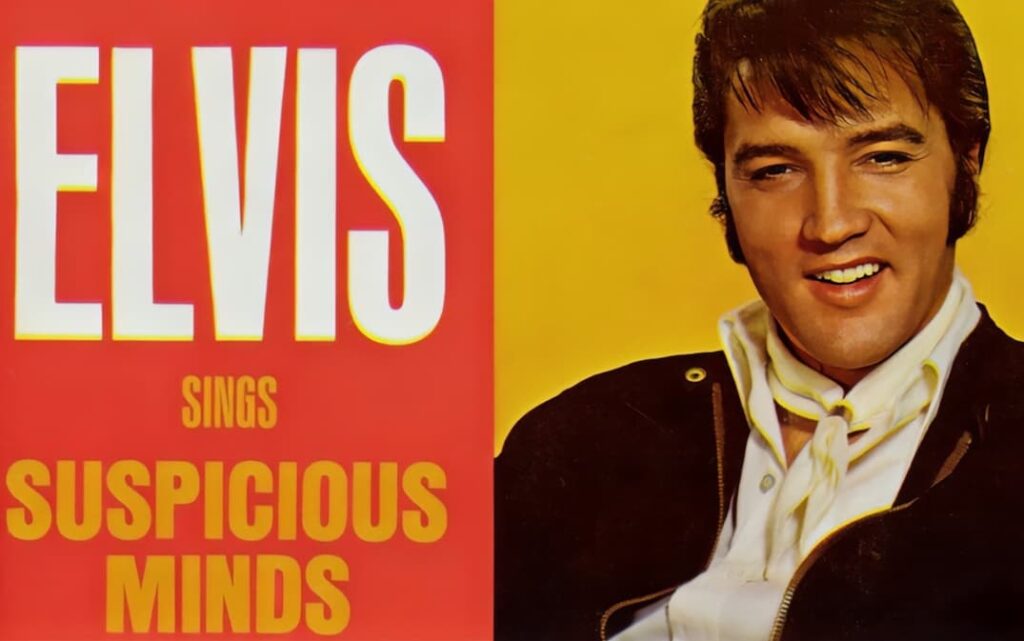
A desperate plea for love to survive mistrust and jealousy “Suspicious Minds” by Elvis Presley
“Suspicious Minds” is a powerful, horn-driven ballad in which Elvis Presley confronts the pain of a relationship eroded by doubt, longing for a way to rebuild trust and keep love alive.
When Elvis released “Suspicious Minds” on August 26, 1969, it marked one of the greatest comebacks in his storied career. The single soared to #1 on the U.S. Billboard Hot 100, becoming his last No. 1 pop hit during his lifetime a milestone that underscored both its commercial power and emotional weight. At the same time, its release helped to define the turning point in his late-’60s resurgence, following his celebrated ’68 Comeback Special.
The song’s origin is deeply personal, rooted in the life of its writer, Mark James. He first recorded “Suspicious Minds” in 1968 for Scepter Records, but his version did not gain traction. The lyrics, as James later shared, reflect his experience of a complicated love triangle: feelings for his childhood sweetheart even though he was married led to tension, distrust, and emotional conflict. When producer Chips Moman brought the song to Elvis during the Memphis sessions, Elvis recognized its emotional honesty and insisted on recording it even though there were business disputes over publishing rights.
The recording itself was a labor of love. Elvis laid down multiple takes in the early hours of January 23, 1969, at American Sound Studio in Memphis. The final master was crafted from several takes and later augmented with horn overdubs in Las Vegas a bold production choice by his team, notably Felton Jarvis, intended to reflect the dramatic intensity of Elvis’s live performances. This overdub, especially the distinctive fade-out and fade-in near the end of the song, became one of its most memorable and emotionally charged moments.
At its core, “Suspicious Minds” is about being “caught in a trap” the trap of misunderstanding, the trap of love balanced on doubt. Elvis sings of desperate vulnerability: “I can’t walk out / Because I love you too much, baby,” and pleads for a chance to let their love “survive.” Ultimately, he warns that they “can’t build our dreams on suspicious minds,” underlining the idea that love cannot truly flourish where trust is absent.
Beyond the lyrics, the song’s structure supports its emotional journey. The arrangement swells with strings, horns, and backing vocals, creating a richly textured soundscape that reflects the tension and release in a troubled relationship. Elvis’s vocal delivery is nothing short of masterful he begins with a calm, pleading tone, then rises into powerful intensity, layering anguish, love, and conviction in every note.
There’s a timelessness to “Suspicious Minds” its themes of jealousy, trust, and the fragile foundations of love resonate across generations. And although it was written about Mark James’s own life, Elvis makes it universal: it could be the story of any couple walking that dangerous edge between love and suspicion.
Its legacy is profound. Long after its release, the song came to be seen not just as a mid-career hit, but as a defining moment in Elvis’s artistic resurgence. It has since been covered by many artists, remained a staple of his greatest hits collections, and continues to be celebrated as one of his most emotionally honest and musically bold recordings.
For older listeners who remember vinyl spinning on a quiet evening, or the glow of a radio broadcast in a dimly lit room, “Suspicious Minds” evokes a strong sense of nostalgia not just for Elvis, but for the era when music could articulate the subtleties of heartbreak and hope in a way that felt deeply personal. In every trembling note and every horn-punctuated crescendo, the song invites us back into that fragile space of doubt and devotion, reminding us that true love often demands the greatest courage to survive.