
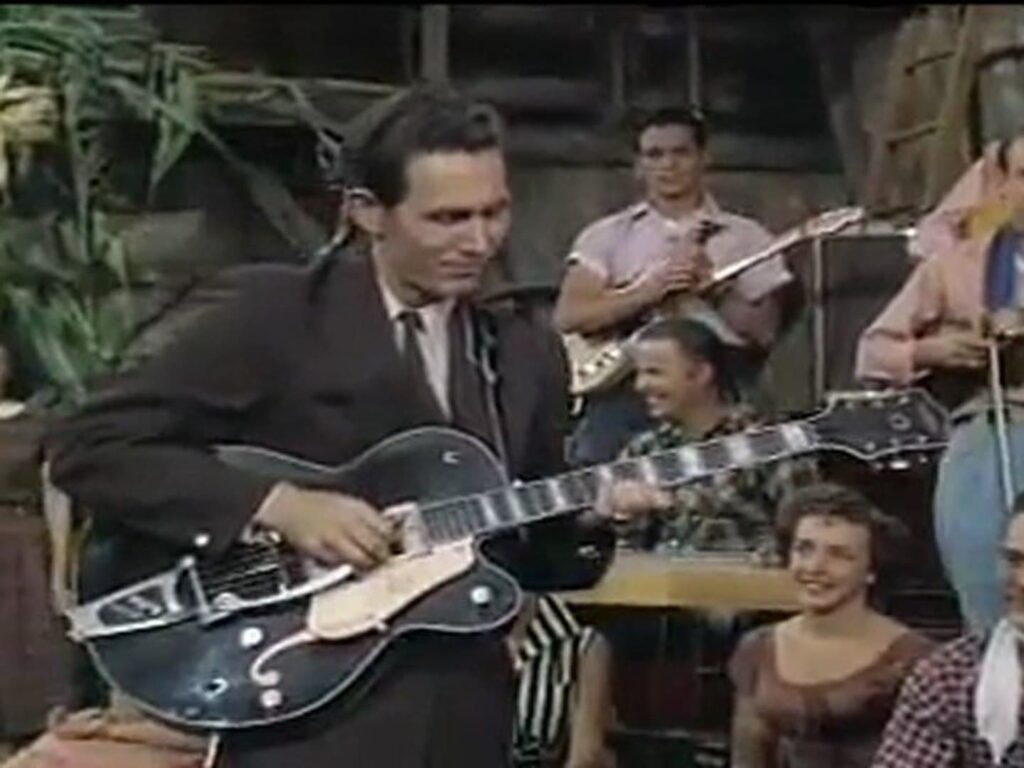
A Wordless Meditation on Desire and Distance, Where a Guitar Speaks What the Heart Cannot Say
When Chet Atkins recorded “Dark Eyes”, he was not chasing a hit record or a place on the pop charts. He was doing something far more enduring: translating an old, wandering melody into a deeply personal reflection, told entirely through the voice of his guitar. Known internationally as “Ochi Chornye”—a traditional Russian and Romani song dating back to the 19th century “Dark Eyes” had already traveled across borders, cultures, and generations long before Atkins touched it. What he gave the song, however, was something uniquely his: restraint, elegance, and quiet emotional authority.
Chet Atkins’ instrumental recording of “Dark Eyes”, released in the early 1960s and appearing on several of his albums and compilations during that decade, did not enter the mainstream pop charts upon release. Instrumental guitar pieces rarely did by that time. Yet chart positions tell only a small part of the story. Within musical circles and especially among guitarists this recording quickly became one of his most admired performances, frequently cited as an example of his unmatched control of tone, timing, and emotional balance.
By the early ’60s, Chet Atkins was already far more than a successful recording artist. As a producer, executive, and creative architect at RCA, he had helped shape what would later be called the “Nashville Sound.” But “Dark Eyes” feels intentionally removed from industry ambition. It sounds like a man alone with his instrument, revisiting an old melody not to modernize it, but to listen to what it still has to say.
The origins of “Dark Eyes” are steeped in longing. The original song tells of infatuation so powerful it borders on torment—dark eyes that haunt the singer, stirring passion, jealousy, and melancholy all at once. Atkins removes the lyrics entirely, yet somehow preserves their emotional gravity. His guitar phrases linger, hesitate, then move forward again, as if remembering something both beautiful and painful. Each note is allowed to breathe. Silence becomes part of the storytelling.
What makes this performance remarkable is Atkins’ refusal to dramatize. There are no flourishes meant to impress, no speed runs to showcase technical dominance. Instead, he relies on touch. His right hand controls dynamics with near-invisible precision, while his left hand shapes the melody with gentleness and intention. The result is intimate, reflective, and timeless. It feels less like a performance and more like a confession made quietly, without the need for witnesses.
In the broader context of his career, “Dark Eyes” reveals an essential truth about Chet Atkins: beneath his role as producer, innovator, and industry leader was a deeply introspective musician. He understood that music did not always need words to tell a story and that sometimes, words might only get in the way. This belief guided much of his instrumental work, but nowhere does it feel more fully realized than here.
The song’s endurance lies in its universality. Everyone, at some point, has known a feeling they could not fully explain an attachment, a memory, a face that returns uninvited. “Dark Eyes” captures that sensation without naming it. It trusts the listener to recognize the emotion for themselves. That trust is rare, and it is powerful.
Decades later, this recording remains a quiet companion rather than a nostalgic artifact. It does not belong to a single era. It belongs to moments of reflection, to evenings when memories surface without warning, to times when the past feels close enough to touch. In those moments, Chet Atkins’ “Dark Eyes” does not demand attention—it earns it.
And perhaps that is its greatest strength. Long after charts fade and trends disappear, this piece endures as a reminder that the most profound music often speaks softly, asking only that we listen.