
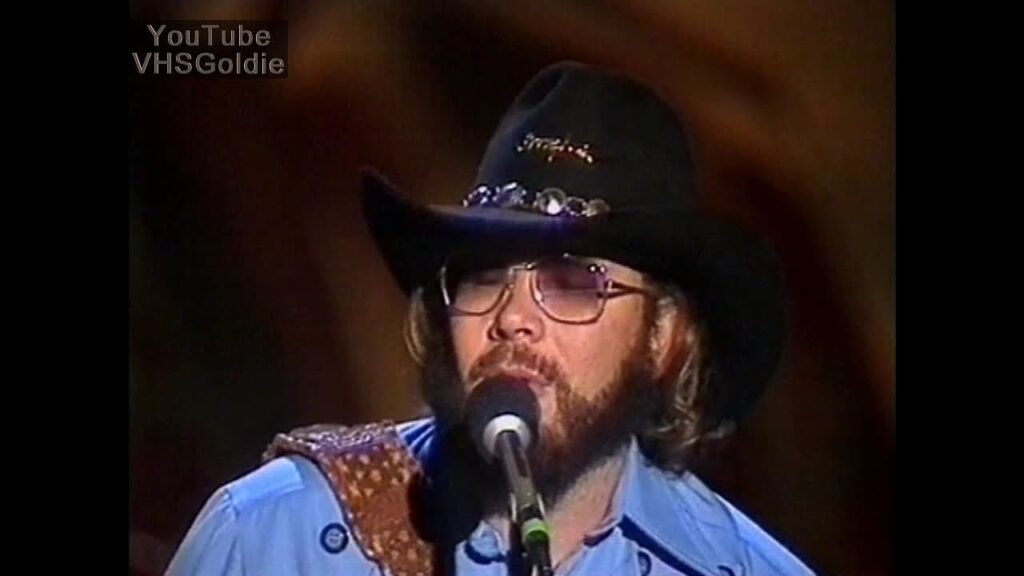
A Defiant Declaration of Identity, Where Heritage Becomes Both Burden and Strength
When Hank Williams Jr. released “Family Tradition” in 1979, it arrived not merely as a song, but as a statement—direct, confrontational, and long overdue. Issued as the title track of the album Family Tradition, the song became one of the defining moments of his career, reaching No. 4 on the Billboard Hot Country Singles chart. More importantly, it marked the moment when Hank Williams Jr. finally stepped out of a long, imposing shadow and spoke in his own voice.
By the late 1970s, the name Hank Williams was already sacred in American music. To carry that name was both an honor and a heavy burden. For years, Hank Williams Jr. had been expected to sound like his father, sing his father’s songs, and live up to an image frozen in time. Early in his career, he did exactly that—faithfully and respectfully. But faithfulness came at a cost. The expectations were suffocating, and the comparisons endless.
“Family Tradition” is the sound of resistance turning into self-definition. Written by Hank Williams Jr. and Barry Beckett, the song confronts criticism head-on. From its opening lines, it makes clear that this is not an apology, nor a plea for understanding. It is an explanation offered once, firmly, with no intention of repeating it.
Lyrically, the song addresses accusations of excess, rebellion, and irresponsibility. The narrator acknowledges the behavior others condemn, but reframes it through lineage. Drinking, living hard, refusing to conform—these are not presented as moral failures, but as inherited traits, woven into the fabric of a family legacy. The phrase “family tradition” becomes both shield and truth, suggesting that identity is not chosen freely, but shaped by blood, history, and expectation.
Musically, the song blends country roots with Southern rock energy, reflecting the very hybrid identity Williams was claiming. The driving rhythm, electric guitar lines, and assertive vocal delivery stand in stark contrast to the lonesome restraint of his father’s era. This was intentional. Hank Williams Jr. was not rejecting tradition—he was expanding it, insisting that it could evolve without losing its soul.
Vocally, Williams sounds unfiltered and unapologetic. There is grit in his voice, but also clarity. He sings not to persuade, but to assert. Each line feels like it has been lived, argued over, and finally settled. The confidence here is not arrogance; it is survival. After years of being measured against an impossible standard, this song draws a boundary.
The album Family Tradition itself marked a turning point. It solidified Williams’ “outlaw” image—not in imitation of others, but as a personal truth. The record connected deeply with listeners who understood what it meant to inherit expectations without being given room to breathe. In that sense, the song resonated far beyond country music. It spoke to anyone who had ever been told who they were supposed to be.
Historically, the late 1970s were a period of reckoning in country music. The genre was negotiating its relationship with pop polish, outlaw rebellion, and cultural change. “Family Tradition” sat squarely in the middle of that tension. It honored roots while refusing to be restrained by them. That balance is precisely why the song endured.
What gives “Family Tradition” its lasting power is its honesty. It does not glorify self-destruction, nor does it deny consequence. Instead, it acknowledges complexity. Heritage can inspire, but it can also confine. Williams does not resolve that tension neatly. He simply names it and moves forward.
Over time, the song became an anthem—not of rebellion for rebellion’s sake, but of self-acceptance forged through struggle. It redefined Hank Williams Jr. not as a successor trying to replicate greatness, but as an artist willing to stand with his inheritance rather than hide behind it.
In the broader arc of his career, “Family Tradition” represents emancipation. After this song, Williams was no longer “Hank’s son” trying to find his footing. He was Hank Williams Jr., fully formed, imperfect, and unmistakably himself.
Decades later, the song still carries weight because its central question remains unresolved in human experience: how much of who we are is chosen, and how much is inherited? “Family Tradition” does not offer an answer—but it offers courage. The courage to speak plainly, to accept one’s roots without surrendering individuality.
And in that defiant chorus, sung not in anger but in recognition, Hank Williams Jr. finally claims what was always his to claim—not just a name, but a voice, shaped by history and hardened by truth.