
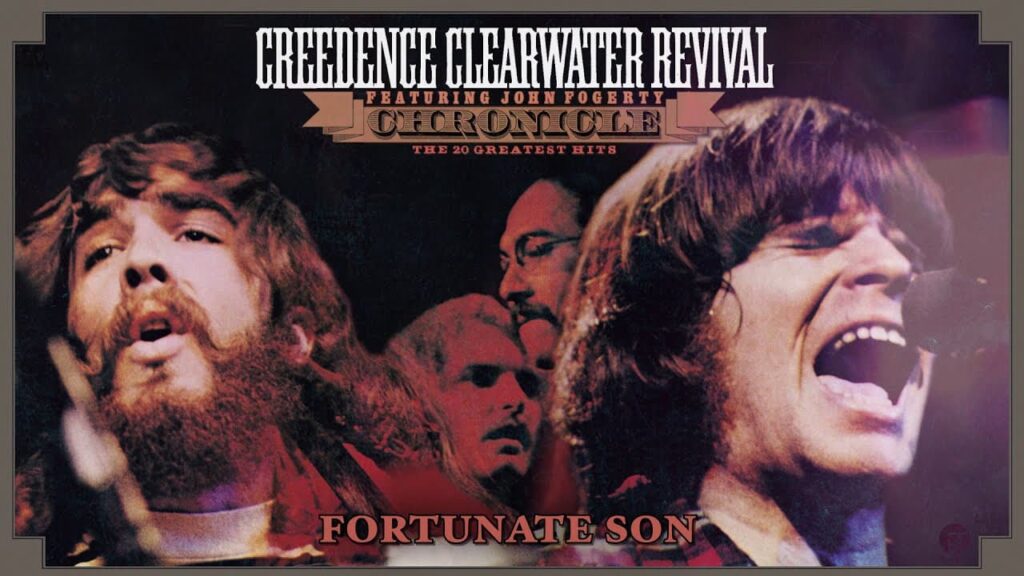
A Fierce Protest Against Privilege and Power, Where Rock Music Spoke for the Silenced
When Creedence Clearwater Revival released “Fortunate Son” in 1969, it entered the world with urgency and purpose, sounding less like entertainment and more like a warning bell. Issued as a double A-side single with “Down on the Corner”, and later included on the album Willy and the Poor Boys, the song reached No. 14 on the Billboard Hot 100. Yet its true impact has never been measured by chart position. “Fortunate Son” became one of the most enduring protest songs in American music history—a blunt, uncompromising indictment of inequality, wrapped in three minutes of raw rock energy.
By 1969, the United States was deeply fractured. The Vietnam War had dragged on for years, trust in institutions was eroding, and the divide between those who bore the cost of war and those who avoided it was painfully visible. John Fogerty, the primary songwriter and voice of Creedence Clearwater Revival, observed this reality with growing anger. Unlike many protest songs that relied on metaphor or poetic abstraction, Fogerty chose clarity. “Fortunate Son” names the problem directly.
The song targets inherited privilege—the sons of wealth and political power who could escape the draft while others were sent to fight and die. Lines like “Some folks are born silver spoon in hand” cut straight to the heart of the issue. This is not a general anti-war lament; it is a critique of hypocrisy. Fogerty does not argue ideology. He points to imbalance. The anger in the song is focused, disciplined, and unmistakably moral.
Musically, “Fortunate Son” is built on propulsion. The driving guitar riff, the relentless rhythm section, and Fogerty’s urgent vocal delivery create a sense of forward motion that mirrors the song’s emotional force. There is no room for reflection here—only confrontation. The tempo pushes the listener along, as if refusing to allow complacency.
Fogerty’s voice is crucial to the song’s power. Strained, sharp, and insistent, it sounds like someone shouting truth over noise rather than singing for applause. There is no theatrical polish, no ornamental phrasing. The vocal performance feels almost documentary, as if the song were being reported rather than performed. This immediacy is what gives “Fortunate Son” its lasting authority.
Within the album Willy and the Poor Boys, the song occupies a central moral position. The record itself blended humor, nostalgia, and social commentary, but “Fortunate Son” stands as its most confrontational moment. It contrasts sharply with lighter tracks, reinforcing the idea that joy and outrage can coexist—that music can celebrate life while still demanding accountability.
Historically, “Fortunate Son” arrived at a moment when popular music was becoming a primary vehicle for political expression. Yet unlike many songs of the era, it did not drift into abstraction or symbolism. Its language is plain, its target clear. That clarity has allowed the song to remain relevant long after the Vietnam War ended. The systems it criticizes—privilege without consequence, power without accountability—did not disappear with that conflict.
Over the decades, the song has often been misunderstood or misused, sometimes presented as a generic anthem of patriotism or military spectacle. This misreading only underscores its message. “Fortunate Son” is not anti-soldier; it is anti-exemption. It does not condemn service—it condemns inequality. Fogerty later spoke openly about his frustration with the song being detached from its meaning, emphasizing that it was written in defense of those who had no choice.
What makes “Fortunate Son” endure is not just its political stance, but its emotional honesty. The song does not ask permission to be angry. It does not soften its edges for broader appeal. In doing so, it captures a feeling that transcends its era—the resentment that arises when sacrifice is demanded unevenly.
In the broader legacy of Creedence Clearwater Revival, the song stands as a defining statement. CCR were never a band of excess or spectacle. They dressed plainly, avoided psychedelic indulgence, and focused on direct songwriting. “Fortunate Son” reflects that ethos perfectly. It is lean, forceful, and impossible to ignore.
Decades later, the song still resonates because it speaks to a recurring truth: when power shields itself from consequence, protest becomes inevitable. “Fortunate Son” does not resolve that tension. It exposes it and leaves it unresolved, demanding that the listener sit with the discomfort.
In the end, “Fortunate Son” remains one of rock music’s most honest acts of resistance. Not because it shouts the loudest, but because it refuses to look away. It stands as a reminder that music, at its most vital, does more than reflect its time—it challenges it.