
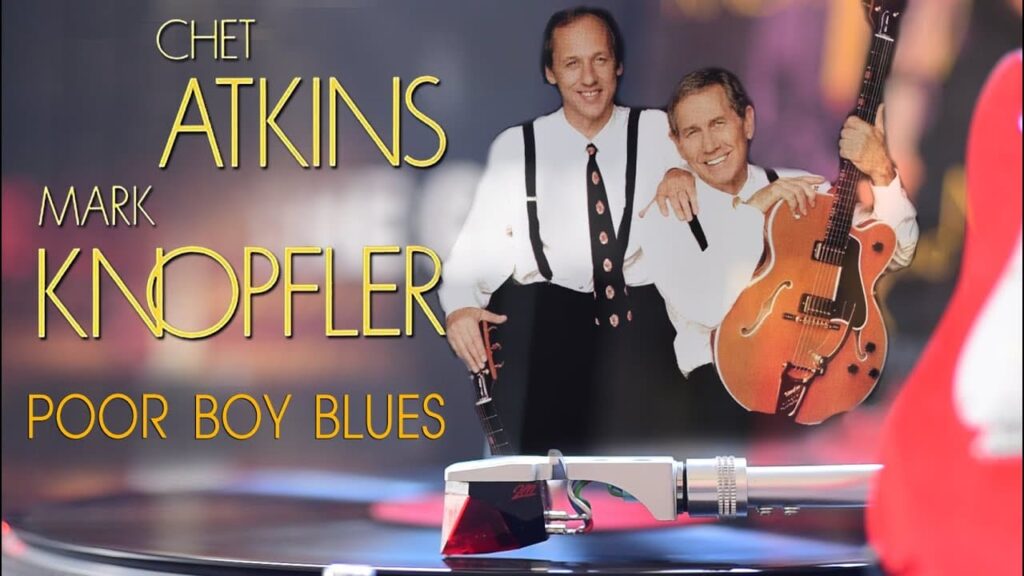
A Meeting of Two Gentle Masters, Where Humility, Craft, and the Blues Speak Softly but Last Forever
When Mark Knopfler and Chet Atkins came together to record “Poor Boy Blues” in 1990, the result felt less like a collaboration engineered by the music industry and more like a quiet conversation between two kindred spirits. Released on the album Neck and Neck, the song did not enter mainstream pop charts, nor was it designed to. Instead, it found its place where it truly belonged—among listeners who value musicianship, understatement, and emotional truth. The album itself reached No. 1 on the Billboard Top Country Albums chart and later earned the Grammy Award for Best Country Collaboration with Vocals, confirming that subtlety, when done honestly, still carried weight.
“Poor Boy Blues” is rooted in a long musical lineage. Originally associated with Merle Travis, one of Chet Atkins’ earliest and most formative influences, the song carries the DNA of American country blues—simple on the surface, deeply expressive underneath. By choosing this piece, Chet Atkins was not merely revisiting a tune; he was acknowledging a personal musical inheritance. Bringing Mark Knopfler into that space elevated the moment into something generational, almost symbolic.
At the time of recording, Chet Atkins was already a living institution. Known as “Mr. Guitar,” he had shaped the Nashville Sound, guided countless careers as a producer, and redefined what country guitar could be. Mark Knopfler, though from a different generation and cultural background, shared Atkins’ core values: clarity over flash, feeling over force, and respect for the song above all else. Their partnership felt inevitable once it happened, as though the music had been waiting for them to meet.
Musically, “Poor Boy Blues” is a masterclass in restraint. The arrangement is sparse—two guitars, a relaxed tempo, and plenty of air between the notes. There is no competition here, no attempt to dominate the spotlight. Instead, the guitars listen to one another. Atkins’ clean, precise fingerstyle lines provide structure and elegance, while Knopfler’s fluid, conversational phrasing adds warmth and narrative depth. Each phrase feels answered rather than challenged.
Vocally, the performance is understated and sincere. Neither singer reaches for drama. The lyrics speak of hardship and humility, yet they are delivered without bitterness. This is the blues as reflection, not complaint. The narrator does not demand sympathy; he simply tells the truth. That quiet honesty is what gives the song its emotional pull.
The meaning of “Poor Boy Blues” extends beyond its words. In the hands of these two artists, the song becomes a meditation on simplicity—on knowing who you are and accepting what life hands you without pretense. There is dignity in that acceptance, and both Atkins and Knopfler understand it instinctively. Their performance suggests that wisdom is not found in volume or speed, but in knowing when to leave space.
The official video reinforces this feeling. There are no elaborate visuals, no narrative distractions. The focus remains on the musicians themselves—seated, relaxed, engaged with the music and with each other. Watching them play feels like being invited into a private room, where technique is second nature and ego has no place. Every glance, every smile exchanged between them speaks of mutual respect.
Within Neck and Neck, “Poor Boy Blues” stands as one of the album’s emotional anchors. The record as a whole explored American roots music through a refined, almost conversational lens, and this song embodies that approach perfectly. It bridges eras without announcing itself as a bridge. Tradition flows naturally into the present.
Historically, the collaboration carried deeper meaning. Chet Atkins, nearing the later years of his career, was passing something forward—not explicitly, but through example. Mark Knopfler, already an established artist, approached the partnership not as a star, but as a student and equal. That balance is rare, and it is audible in every bar of music.
What makes “Poor Boy Blues” endure is its humanity. It does not seek to impress. It seeks to connect. The song reminds us that great music often comes from restraint, from listening, from honoring what came before without being trapped by it.
In the broader story of both artists, this recording feels essential. For Chet Atkins, it reaffirmed his belief that music should remain graceful and generous. For Mark Knopfler, it highlighted his deep connection to American roots and his respect for the masters who shaped them.
Decades later, “Poor Boy Blues” still feels unhurried, unforced, and quietly profound. It stands as evidence that when two musicians share not just skill, but values, the result can transcend time.
In the end, this song is not about poverty or hardship alone. It is about humility—musical and human. And in that gentle exchange of notes between Mark Knopfler and Chet Atkins, one hears something rare: mastery that no longer needs to prove itself, speaking softly, and being heard clearly.