
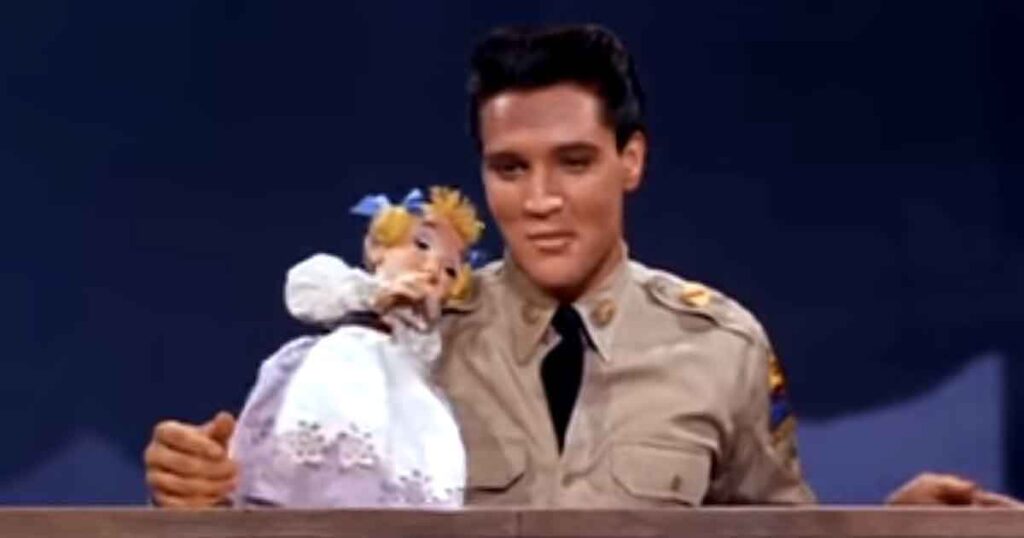
A gentle soldier’s song about love, longing, and the ache of goodbye hidden behind a cheerful smile
“Wooden Heart” stands as one of the most deceptively tender recordings in Elvis Presley’s vast catalog a song that sounds light and playful on the surface, yet carries a quiet emotional weight that lingers long after the final note. Released in 1961 from the soundtrack album G.I. Blues, the song became a major international success. It reached No. 1 on the Billboard Hot 100 in the United States and also topped the UK Singles Chart, confirming Elvis’s extraordinary global appeal at the dawn of the new decade.
At first listen, “Wooden Heart” feels almost whimsical. Its lilting melody, gentle rhythm, and fragments of German lyrics give it the charm of a folk tune sung with a wink. Yet beneath that approachable exterior lies a story of emotional restraint, vulnerability, and the quiet loneliness of a man far from home. The song is adapted from the traditional German folk song “Muss i denn”, a melody about leaving a loved one behind and trusting that love will endure across distance and time. By blending English lyrics with the original German phrases, the song subtly reinforces the theme of separation two languages, two worlds, one aching heart.
Elvis recorded “Wooden Heart” during a pivotal moment in his career. Having returned from military service in Germany, he was reshaping his public image. The raw, rebellious energy of his early years was giving way to a more polished, mature presence. G.I. Blues presented Elvis as approachable, gentle, and emotionally open and “Wooden Heart” captured that transition perfectly. His vocal performance is restrained, almost conversational, yet deeply sincere. There is no bravado here, no dramatic flourish. Instead, Elvis sings as if confiding in the listener, admitting that while he may appear strong, his heart is anything but unfeeling.
The lyrics revolve around a central metaphor: a “wooden heart” that pretends not to feel. The singer insists he has one hard, unbreakable, immune to pain. But every line that follows contradicts that claim. His voice carries longing, hesitation, and hope. This contradiction is the soul of the song. It speaks to the human habit of masking emotion, especially when facing departure or uncertainty. The wooden heart is not real it is armor, worn briefly to survive goodbye.
Musically, the arrangement is deliberately simple. Soft accordion tones, gentle percussion, and a steady tempo evoke the feeling of a slow march not of soldiers, but of time itself moving forward whether one is ready or not. The melody never rushes. It allows space for reflection, mirroring the emotional pause that comes just before leaving something precious behind.
What made “Wooden Heart” particularly powerful upon release was its universality. Though tied to a film narrative, the song transcended its cinematic origins. It spoke to anyone who had ever left love behind—whether for duty, work, or fate and carried the quiet hope of reunion. That emotional clarity is why the song resonated so strongly across borders, cultures, and languages.
Critically, the song marked an important chapter in Elvis’s artistic evolution. It proved that he could communicate depth without volume, tenderness without excess. While some later critics dismissed his early 1960s film songs as lightweight, “Wooden Heart” remains an exception remembered not for spectacle, but for sincerity.
Decades later, the song still holds its place as one of Elvis Presley’s most beloved recordings. Not because it demands attention, but because it invites reflection. It reminds us that strength often disguises itself as distance, and that love, even when spoken softly, can echo across years.
In “Wooden Heart,” Elvis Presley offers a quiet truth wrapped in melody: sometimes the bravest thing a heart can do is admit that it feels deeply, painfully, and honestly even when pretending otherwise.