
A gentle manifesto of freedom and idealism, sung by a man choosing the open road over the easy answer
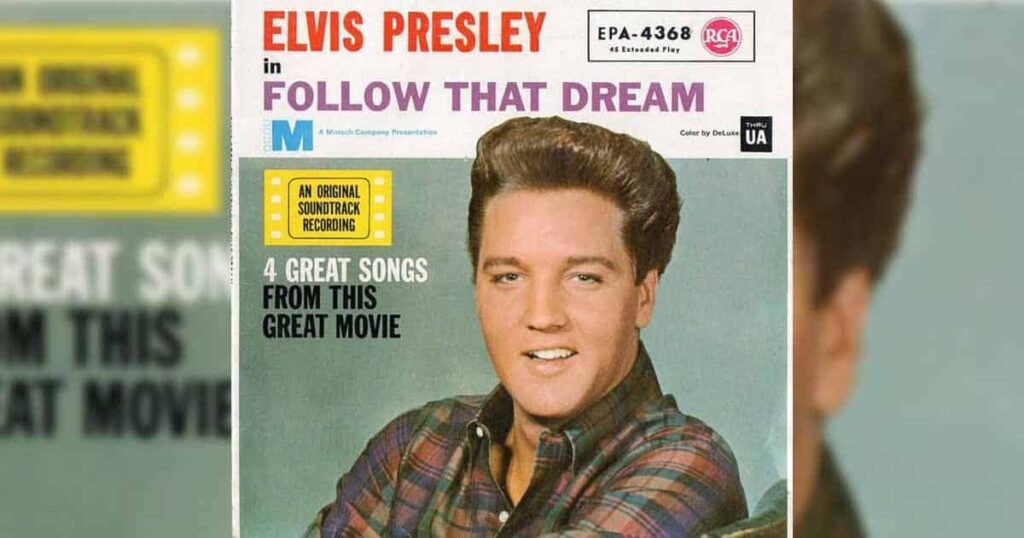
Released in 1962, “Follow That Dream” captures Elvis Presley at a subtle but revealing crossroads artistically, personally, and culturally. Issued as a single from the soundtrack to the film of the same name, and also appearing on the Follow That Dream EP, the song reached No. 15 on the Billboard Hot 100 in the United States and climbed higher overseas, peaking at No. 5 on the UK Singles Chart. While not among Elvis’ most explosive chart-toppers, its impact has proven far more enduring than its numbers might suggest.
At first listen, “Follow That Dream” feels almost disarmingly simple. There is no dramatic heartbreak, no swaggering bravado, no soaring vocal fireworks. Instead, Elvis delivers the song with quiet conviction, supported by a gentle folk-leaning arrangement that was unusual for him at the time. This restraint is precisely what gives the song its power. It does not demand attention it earns it.
The song was written by Fred Wise and Ben Weisman, two of Elvis’ most reliable collaborators, and tailored carefully to the spirit of the film Follow That Dream, in which Elvis plays Toby Kwimper, a free-spirited drifter who values independence over comfort. Yet the song transcends its cinematic origin. In many ways, it feels less like a movie tie-in and more like a personal credo—one that resonated with Elvis’ own complicated relationship with fame and expectation.
Musically, “Follow That Dream” stands apart from much of Elvis’ early-1960s output. The arrangement is built around acoustic guitar, light percussion, and a relaxed tempo that leans toward folk-pop rather than rock and roll. This was a period when popular music was shifting, with folk revival influences beginning to seep into the mainstream. Elvis, often portrayed as disconnected from emerging trends during his Hollywood years, sounds quietly attuned here.
Vocally, his performance is understated but deeply assured. Elvis sings not as a preacher or a rebel, but as a man who has already learned the cost of compromise. His phrasing is calm, almost conversational, yet there is resolve beneath the softness. He does not urge the listener to chase fame or fortune, but to remain faithful to an inner compass “Follow that dream wherever that dream may lead.”
Lyrically, the song speaks to self-trust and moral clarity. It acknowledges obstacles, doubts, and loneliness, but never dwells on them. Instead, it emphasizes integrity: the idea that a life lived honestly, even if difficult, is richer than one built on convenience or surrender. This message felt especially poignant in the early 1960s, a time of social conformity on the surface and quiet unrest beneath it.
Within Elvis’ broader catalog, “Follow That Dream” occupies a unique emotional space. It lacks the youthful urgency of his 1950s hits and the grand theatricality of later ballads. Instead, it reflects a man in between still searching, still hopeful, but more reflective than before. For listeners familiar with Elvis’ biography, the song carries an added layer of meaning. By 1962, he was navigating the pressures of Hollywood contracts, public image, and artistic limitation. To hear him sing about choosing one’s own path feels quietly defiant.
The Follow That Dream EP itself is often cited as one of the strongest soundtrack releases of Elvis’ film era. Compact, focused, and free from filler, it showcased a more thoughtful side of his musical personality. Among its tracks, the title song stands as the emotional and philosophical center.
Over time, “Follow That Dream” has grown in stature. It has been cited by critics and fans alike as one of Elvis Presley’s most sincere recordings of the 1960s a song that reveals character rather than spectacle. It reminds us that Elvis was not only a symbol or a performer, but an interpreter capable of conveying quiet truths with remarkable grace.
Today, the song feels timeless. Its message does not age because it speaks to something permanent: the courage to remain true when the world encourages shortcuts. In “Follow That Dream,” Elvis Presley offers no guarantees only reassurance that meaning lies in the journey itself.
It is not a song about success. It is a song about direction. And in that sense, it may be one of the most honest statements Elvis ever recorded soft-spoken, reflective, and quietly brave.