
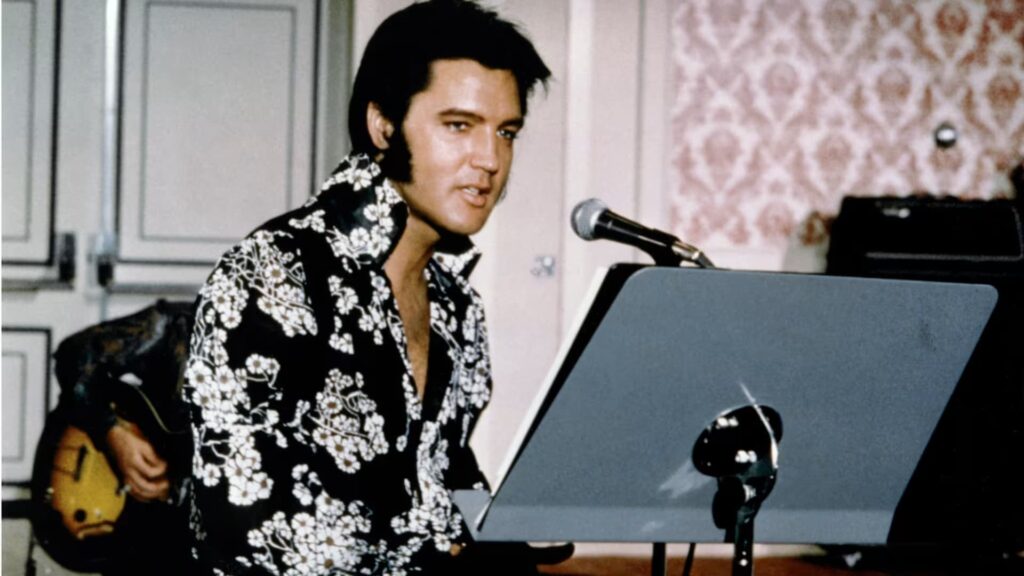
A wounded voice seeking understanding — Elvis pleads for truth beyond the rumor
Recorded in 1972, “My Side of the Story” captures Elvis Presley in a period marked by emotional intensity and personal turbulence. The song was included on the 1973 album Separate Ways (released by RCA Records), a compilation that reflected the deeply introspective tone of many of his early-1970s recordings. Though not released as a major standalone single, the track fits squarely within the dramatic, confession-styled material that defined Elvis’ post-1968 comeback era.
By the early ’70s, Elvis’ music had grown heavier in emotional weight. Gone was the playful charm of his early film soundtracks; in its place stood a mature vocalist grappling with heartbreak, public scrutiny, and the unraveling of his marriage to Priscilla Presley. In that context, “My Side of the Story” feels almost autobiographical — even if not written by him. Like many songs he chose during this period, it mirrored his internal landscape.
Lyrically, the song centers on misunderstanding. The narrator pleads for the chance to explain himself, suggesting that judgment has come too quickly and without hearing the full truth. There is a sense of isolation — of being talked about rather than listened to. The title itself implies imbalance: a story told by others, incomplete without his voice.
Musically, the arrangement leans toward the lush Nashville sound of the era. Orchestral strings swell behind a steady rhythm section, while backing vocals add gospel-tinged depth. Elvis delivers the song with controlled intensity. His phrasing stretches across lines, lingering on key words, giving the impression that each sentence carries personal weight. His lower register is warm and steady, but when he rises into the chorus, there is a tremor of urgency.
What makes the performance compelling is its sincerity. By 1972, Elvis’ voice had matured into a powerful instrument capable of dramatic nuance. He no longer needed youthful swagger; instead, he relied on emotional shading. In “My Side of the Story,” he balances restraint and release — beginning softly, almost conversationally, then building toward impassioned appeal.
The early 1970s were commercially successful years for Elvis, with hits like “Burning Love” reaching No. 2 on the Billboard Hot 100 in 1972. Yet beneath that success lay personal challenges and increasing media attention. Songs like this resonate because they seem to echo that reality. Whether intentional or coincidental, the emotional alignment between artist and material feels undeniable.
Listening today, the track stands as part of the broader narrative arc of Elvis’ later career — a period defined less by rebellion and more by vulnerability. He was no longer the untouchable icon of the 1950s; he was a man confronting the consequences of fame, love, and loss.
In the end, Elvis Presley turns “My Side of the Story” into more than a plea within a song. It becomes a moment of human exposure — a reminder that behind the legend was a voice still longing to be heard fairly, fully, and truthfully.