
A crystalline journey through the roots of the mountains, where the heavy thumb of a coal miner’s son breathes new life into a timeless floral tapestry.
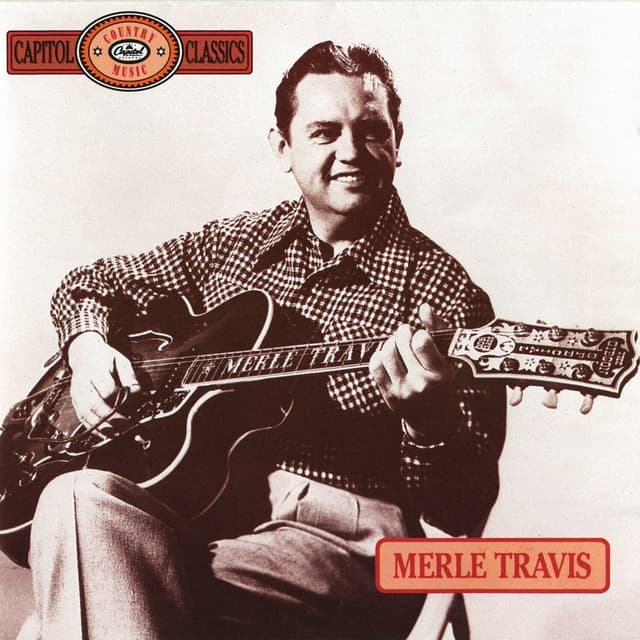
When the first notes of “Wildwood Flower” ring out from the hollow-body guitar of Merle Travis, one isn’t just listening to a folk song; one is witnessing the preservation of a musical soul. Originally a mid-19th-century parlor song titled “I’ll Twine Midst the Ringlets,” it was immortalized in 1928 by The Carter Family, becoming the “national anthem” of country music. However, when Merle Travis—the man whose name became a style—approached this melody, he brought to it the rhythmic complexity of the Kentucky coal country. His rendition, particularly the one featured on the legendary 1972 album Will the Circle Be Unbroken, served as a profound bridge between the primitive beginnings of the genre and the sophisticated, syncopated future of the acoustic guitar. For the listener who remembers the quiet evenings of the past, where music was something made by hand on a porch, this performance is a resonant, golden echo of home.
Historically, “Wildwood Flower” sits at the very top of the hierarchy of American guitar pieces. While it didn’t top the pop charts in the modern sense, its “ranking” is measured in its ubiquity; it is likely the most studied and performed instrumental in the history of the United States. Merle Travis, a Country Music Hall of Fame inductee and the primary architect of the “Travis Picking” technique, took the straight, steady stroke of Maybelle Carter and added a “walking” bassline and a bluesy, syncopated swing. It was this specific evolution that paved the way for artists like Chet Atkins and Doc Watson. To hear Merle play it is to hear the transition from the 19th-century drawing room to the 20th-century concert hall, all contained within the vibration of six steel strings.
The story behind the song is a fascinating study in cultural memory. For decades, the lyrics were sung with beautiful, mysterious errors—words like “mingle” became “pale and the leader,” and “amanthos” became “myrtle”—because they had been passed down through generations by ear rather than by page. Merle Travis, who grew up in the impoverished Muhlenberg County, understood this “folk process” intimately. He didn’t just learn songs; he inherited them. By the time he recorded his definitive version for the Nitty Gritty Dirt Band project in the early 70s, he was an elder statesman showing a younger generation how to honor the “dirt” and the “grit” of their heritage. There is a palpable sense of reverence in his touch, a recognition that he was handling a sacred relic of the Appalachian hills.
Meaningfully, “Wildwood Flower” explores the themes of fading beauty and the resilience of memory. The lyrics tell of a woman weaving a crown of flowers to hide the “sorrows” and “dark wavy hair” of a lost love. For a mature audience, this metaphor for masking one’s pain with the beauty of the natural world is deeply poignant. As Merle’s thumb keeps a relentless, driving beat—mimicking the steady passage of time—his fingers pick out a melody that feels like a delicate blossom struggling against a heavy wind. It is a song about survival, about the things we keep and the things we let go. It speaks to the wisdom of age: the understanding that even when the “roses are red” and the “lilies are white,” there is a season for everything to bloom and a season for everything to fade.
There is a warm, dry, and honest woodiness to Merle’s tone that feels like the interior of an old country church. Listening to him play today, in an age of digital perfection and over-produced spectacles, is a grounding experience. It is a reminder that the most powerful music doesn’t need a stadium; it only needs a story and a steady hand. Merle Travis didn’t just play “Wildwood Flower”; he allowed it to speak through him. He proved that the simplest melodies carry the heaviest weight of our history. For those of us who have lived through the changing tides of the last century, this performance is a soft, melodic place to rest—a reminder that while the world may change, the “wildwood flower” of our shared memories remains forever in bloom.