
Before the Legend Found Her Voice: Patsy Cline in a Quiet Room, Singing Toward Forever
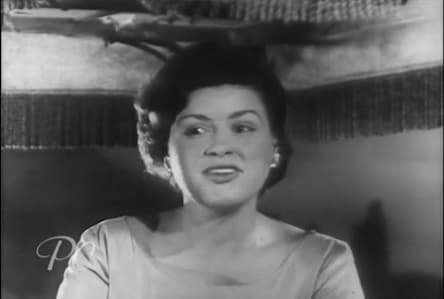
In a modest television setting in 1960, Patsy Cline stood before a small audience on Community Jamboree and delivered a performance of “Come On In” that now feels far more significant than it may have seemed at the time. There were no grand arrangements, no sweeping orchestration, and no sense of spectacle. What remains, however, is a rare and revealing portrait of an artist in transition, poised on the edge of becoming a defining voice in American country music.
“Come On In” is, on the surface, an inviting song. Its lyrics suggest warmth, openness, and a willingness to welcome someone into an intimate space. Yet beneath that invitation lies a subtle emotional tension. The performance carries a quiet sense of longing, as if the act of opening the door is less about hospitality and more about hope. In Cline’s delivery, that emotional duality becomes unmistakable. Her voice is controlled yet unguarded, expressive yet restrained, reflecting a depth that would later define her most celebrated recordings.
At this point in her career, Cline was still recording under the constraints of her contract with 4 Star Records. The label limited her artistic choices, often assigning material that did not fully align with her instincts. “Come On In” belongs to this period, where the songs themselves were not always exceptional, but her interpretations elevated them. It is precisely this tension between limitation and expression that gives the performance its quiet power.
The setting of Community Jamboree also plays a crucial role. Unlike the polished studio recordings that would soon follow her move to Decca Records, this appearance captures Cline in an environment that demanded immediacy and authenticity. The camera remains close, the stage is unadorned, and the distance between performer and audience all but disappears. What emerges is a sense of intimacy rarely preserved in later, more orchestrated productions.
There is also a subtle resonance between the song’s theme and Cline’s personal life. Her early years were marked by instability, including a difficult first marriage and the broader challenge of establishing herself in a male dominated industry. The idea of inviting someone in, of seeking connection while navigating uncertainty, mirrors the emotional landscape she inhabited at the time. Without overstating the parallel, it is possible to hear in her voice a lived understanding of both vulnerability and resilience.
Looking back, this performance does not represent a peak but rather a threshold. Within a year, Cline would record “Crazy” and enter a new phase of artistic and commercial success. Yet it is in moments like this, on a small stage with a simple song, that the foundations of her legacy are most clearly visible. The door she sings about may be part of the lyric, but it also stands as a quiet metaphor for the moment before everything changed.