
A twilight serenade of timeless longing, where the velvet voice of a legend breathes new life into the most romantic whisper of the heart.
The arrival of the official video for Engelbert Humperdinck’s rendition of “Bésame Mucho” is more than a mere musical release; it is an encounter with elegance. For those of us who have followed the “King of Romance” since the days of “Release Me” in the late 1960s, hearing him take on this definitive Latin standard feels like a long-overdue conversation with an old friend. Engelbert Humperdinck, a man whose career has spanned over five decades with more than 140 million records sold, remains one of the few vocalists capable of capturing the sheer gravity of a song that demands both power and a delicate, almost breathless intimacy.
“Bésame Mucho,” which translates to “Kiss me a lot,” holds a pedigree that commands respect. Written in 1940 by the Mexican songwriter Consuelo Velázquez—reportedly before she had ever been kissed herself—the song quickly became the most recorded Mexican track in history. By the time it reached the Billboard charts in 1944 via Jimmy Dorsey, it hit No. 1 and stayed there for weeks, becoming an anthem for soldiers and sweethearts separated by the vast distances of World War II. It was later inducted into the Latin Grammy Hall of Fame, cementing its status as a masterpiece of the human spirit.
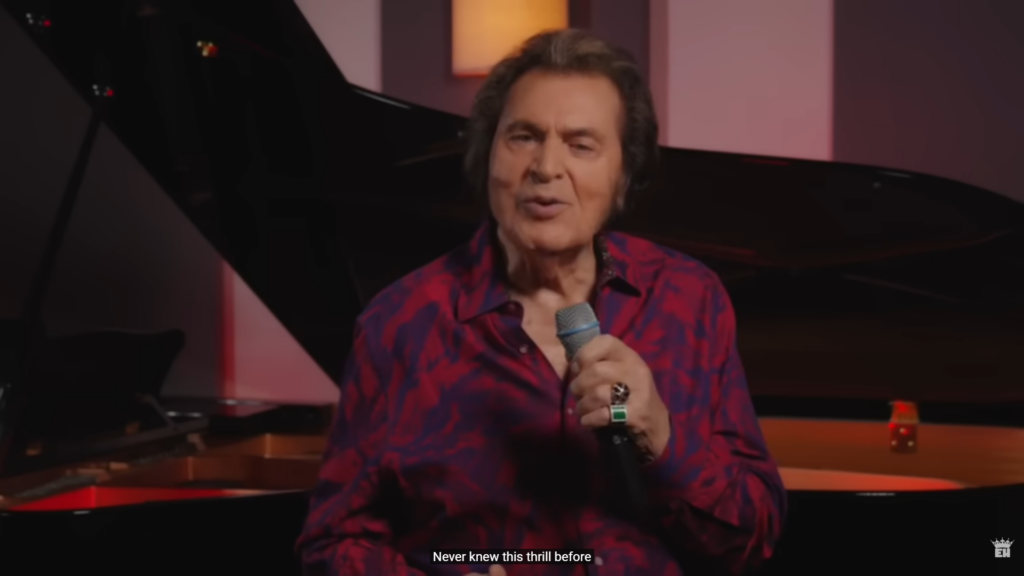
The story behind this specific performance is one of enduring mastery. In his later years, Engelbert has focused on polishing the “Great American Songbook” and international classics with a wisdom that only age can provide. While younger singers might approach “Bésame Mucho” with a frantic passion, Humperdinck treats the melody like a vintage wine. His voice, still rich with that trademark vibrato but now seasoned with a deeper, more resonant baritone, emphasizes the “longing” rather than the “lust.” The official video captures this beautifully, placing the artist in a setting that reflects the sophistication of his audience—people who appreciate the finer details, the steady hand, and the soul that remains vibrant despite the passing of the seasons.
The meaning of the song resonates profoundly with those of us who understand that time is the most precious currency. The lyric “as if this night were the last time” is no longer a dramatic hyperbole used by a teenager; for the mature listener, it is a poignant reflection on the beauty of the present moment. It speaks to the deep-seated desire to hold onto the people and the memories that define our existence. In an era where music often feels disposable and loud, this rendition is a sanctuary of quiet strength and refined emotion. It reminds us of the formal dances, the handwritten letters, and the slow-burning romances that formed the bedrock of our generation.
To listen to Engelbert Humperdinck sing these words today is to take a journey back through our own personal histories. We remember the first time we heard this melody—perhaps on a crackling radio or a parent’s turntable—and we marvel at how it has followed us through the decades. The song hasn’t changed, but we have, and there is a profound comfort in hearing a voice we trust guide us through its familiar, minor-key shadows. It is a tribute to a world that valued poise and poetic sentiment, a world that Engelbert continues to represent with every silver-toned note. This is not just a song; it is a legacy of love, wrapped in a melody that will never truly say goodbye.