
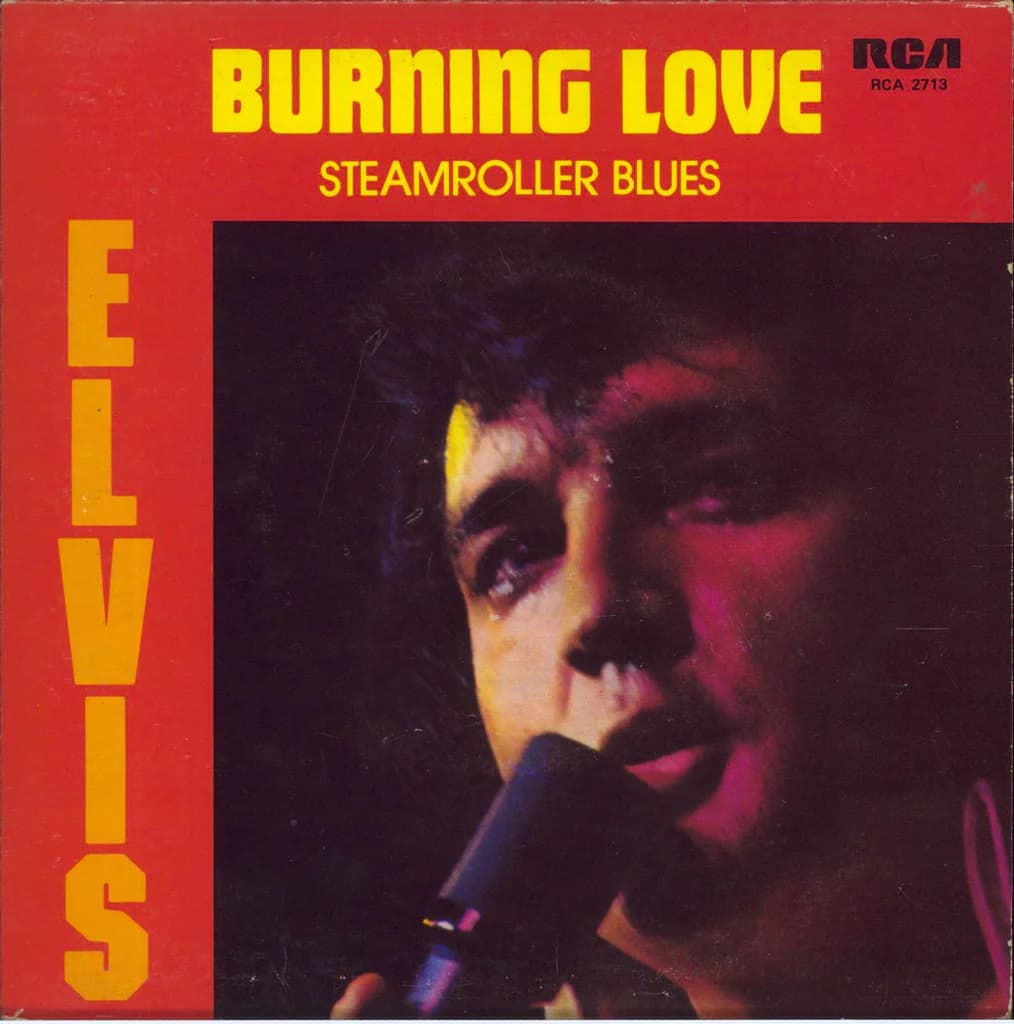
A fiery anthem to desire — “Burning Love” by Elvis Presley
“Burning Love” crackles with passion and longing, as Elvis Presley channels the heat of intense emotion through a performance that feels as immediate as a spark.
When Elvis Presley released “Burning Love” as a single on August 1, 1972, it marked one of his most electrifying comebacks in the rock/pop arena. The song surged up the charts, peaking at #2 on the U.S. Billboard Hot 100, making it his highest-charting pop hit in years. In Cashbox, it even reached #1, declaring its broad appeal. In the United Kingdom, the single climbed to #7, proving that Elvis’s fire still burned strong on both sides of the Atlantic.
The story behind “Burning Love” is as compelling as its sound. The song was written by Dennis Linde, who later recalled composing it in a burst of creative energy: he literally laid down a drum track on his home four-track machine, then overdubbed the guitar, vocals, and other parts — all in about 20 minutes. When Elvis heard the demo, he was initially hesitant; those around him recognized its potential and urged him to record it. He eventually laid it down in RCA’s Studio C in Hollywood on March 28, 1972, joined by his TCB touring band — James Burton and John Wilkinson on guitar, Emory Gordy Jr. on bass, Glen Hardin on piano, and Ronnie Tutt on drums. Linde himself played the opening guitar riff, which added a distinctive edge to the recording.
At its core, “Burning Love” is a musical portrait of desire’s flame. Elvis’s lyrics speak of an all-consuming passion: “Lord Almighty, I feel my temperature risin’ … Girl, girl, girl, you’re gonna set me on fire.” There’s no gentle whisper here — it’s a declaration of love so powerful it threatens to engulf him. The repeated notion of fire, rising temperature, and longing brings a visceral urgency to the song, as though the very air around him crackles with intensity. This isn’t just infatuation — it’s a blaze that demands recognition.
Musically, the arrangement marries rock and southern soul, a blend that was well suited to Elvis’s evolving style in the early 1970s. Felton Jarvis, the record’s producer, crafted a sound that’s both tight and expansive: the drums and bass drive the rhythm, backing vocals lend gospel-like depth, and the guitar parts — especially Linde’s intro riff — spark like flint. Elvis’s vocal performance is electric: confident and urgent, yet grounded in his unmistakable timbre. There’s a moment on the recording where he even ad-libs a little callback to his 1959 song “A Big Hunk o’ Love”, reminding listeners of his rock & roll roots and his capacity for reinvention.
Beyond its chart success, “Burning Love” holds a poignant place in Elvis’s legacy. It was his last Top 10 hit on the Billboard Hot 100 — a powerful late-career triumph. The song was also certified a million-seller, a testament to how deeply it resonated with listeners. It was included on the compilation Burning Love and Hits from His Movies, Volume 2, which helped cement its importance in his catalog.
Live, “Burning Love” became one of his high-voltage showpieces. Perhaps most memorably, he performed it during his iconic “Aloha from Hawaii” satellite concert in January 1973 — his voice ringing out over a packed stadium and across the world, delivering that fierce, fiery energy exactly how the song demands.
Emotionally, “Burning Love” is an anthem of unfiltered passion — a reminder that even in his later years, Elvis could summon the same raw fire that had first made him a legend. For those who remember the glow of his performances, the warmth of his voice through the speakers, and the sense that he could still surprise and excite, this song remains a blazing testament to his enduring power. Its legacy is not just in its chart numbers, but in the way it still lights a spark in the hearts of listeners — a reminder that some loves don’t fade, they flame.