
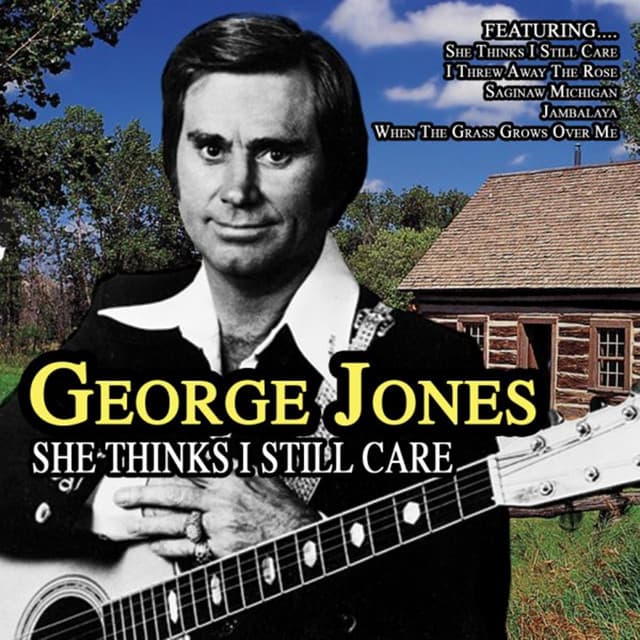
“She Thinks I Still Care” a heart’s stubborn ache, wrapped in a single unforgettable melody
When you listen to “She Thinks I Still Care”, you feel the quiet ache of someone pretending to be free while memories of love still cling like shadows.
At its release in April 1962, George Jones unveiled “She Thinks I Still Care” as his first single under United Artists Records, after his tenure at Mercury Records. The song soared to #1 on the U.S. Billboard Hot Country Singles chart, where it held the top position for six weeks, and stayed on the chart for twenty-three weeks overall a signal, as Jones himself later acknowledged, that this was a “career record,” the song that would define him to the public.
Behind the numbers lies a story both humble and powerful. The song had been written by Dickey Lee and Steve Duffy, two songwriters pitching the song to Jones at Gulf Coast Studio in Beaumont. There’s a famous anecdote: George at first refused, grumbling about the “too many damn ‘just becauses’” in the lyrics; one of the men jokingly offered him the tape recorder if he’d record it and still, George hesitated. But once he heard it sung with a stronger country feel, something clicked. As he recalled years later: “Boy, I just flipped! … It knocked me out. I couldn’t wait to get into the studio.”
The session took place on January 4, 1962, at the Quonset Hut Studio on Music Row in Nashville. Accompanied by pianist, drums, and the gentle background harmonies of the The Jordanaires, George delivered a vocal that seemed to come from the bottom of his soul quiet, aching, haunted.
Musically and emotionally, the song is a study in restrained sorrow. The arrangement is simple piano, soft backing, subtle rhythm letting the voice, with its cracks and trembling honesty, carry the weight. George’s delivery doesn’t wail; it doesn’t dramatize. It confides. It whispers of heartbreak, of illusions maintained for the sake of pride, of longing that refuses to die even when love has left. That subtle vulnerability is what gave the song its power.
Lyrically, the narrator walks the fine line between pretending he doesn’t care and knowing deep down that he does. “Just because I asked a friend about her / Just because I spoke her name somewhere…” these seemingly casual gestures become heavy with regret, burdened with unspoken admission. The refrain “She thinks I still care” becomes both a shield and a confession, a dangerous dance between denial and truth. Many listeners heard in that tension their own attempts to move on, to show strength while inside, their heart was still tangled in memory.
In the arc of George Jones’s career, “She Thinks I Still Care” was more than a hit it was a statement of identity. After moving from Mercury to United Artists, the song re-established him, cementing his place among country’s great voices. As he himself wrote in his memoir, for years it remained his most requested song. Over decades, many artists covered the song attesting to its versatility and emotional truth but none matched the trembling sincerity of Jones’s original.
For listeners today, the song retains its potency. It invites you into that quiet final hour late night, dim lights, memories drifting like smoke and it doesn’t shy away from the pain. Instead, it sits beside it, offering companionship. When the chords open and George’s voice rises, you remember that grief, loss, longing they don’t always end. Sometimes they quietly linger, in memories, in regrets, in the questions we ask ourselves when no one else listens.
That is why “She Thinks I Still Care” still matters. Not because it glitters or shouts; but because it speaks softly, truthfully, to the parts of the heart that never quite healed. In its gentle sorrow lies a comfort the comfort of knowing that we are not alone in remembering, in missing, in caring long after everything else has moved on.
 Oldies Songs