
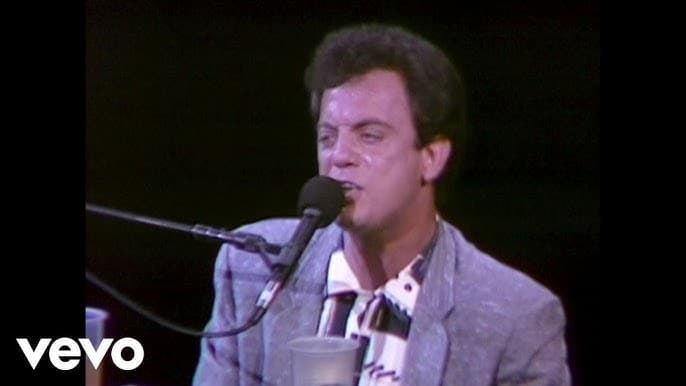
A cinematic masterpiece of suburban memory, where the “Piano Man” turns a London arena into a nostalgic corner booth for two.
When Billy Joel took the stage at Wembley Arena on June 8, 1984, he was at the absolute peak of his global influence. Captured during the An Innocent Man tour, this performance of “Scenes From An Italian Restaurant” stands as a magnificent display of his dual identity: the sophisticated composer and the gritty Long Island storyteller. For those of us who have followed Billy from the smoke-filled clubs of the early seventies to the world’s grandest stages, this song is widely considered his “magnum opus.” It is a seven-and-a-half-minute epic that mirrors the complexity of our own lives—shifting from a quiet reunion to a rock-and-roll flashback, and finally settling back into the comfort of a shared bottle of wine.
The history of “Scenes” is rooted in the peak of creative ambition. Featured on his 1977 landmark album The Stranger, the song was never released as a single, yet it became the definitive fan favorite. Influenced by the multi-part suites of The Beatles’ Abbey Road, Billy crafted a “mini-opera” that captured the arc of the American Dream through the story of Brenda and Eddie. By 1984, performing at Wembley, Billy was no longer just a New York artist; he was an international phenomenon. This London performance was particularly significant as it showcased the incredible tight-knit chemistry of his band—featuring the legendary saxophone work that provides the song’s soulful heartbeat.
For the discerning listener, the meaning of this live rendition lies in the passage of time. When Billy sings, “A bottle of white, a bottle of red / Perhaps a bottle of rosé instead,” he invites us into a space where the present meets the past. For a generation that has seen the “Brendas and Eddies” of our own youth—the prom queens and the kingpins who grew up and moved on—the song is a poignant reflection on the inevitability of change. It speaks to a philosophy we have often shared: that while the “glory days” may fade, there is a profound, steady dignity in the quiet life that follows. It evokes memories of our own high school reunions, the old neighborhood haunts, and the realization that the best conversations are the ones that start with, “Do you remember those days?”
Revisiting this 1984 performance today brings back a powerful wave of nostalgia for the era of high-energy, high-talent live shows. It reminds us of a time when a performer didn’t just sing; they controlled the energy of thousands with a piano and a story. There is a deep, reflective joy in hearing the shift from the jazzy, sophisticated opening to the frantic “rock-and-roll” middle section. It brings back the feeling of the mid-eighties—a world of big sounds and even bigger ambitions—yet at its core, the song remains remarkably intimate. It reminds us of the dinners we’ve shared in our own favorite local spots, where the world outside disappears for a few hours.
The significance of “Scenes From An Italian Restaurant” in Billy Joel’s legacy is its enduring humanity. He managed to turn a specific tale of suburban New York into a universal anthem for the human experience. For a sophisticated audience that has navigated the decades with grace, this song remains a golden standard of songwriting. As the final, melancholy notes of the saxophone fade into the Wembley night, we are left with a lingering sense of peace. It is a reminder that we are all just “living our lives in our own way,” and that there is no better way to honor the past than by sharing a glass of wine with an old friend.