
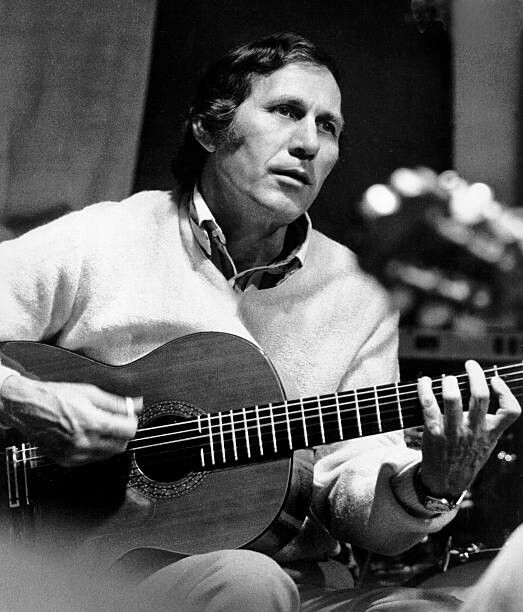
A rhythmic tapestry of change and contemplation, where the “Country Gentleman” reimagines a folk anthem through the lens of Nashville sophistication.
When Chet Atkins released his instrumental rendition of “Blowin’ in the Wind” in 1965 on the album More of That Guitar Country, he was engaging in a fascinating musical dialogue. For those of us who remember the mid-sixties, it was a time of profound transformation—a period when the folk revival was challenging the status quo and the air was thick with the spirit of social change. By taking Bob Dylan’s revolutionary anthem and dressing it in the polished, intricate harmonies of his signature fingerstyle guitar, Chet bridged a gap between generations. He brought a sense of calm, dignified reflection to a song that was, at its heart, a series of restless questions.
The history of this recording is a testament to Chet’s uncanny ability to stay current while remaining true to his roots. By 1965, Atkins was the executive power at RCA Victor, and he was constantly looking for ways to expand the “Country” label into something more universal. More of That Guitar Country reached No. 4 on the Billboard Country Albums chart, proving that his audience was ready for a more cosmopolitan sound. His version of “Blowin’ in the Wind” stripped away the protest lyrics, allowing the melody itself to carry the weight of the era. It was a time when the world felt both fragile and full of possibility, and Chet’s guitar provided the steady, melodic anchor we all seemed to be looking for.
For the discerning listener, the meaning of this instrumental lies in its spaciousness. Without the words, the melody becomes a canvas for our own thoughts and memories. Chet’s “Travis picking” style—the driving, alternating bass played with the thumb while the fingers dance through the melody—creates a sense of constant movement, much like the wind mentioned in the title. It speaks to a philosophy we have often shared: that the most important answers are often found not in loud proclamations, but in the quiet, steady rhythm of our daily lives. As we listen today, it evokes memories of the long Sunday drives of our youth, the changing landscapes of our hometowns, and the quiet realization that the “answers” we sought in our twenties have evolved into the wisdom of our later years.
Revisiting this 1965 classic today brings a powerful surge of nostalgia for the warmth of the analog era. It reminds us of a time when the quality of a recording was measured by the clarity of the instrument and the soul of the player. There is a profound, reflective joy in the tone of his guitar—it is a sound that is both crisp and comforting, like a familiar voice in a crowded room. It brings back the feeling of a world that was expanding, where the “main streets” of our lives were being reshaped by new ideas, yet the fundamental values of craftsmanship and sincerity remained unchanged.
The significance of “Blowin’ in the Wind” in the legacy of Chet Atkins is its enduring grace. He took a song born of upheaval and turned it into a piece of timeless art that invites contemplation rather than conflict. For a generation that has seen the world turn many times over, this melody remains a constant—a reminder that while the times may change, the beauty of a well-played song is a permanent sanctuary. As the final, shimmering notes of the guitar fade away, we are left with a sense of peace, knowing that some melodies, like the wind itself, will always be a part of the air we breathe.