
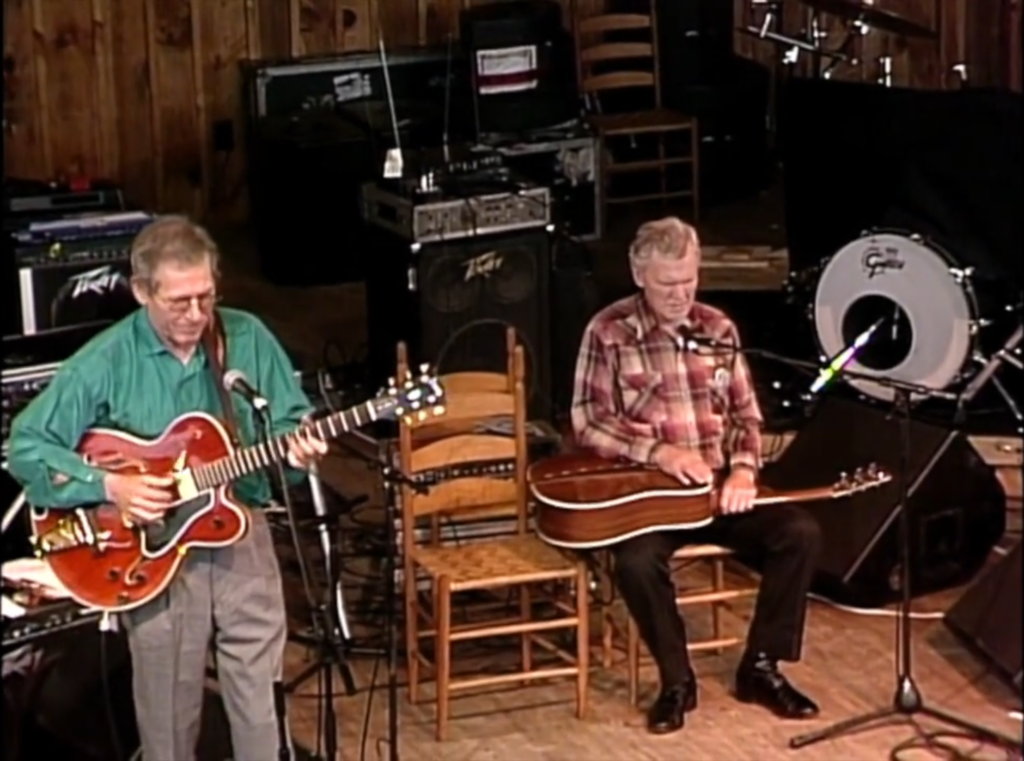
A prismatic journey through the golden era of the guitar, where every note painted a vivid stroke on the canvas of a legendary career.
The year 1992 at the Merle Watson Festival provided a moment of pure, shimmering clarity when Chet Atkins performed “Rainbow.” Captured during a prolific twenty-year span from 1975 to 1995, this performance stands as a testament to a man who never stopped evolving. For those of us who spent those decades watching him on Pop Goes The Country or Austin City Limits, Chet wasn’t just a musician; he was a constant companion in our living rooms. This particular era saw the “Country Gentleman” transition from a hit-making producer to a global guitar statesman, blending the technical precision of his youth with a soulful, reflective depth that only comes with the passage of time.
“Rainbow” is a composition that perfectly encapsulates the “Chet Style”—a sophisticated, rolling melody that seems to float effortlessly over a steady, rhythmic bass line. While Atkins had been a fixture on the Billboard charts since the 1950s, his work in the late 70s and 80s, such as his 1976 appearance playing “I’ll Say She Does” or his 1980 rendition of “Malaguena,” showed a master musician at the height of his powers, unafraid to tackle everything from pop standards to classical firecrackers. By the time he reached the MerleFest stage in 1992, his playing had taken on a more pastoral, serene quality. “Rainbow” didn’t need to be loud or flashy; it relied on the warmth of his tone and the impeccable phrasing that made his guitar sound almost human, like a voice whispering secrets from a long-remembered summer.
The story behind this era of Chet’s life is one of homecoming and legacy. After years of running RCA Records in Nashville, the period between 1975 and 1995 represented a return to his first love: the instrument itself. We saw him collaborate with the next generation of greats and revisit the songs that built his legend. Who among us can forget the emotional weight of “I Still Can’t Say Goodbye” on Austin City Limits in 1991? It was a time when he moved back into the sanctuary of his home studio, as seen in 1995 with tracks like “Happy Again.” He was no longer trying to prove anything to the industry; he was playing for the sheer joy of the vibration of the strings, a sentiment that resonates deeply with anyone who has found peace in their own lifelong hobbies and passions.
For the mature listener, “Rainbow” evokes a powerful, multi-colored nostalgia. It brings back the flickering glow of the television on a Saturday night, the smell of woodsmoke, and the quiet dignity of an era where excellence was quiet and understated. The song feels like a bridge between the different stages of our lives—from the vibrant energy of the seventies to the more contemplative nineties. There is a profound philosophy in his music: that complexity can be made to look simple through hard work, and that beauty is often found in the spaces between the notes.
To look back on the titles of this era—from the patriotic flair of “Stars and Stripes Forever” in 1978 to the whimsical medley of “Mr. Sandman” and “Wildwood Flower”—is to see a map of our own cultural history. Chet Atkins provided the soundtrack to our transitions, his guitar acting as a steady, elegant hand on our shoulders. “Rainbow” remains a fitting title for this legacy; it is a reminder that after the storms of life, there is a lingering beauty that remains, composed of all the different colors of our experiences. As we hear those final, ringing chords, we are reminded that true mastery is ageless, and a melody played with heart never truly fades away.