
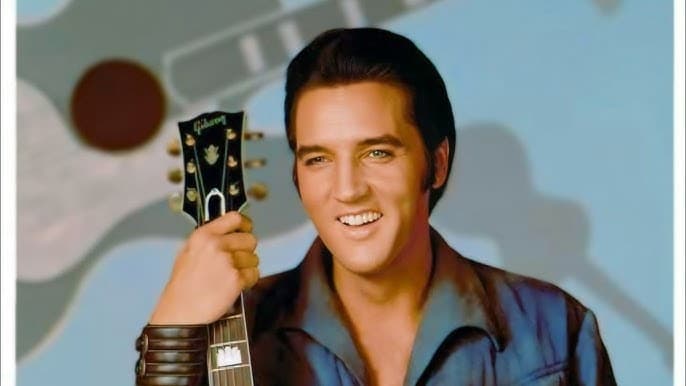
The Outsider Who Never Put the Guitar Down: Freedom, Restlessness, and Identity in “Guitar Man”
“Guitar Man” stands as one of Elvis Presley’s most revealing recordings a song about movement, independence, and the quiet loneliness that follows those who refuse to settle. Beneath its driving rhythm and confident swagger lies a deeply personal statement. This is not merely a character sketch; it is a reflection of Elvis himself at a turning point, caught between expectation and instinct, between belonging and freedom.
The song was written by Jerry Reed, a guitarist and songwriter whose sense of groove and wit would leave a lasting mark on American music. Elvis recorded “Guitar Man” in September 1967, and it was released as a single in January 1968, backed with “Hi-Heel Sneakers.” Issued by RCA Victor, the single reached No. 28 on the Billboard Hot 100 and performed strongly internationally, becoming a notable hit in the United Kingdom. While not a chart-topper in the U.S., its cultural importance far exceeded its numerical ranking.
By the late 1960s, Elvis was in a complicated phase of his career. Years of film soundtracks had softened his public image, sometimes at the expense of artistic credibility. Yet “Guitar Man” cut through that fog. It sounded modern, grounded, and unmistakably alive. It reintroduced Elvis not as a movie star or romantic ideal, but as a working musician restless, proud, and always moving on.
Musically, “Guitar Man” is driven by a sharp, percussive guitar line played by Jerry Reed himself, whose distinctive style gives the song its backbone. The rhythm is tight and propulsive, blending country, rock, and Southern funk in a way that felt fresh in 1968. There is a sense of forward motion from the very first notes, as if the song refuses to sit still. That motion mirrors the character at its center.
Elvis’ vocal performance is controlled and confident. He sings with clarity and restraint, allowing the rhythm to do much of the work. There is no melodrama here. Instead, his voice carries a quiet authority, suggesting a man who knows who he is even if others do not. The phrasing is relaxed but purposeful, reinforcing the idea that this “guitar man” answers to no one but himself.
Lyrically, the song tells the story of a traveling musician who drifts from town to town, playing his guitar and refusing to be tied down. He is admired, sometimes misunderstood, and ultimately accepted for what he is. The refrain simple and repetitive feels almost like a personal creed. This man does not ask permission. He arrives, he plays, and he moves on.
What gives “Guitar Man” its emotional weight is how closely it aligns with Elvis’ own situation. At the time of recording, he was eager to return to live performance and reconnect with his musical roots. The song’s theme of reclaiming identity resonates strongly in that context. It feels like Elvis reminding the world and perhaps himself that before the movies, before the fame, there was a guitar and the road.
The song was also included on the Clambake soundtrack album, though its energy stood in contrast to much of the film material surrounding it. In many ways, “Guitar Man” pointed forward rather than backward. It hinted at the creative resurgence that would soon follow with the 1968 NBC television special, where Elvis would fully reclaim his image as a powerful live performer.
Within Elvis’ catalog, “Guitar Man” occupies a unique place. It bridges eras. It still carries the polish of his 1960s recordings, yet it feels closer in spirit to the raw confidence of his early work. The song does not rebel loudly, but it asserts independence quietly and that restraint makes it convincing.
There is also a deeper emotional undercurrent beneath the song’s confident exterior. The guitar man is admired, but he is also alone. He belongs everywhere and nowhere at once. This duality freedom paired with isolation is central to the song’s lasting appeal. It speaks to anyone who has chosen movement over comfort, purpose over permanence.
For listeners returning to the song later in life, “Guitar Man” often feels like a meditation on identity. It asks an unspoken question: who are you when the applause fades, when the crowd moves on? Elvis answers not with words, but with rhythm and resolve. He remains the guitar man defined not by place, but by motion.
In retrospect, “Guitar Man” can be heard as a quiet declaration of intent. Elvis was not finished. He was not settled. He was still searching for connection through sound. The song’s success on the charts mattered less than its symbolic role it marked the moment Elvis began to step back toward himself.
Ultimately, “Guitar Man” endures because it feels honest. It celebrates independence without glamorizing it, and confidence without arrogance. Through Elvis’ grounded performance and Jerry Reed’s unmistakable groove, the song becomes a statement of identity that still resonates. The guitar keeps playing. The road keeps calling. And the man follows faithful to the only thing that has ever truly defined him.