
Hope Refusing to Let Go: Emotional Surrender and Fragile Faith in “I Just Can’t Help Believin’”
“I Just Can’t Help Believin’” captures Elvis Presley in a moment of rare emotional openness where doubt and hope exist side by side, and love is embraced not because it is safe, but because it feels true. It is a song about choosing belief over caution, tenderness over self-protection, and trust over fear. In Elvis’s voice, that choice becomes deeply personal, almost confessional.
The song was written in 1970 by Barry Mann and Cynthia Weil, one of the most respected songwriting teams of the era. Their work often explored emotional complexity beneath accessible melodies, and “I Just Can’t Help Believin’” is a perfect example. The song was first recorded by B.J. Thomas, whose version reached No. 9 on the Billboard Hot 100 in 1970, establishing it as a contemporary pop success before Elvis ever touched it.
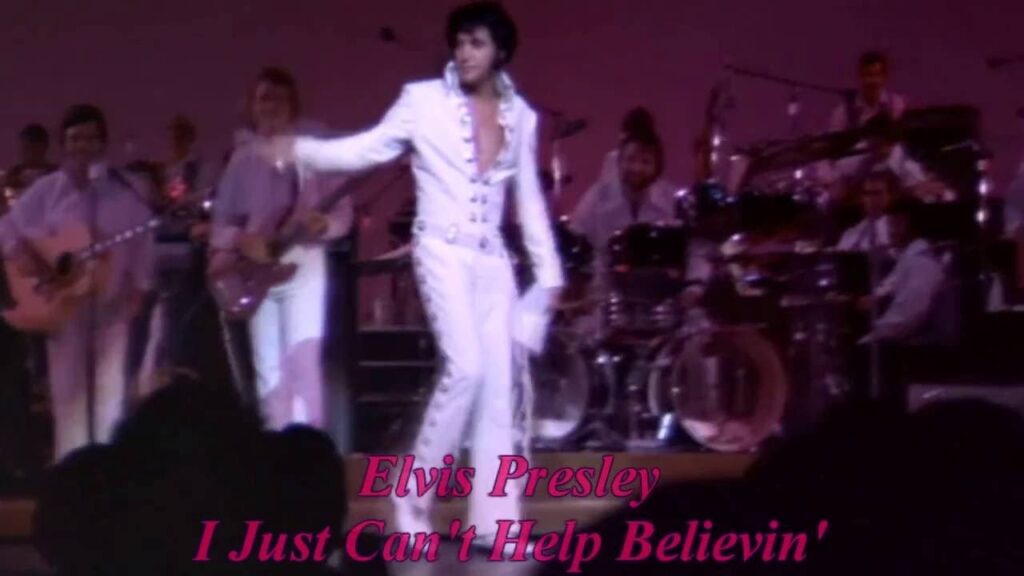
Elvis Presley recorded the song during rehearsals and performances in Las Vegas in August 1970, and it was famously included in the documentary film and soundtrack album That’s the Way It Is. Released later that year, the album reached No. 12 on the Billboard Top LPs chart and showcased Elvis in extraordinary vocal form confident, relaxed, and emotionally present. Unlike many studio recordings, Elvis’s definitive version of “I Just Can’t Help Believin’” is live, and that fact matters deeply to its impact.
While the song was not released as a U.S. single, Elvis’s version gained strong international attention. In the United Kingdom, it was released as a single in 1972 and climbed to No. 6 on the UK Singles Chart, confirming its enduring appeal beyond its original context. Over time, it has become one of Elvis’s most beloved performances from his early 1970s period.
Lyrically, “I Just Can’t Help Believin’” is about emotional vulnerability the quiet kind that doesn’t announce itself dramatically. The narrator acknowledges uncertainty and past disappointment, yet chooses to trust the present moment. Lines such as “When you put your hand in mine, I know that it’s true” express belief not as blind optimism, but as an emotional instinct that cannot be reasoned away. The title itself suggests surrender: belief not as a decision, but as something unavoidable.
Elvis’s performance elevates the song beyond its already strong writing. His voice in 1970 had matured into a rich, flexible instrument capable of power, but equally capable of intimacy. On this recording, he sings with warmth and ease, shaping phrases gently, letting emotion rise naturally rather than forcing it. There is a conversational quality to his delivery, as if he is sharing a realization rather than performing a song.
The live arrangement is understated and elegant. Piano, soft strings, and restrained rhythm support the vocal without overwhelming it. The Sweet Inspirations provide subtle background harmonies, adding emotional depth without drawing focus away from Elvis. Everything about the performance feels balanced, unhurried, and sincere. It is confidence without arrogance, emotion without excess.
Within That’s the Way It Is, “I Just Can’t Help Believin’” plays a crucial role. The album documents Elvis not as a myth or symbol, but as a working artist reconnecting with his musical instincts after years of Hollywood isolation. This song, in particular, reveals his renewed emotional engagement. He is not hiding behind character or spectacle. He is present, listening to the band, responding to the moment, trusting his voice.
In the broader arc of Elvis Presley’s career, the song represents a turning point. The early rebellious fire of the 1950s had evolved into something more reflective. The dramatic heartbreak of the 1960s ballads gave way to emotional nuance. Here, Elvis sings not as a boy in love, nor as a man defeated by it, but as someone willing to believe again despite knowing the risks.
There is also a quiet universality in the song’s message. It speaks to that moment when experience tells us to be cautious, but the heart insists otherwise. Elvis does not argue with that tension. He accepts it. That acceptance gives the song its emotional gravity and lasting relevance.
Over time, “I Just Can’t Help Believin’” has become associated with memory of live performances, of voices filling quiet rooms, of moments when belief felt necessary rather than naive. It is a song that does not promise permanence or certainty. It promises only honesty in the moment.
In the end, “I Just Can’t Help Believin’” endures because it understands something essential: belief is not always logical, and love is not always safe. Yet sometimes, despite everything we know, we choose to trust what we feel. In Elvis Presley’s voice, that choice sounds gentle, courageous, and profoundly human.