
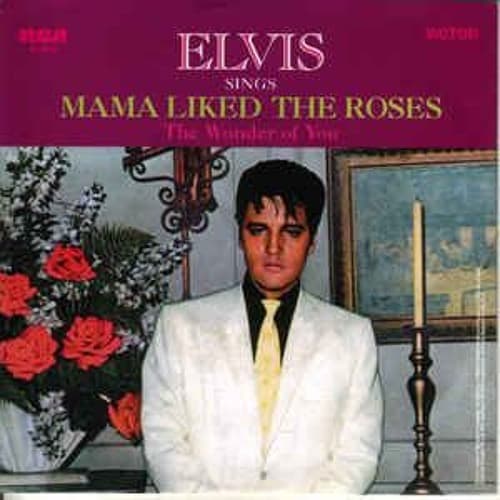
A Son’s Quiet Goodbye: Memory, Gratitude, and Unspoken Love in “Mama Liked the Roses”
“Mama Liked the Roses” is one of the most tender and emotionally restrained recordings in Elvis Presley’s catalog a song that speaks softly, yet lingers deeply. It is not a grand statement, nor a dramatic confession. Instead, it unfolds like a private memory, shaped by gratitude, loss, and the gentle weight of things left unsaid. In Elvis’ voice, the song becomes a son’s quiet farewell, offered with humility rather than display.
Written by Johnny Christopher, “Mama Liked the Roses” was recorded in 1969 at American Sound Studio in Memphis, during the same highly creative period that produced the album From Elvis in Memphis. Although the song did not appear on the original album, it was released as a single in 1970 by RCA Victor. Upon release, it achieved Top 40 success on the Billboard Hot 100 and reached the Top 10 on the Easy Listening chart, reflecting its emotional appeal across generations and musical tastes.
By 1969, Elvis Presley was experiencing a remarkable artistic renewal. After years of formulaic film soundtracks, his Memphis sessions marked a return to emotional honesty and musical depth. “Mama Liked the Roses” fits squarely within that revival not because it is ambitious, but because it is sincere. It reveals a quieter Elvis, one willing to step back and let the story speak for itself.
Musically, the arrangement is deliberately simple. Soft acoustic guitar, subtle strings, and restrained rhythm create a warm, almost domestic atmosphere. Nothing distracts from the narrative. The song moves at an unhurried pace, as though respecting the delicacy of its subject. This simplicity gives the lyrics room to breathe, allowing each line to settle gently in the listener’s mind.
Elvis’ vocal performance is among his most understated. He does not sing with force or theatrical emotion. Instead, his voice is calm, reflective, and deeply personal. There is no attempt to impress only to remember. That restraint makes the song feel intimate, as though the listener has been invited into a private moment of reflection.
Lyrically, “Mama Liked the Roses” avoids sentimentality. It does not idealize the past or dramatize loss. The mother in the song is remembered through small, human details her love of roses, her quiet presence, her steady influence. These details feel authentic, almost ordinary, and that ordinariness is precisely what gives them power. The song suggests that love is often expressed not through grand gestures, but through simple constancy.
The theme of memory is central. The narrator looks back with appreciation rather than regret. There is sadness, but it is softened by gratitude. The song acknowledges absence without bitterness, conveying the understanding that love continues even after loss. In this way, “Mama Liked the Roses” speaks to anyone who has learned, too late perhaps, how much a quiet presence once meant.
Within Elvis Presley’s later work, this song holds a special place. It is not among his most famous recordings, yet it is frequently cited as one of his most heartfelt. It reflects an artist who had matured emotionally and vocally and who understood that sometimes the most powerful songs are the ones that speak softly.
Ultimately, “Mama Liked the Roses” endures because it honors memory without embellishment. It reminds us that love does not fade with time, and that remembrance itself can be a form of devotion. In Elvis Presley’s gentle delivery, the song becomes more than a tribute it becomes a shared moment of quiet reflection, carried forward on a voice that knew how to be strong by being tender.