
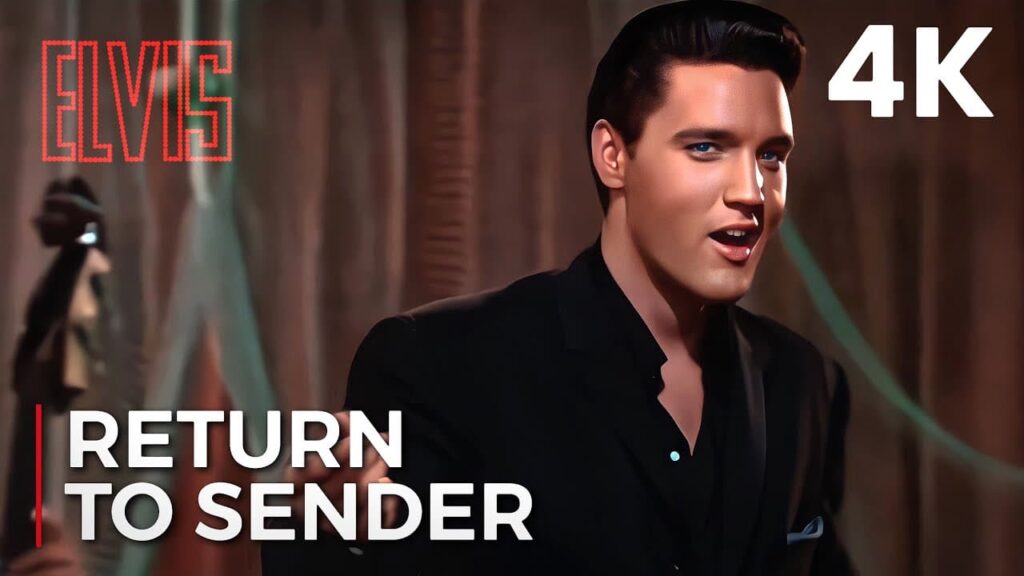
A Love Letter That Came Back Unopened: Youthful Charm, Humor, and Heartbreak in Motion
“Return to Sender” captures Elvis Presley at a fascinating crossroads—where youthful playfulness meets emotional disappointment, and where pop sophistication blends effortlessly with the unmistakable swing of early 1960s rock and roll. On the surface, it is a light, almost cheeky song about a rejected love letter. Beneath that charm, however, lies a portrait of longing softened by wit, pride disguised as humor, and a singer who understood how to smile through heartbreak.
Released in October 1962, “Return to Sender” was recorded for the soundtrack album Girls! Girls! Girls!, tied to Elvis’s film of the same name. At the time, Elvis was deeply immersed in his Hollywood period—often criticized later for its formulaic nature, yet commercially powerful and culturally influential. The song quickly proved that even within a movie framework, Elvis could still deliver a pop classic with lasting appeal.
Upon its release, “Return to Sender” became an immediate international success. In the United States, it reached No. 2 on the Billboard Hot 100, held from the top spot only by “Telstar” by The Tornados. In the United Kingdom, the song went all the way to No. 1 on the UK Singles Chart, confirming Elvis’s enduring global popularity more than six years after his explosive debut. It also topped charts in several other countries, reinforcing his position as one of the most reliable hitmakers of the era.
The song was written by Otis Blackwell and Winfield Scott, a songwriting duo responsible for several of Elvis’s defining hits, including “Don’t Be Cruel” and “All Shook Up.” Their understanding of Elvis’s rhythmic instincts and vocal personality is evident here. The lyrics are simple, direct, and conversational designed not to overwhelm, but to invite the listener into a familiar emotional situation.
The story told in “Return to Sender” is almost cinematic in its clarity. A letter, carefully written and full of feeling, comes back stamped with cruel efficiency: “Address unknown,” “No such number,” “No such zone.” Each returned phrase feels like a small emotional blow, yet the narrator never collapses into despair. Instead, he persists sending the letter again, still hoping it might somehow reach the heart it was meant for. It is a song about rejection, yes, but also about resilience and dignity.
Musically, “Return to Sender” is driven by a buoyant rhythm, accented by backing vocals from The Jordanaires and The Jubilees, whose call-and-response style adds warmth and texture. The production is crisp and upbeat, with a subtle R&B influence that keeps the song moving forward. This lively arrangement contrasts deliberately with the theme of emotional rejection, creating a tension that gives the song its charm.
Elvis’s vocal performance is key to the song’s success. He sings with confidence and lightness, never allowing the disappointment to turn bitter. There is a knowing smile in his delivery, as if the singer understands that pride and humor are sometimes the only defenses against a bruised heart. By 1962, Elvis had perfected this balance able to suggest vulnerability without sacrificing control.
Within Elvis Presley’s broader career, “Return to Sender” represents the refinement of his pop sensibility. The raw rebellion of the 1950s had evolved into something smoother and more self-assured. This was Elvis as a seasoned entertainer, fully aware of timing, phrasing, and emotional restraint. The song does not demand attention; it earns it through charm and precision.
The connection to Girls! Girls! Girls! also adds an interesting layer. In the context of the film, the song reinforces Elvis’s screen persona romantic, likable, slightly mischievous, yet emotionally sincere. While some soundtrack songs from this period faded into obscurity, “Return to Sender” transcended its cinematic origins, standing comfortably alongside his most enduring hits.
Over time, the song has come to symbolize a particular era of optimism and style a moment when heartbreak could still be wrapped in melody, and rejection could be answered with grace rather than resentment. It evokes a world of handwritten letters, stamped envelopes, and patience emotional rituals that unfolded slowly, giving feelings time to breathe.
In the end, “Return to Sender” endures because it understands a simple truth: disappointment does not always require drama. Sometimes it arrives quietly, in the form of a letter returned unopened. And sometimes, the most honest response is not anger, but the steady courage to try once more. In Elvis’s voice, that courage sounds effortless and unforgettable.