
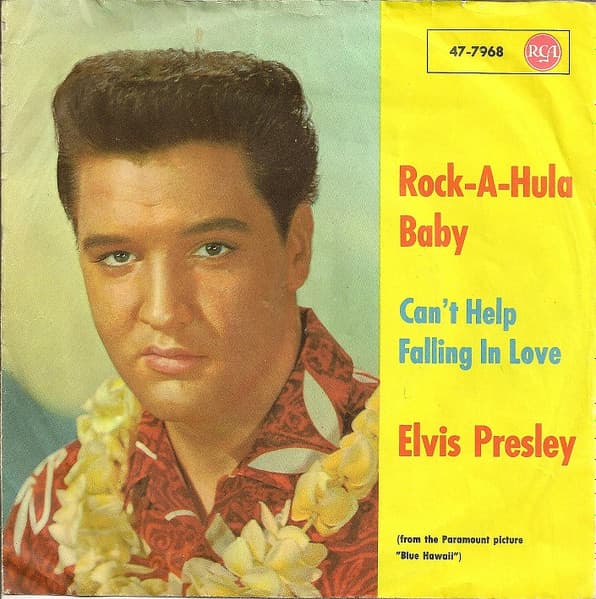
Island Rhythm and Playful Desire: When Rock ’n’ Roll Learned to Smile
When Elvis Presley released “Rock-A-Hula Baby” in 1961, the song captured a lighter, sunlit side of his artistry one shaped by rhythm, charm, and the easy confidence of a performer fully aware of his cultural power. Recorded for the soundtrack of Blue Hawaii, the song was issued as the B-side to “Can’t Help Falling in Love,” one of the most enduring ballads of Elvis’s career. While its companion song climbed to No. 2 on the Billboard Hot 100, “Rock-A-Hula Baby” charted in its own right, reaching No. 23 on the Billboard Hot 100, a notable achievement for a B-side that was never intended to carry the emotional weight of a major single.
By 1961, Elvis Presley was no longer the disruptive force of the mid-1950s. He had evolved into something broader: a global entertainer, a movie star, and a figure who could shift tone effortlessly. “Rock-A-Hula Baby” reflects that transition. It is playful rather than provocative, rhythmic rather than rebellious. Yet beneath its relaxed surface lies a careful blend of rock ’n’ roll energy and pop accessibility, tailored to a changing audience and a changing era.
Written by Ben Weisman, Fred Wise, and Dolores Fuller, the song was designed to fit the tropical fantasy of Blue Hawaii, but it avoids feeling artificial. Instead, it leans into rhythm and movement, drawing from island imagery while keeping Elvis’s rock foundation intact. The title itself suggests motion rocking, swaying, dancing and that physicality is central to the song’s appeal. This is music meant to be felt in the body, not dissected in the mind.
Elvis’s vocal performance is relaxed and confident. There is a smile in his voice, a sense that he is enjoying the moment rather than trying to dominate it. He does not push for intensity. He lets the groove do the work. This approach marks a clear contrast with his earlier, more urgent recordings. In “Rock-A-Hula Baby,” Elvis sounds comfortable in his skin, unhurried, and fully in control of his charisma.
Musically, the arrangement is built around a steady, danceable rhythm with subtle Hawaiian inflections. The percussion and backing vocals add texture without overwhelming the lead. Everything is balanced, clean, and accessible. This polish reflects the broader sound of early 1960s pop, where clarity and ease were beginning to replace the raw edges of early rock ’n’ roll. Yet Elvis’s presence ensures the song never loses its pulse.
Within the context of Blue Hawaii, “Rock-A-Hula Baby” plays an important role. The soundtrack itself became one of the most successful albums of Elvis’s career, spending 20 weeks at No. 1 on the Billboard Top LPs chart. The film and its music helped redefine Elvis’s image for a new decade less dangerous, more romantic, more universally appealing. This song, in particular, embodied that shift. It was flirtation without threat, rhythm without rebellion.
Lyrically, the song is uncomplicated by design. It celebrates attraction, movement, and shared enjoyment. There is no conflict, no longing, no heartbreak. That simplicity is intentional. At this stage in his career, Elvis did not need to prove emotional depth in every recording. Sometimes, presence was enough. “Rock-A-Hula Baby” succeeds because it understands its purpose and fulfills it without excess.
Over time, the song has come to represent a specific moment in Elvis’s catalog a period when joy and escapism were central themes. For listeners returning to it years later, it often carries an added layer of nostalgia. It recalls an era when popular music offered warmth and reassurance, when songs invited listeners to relax rather than confront.
While “Rock-A-Hula Baby” may not carry the cultural gravity of Elvis’s greatest ballads or early rock anthems, it remains an essential piece of the larger picture. It shows an artist adapting without losing identity, smiling without surrendering presence. It reminds us that not every lasting song needs to be heavy. Some endure simply because they make us feel good.
In the end, Elvis Presley did not sing “Rock-A-Hula Baby” to change the world. He sang it to move with it to sway, to smile, to enjoy the moment. And decades later, that gentle invitation still works. The rhythm remains easy, the charm intact, and the memory of that island sound continues to drift back, like music carried on a warm, familiar breeze.