
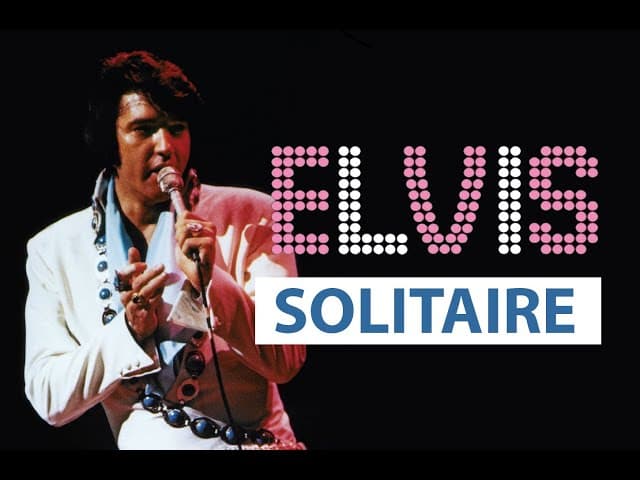
Elvis Presley – “Solitaire”: A Portrait of Loneliness in His Final Studio Years
Recorded on February 3, 1976, and first released on the album From Elvis Presley Boulevard, “Solitaire” remains one of the most introspective and emotionally revealing songs in Elvis Presley’s late catalog. Written by Neil Sedaka and Phil Cody, the song found its deepest meaning not merely in its lyrics, but in the man who sang it.
“Solitaire” tells the story of a lonely figure who has lost love through emotional indifference, retreating into silence and isolation. The central metaphor—a solitary card game played alone, again and again—perfectly captures a life disconnected from the world moving on outside. In Elvis’s hands, this metaphor becomes hauntingly personal.
By 1976, Elvis was far removed from the youthful confidence and romantic optimism of his early recordings. His vocal performance here is subdued, controlled, and quietly heavy with experience. There is no attempt to dramatize the pain; instead, Elvis delivers the song with a weary honesty that allows every line to resonate. When he sings “And solitaire is the only game in town,” it sounds less like fiction and more like reflection.
Musically, the arrangement is understated, giving space to Elvis’s voice and the weight of the lyrics. There are no distractions—only a slow, inevitable emotional descent that mirrors the song’s narrative. The result is a performance that feels deeply internal, almost confessional.
“Solitaire” stands today as one of Elvis Presley’s most mature recordings. It strips away the myth of the King and reveals a man confronting solitude, regret, and emotional distance. More than a cover, it is a moment of truth—an artistic mirror reflecting the quiet struggles of his final years, and a reminder of Elvis’s enduring ability to turn vulnerability into timeless music.