
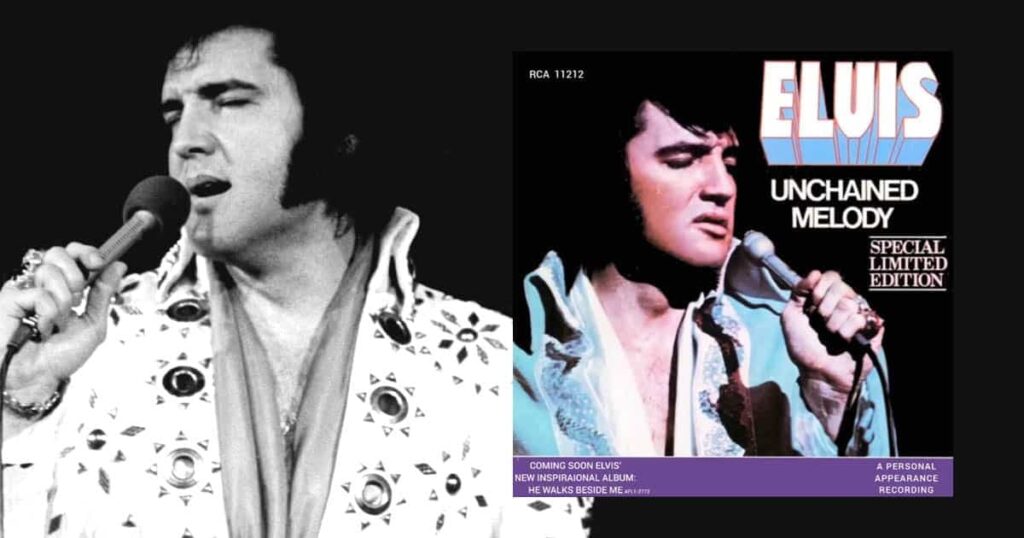
The Unbearable Weight of Longing: Elvis’s Final, Heartbreaking Plea for Connection, Delivered with Raw, Untamed Power.
There are certain performances that transcend mere musicality; they become documents of a moment in time, poignant last statements delivered under the cruel gaze of the spotlight. Elvis Presley’s 1977 rendition of “Unchained Melody” is one such recording. It is profoundly moving, not just for the sheer power of his voice, but because it captures the beautiful, desperate fragility of the man known as The King in his final months. It is less a cover and more a visceral, soul-baring confession.
The song itself, composed by Alex North with lyrics by Hy Zaret, dates back to a 1955 prison film called Unchained and had already become a classic standard, most famously recorded by The Righteous Brothers in 1965. But the Elvis version, delivered live on stage, strips away all the studio polish and formal arrangement, leaving only the raw, majestic force of his baritone.
The version that became legendary was recorded live on June 21, 1977, at the Rushmore Civic Center in Rapid City, South Dakota, and was featured on his final studio album, “Moody Blue,” which was released just weeks before his death in July 1977. However, the track truly came to prominence as a single released posthumously in March 1978, paired with “Softly as I Leave You.” Its chart success was immense and highly emotional for fans: it peaked at Number 6 on the Billboard Country Chart, reaffirming his status, and, perhaps more tellingly, the album “Moody Blue” itself rocketed to Number 3 on the Billboard 200 after his passing.
The story behind this recording is one of unvarnished humanity. Though Elvis performed the song often during his later tours, this version stands out for its intimacy. Seated at the piano, Elvis accompanies himself with simple, direct chords, allowing his voice to carry the full, shattering weight of the lyric. His long-time backing vocalist, Sherrill Nielsen, stands beside him, providing the soaring, almost operatic counterpoint that became a hallmark of the King’s 1970s sound.
The significance of the song “Oh, my love, my darling, I’ve hungered for your touch a long, lonely time” was magnified by his personal state. By 1977, Elvis was physically diminished and emotionally isolated, despite performing to sold-out arenas. When he sang about the long, lonely time, the words felt painfully real, transforming a classic love song into a public prayer for connection. The raw power he summons to hit those high notes, particularly during the final, desperate cries of “I need your love, God speed your love to me,” is chilling. It is a moment of pure, unadulterated vulnerability that bypasses any notion of stardom and speaks directly to the universal experience of longing.
For listeners of a certain age, particularly those who followed his journey from the beginning, this track is heavy with nostalgia and melancholy. It is the sound of a voice the voice that launched a thousand ships and defined a generation making one last, magnificent stand. The fact that this performance was televised as part of his final special, Elvis In Concert, and then released on his final album, lends it an undeniable sense of finality, forever cementing it as his deeply personal farewell.
“Unchained Melody” is a monument to the enduring magic of Elvis Presley a reminder that despite the costumes, the spectacle, and the tragic circumstances, the man possessed one of the greatest, most expressive voices of all time, capable of transforming a decades-old standard into a defining, heartbreaking statement on love, loss, and the timeless hunger for connection.