
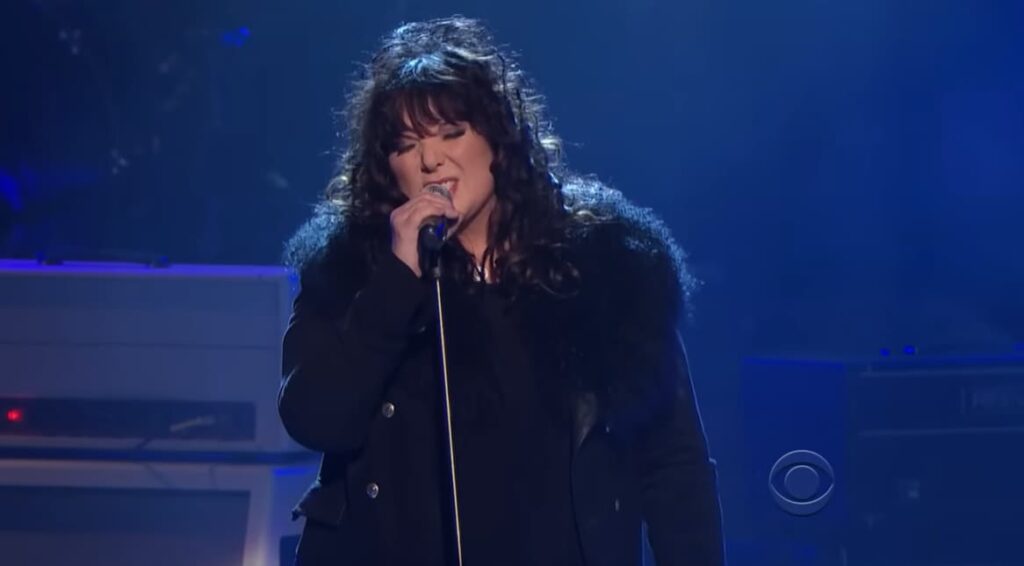
“Stairway to Heaven”, A Night of Tears and Legacy, Heart’s Tribute That Moved Led Zeppelin to Silence
On December 2, 2012, at the prestigious Kennedy Center Honors in Washington, D.C., a moment unfolded that has since become one of the most emotionally powerful tributes in rock history. As Heart took the stage to perform “Stairway to Heaven,” the audience included the very artists who created the song: members of Led Zeppelin. What followed was not merely a performance, but a deeply human exchange between generations of musicians.
Led by Ann and Nancy Wilson, Heart approached the iconic composition with reverence and restraint. The arrangement began quietly, almost cautiously, before gradually expanding into a full orchestral and choral climax. The inclusion of drummer Jason Bonham, son of the late Led Zeppelin drummer John Bonham, added a profound emotional layer to the performance. As the choir appeared wearing bowler hats in tribute to his father, the symbolism became unmistakable.
Throughout the performance, cameras captured the reactions of Robert Plant, Jimmy Page, and John Paul Jones. Plant, who has had a famously complex relationship with the song over the years, appeared visibly moved, at times holding back tears. This reaction underscored the deeper meaning of the moment: a song that had once defined a band’s identity was being returned to them, transformed yet faithful, by artists who grew up under its influence.
“Stairway to Heaven,” originally released in 1971, has long been regarded as a meditation on aspiration, illusion, and spiritual searching. Its lyrics, written by Page and Plant, suggest a journey both personal and universal. In the context of the Kennedy Center tribute, the song’s meaning subtly shifted. It became not only a reflection on life’s path, but also on legacy, memory, and the passage of time.
There is also a quiet parallel between the song’s themes and the personal histories present on stage. For Jason Bonham, performing his father’s music before the surviving band members was more than a professional milestone. It was an act of remembrance. For Heart, a band that had long admired Led Zeppelin and built part of its early identity around their influence, the performance represented a full circle moment of respect and artistic gratitude.
More than a decade later, this rendition continues to resonate widely. It stands as a rare instance where tribute transcended imitation, becoming instead a shared emotional experience. In that evening’s performance, “Stairway to Heaven” was no longer just a classic song. It became a bridge between past and present, between those who created it and those who carry it forward.