
Singing Back to Where It Began: Merle Haggard’s Final Circle of Memory
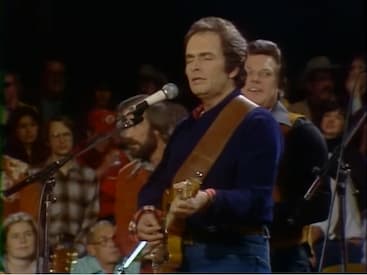
In a quiet performance recorded in Austin, Texas, Merle Haggard delivers “Sing Me Back Home” with a stillness that feels almost ceremonial. It is not simply a rendition of a classic song, but a moment suspended between past and present, where memory and mortality meet in a single, unbroken line.
The song itself has always carried unusual weight. Written in 1967, it draws directly from Haggard’s time in San Quentin State Prison, where he witnessed the final moments of a condemned inmate. The narrative is stark. A prisoner, facing execution, asks to hear a song one last time, hoping to be transported back to a place of innocence and belonging. Haggard was not an observer from afar. He was part of that world, a young man who would later turn lived experience into one of country music’s most enduring pieces of storytelling.
In Austin, that history lingers in every note. There is no attempt to embellish or modernise the performance. Instead, Haggard’s voice, worn and steady, carries the song with quiet authority. The audience responds in kind, listening in near silence as though attending a vigil rather than a concert. When the refrain arrives, the longing to be sung “back home” resonates beyond the confines of the story, becoming something shared and deeply human.
What makes this performance even more poignant is the knowledge of how Haggard’s life came full circle. He died on April 6, 2016, his 79th birthday, an extraordinary coincidence that lends his story an almost poetic symmetry. The date marks both his arrival and his departure, a rare alignment that echoes the very themes of return and closure embedded in “Sing Me Back Home.”
Seen in this light, the Austin performance feels less like a revisiting of past material and more like a reflection from the edge of a long journey. The distance between the young inmate who once witnessed a final request and the elder statesman of country music begins to collapse. In their place stands a single figure, looking back, aware of time’s passage, and of what remains unresolved.
The power of “Sing Me Back Home” lies not in its narrative alone, but in what it invites listeners to confront. It asks what we would reach for in our final moments, and whether memory can offer any form of redemption. In Haggard’s hands, the song becomes both a personal reckoning and a universal meditation.
In the end, the performance does not seek resolution. It offers something quieter. A sense that, through music, it is possible, if only briefly, to return to where it all began.
Video: